


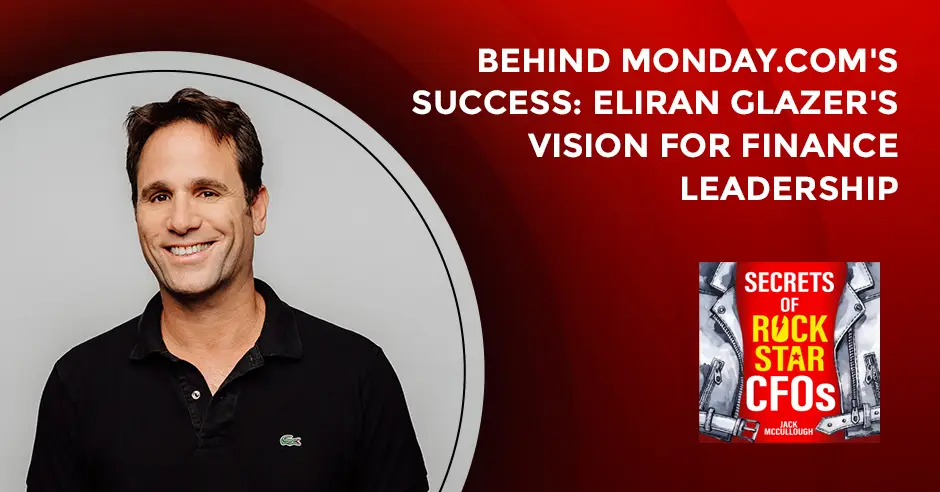
It’s rare to find a CFO who not only manages the numbers but also champions the people and the product with equal passion. Eliran Glazer, the CFO of monday.com, is that leader. As a CFO, “You can be a problem solver. You can be an accountant. You can be a business strategy guy. I saw myself as all of the above throughout my career,” says Glazer. “This is what took me to where I am.”
Glazer joins Jack McCullough to share his journey, from an early fascination with math and physics to his current role steering a tech giant through rapid expansion and public market transitions. Listen by clicking below. The Q&A, lightly trimmed and edited for clarity, follows.
—
Listen to the podcast here
I’m excited about this guest for a number of reasons, not the least of which is that I use the product, which I can’t always say with my guests. That’s going to make this an interesting episode. Please join me in welcoming Eliran GlaZer. Eliran is the CFO of monday.com. A little bit about monday.com. monday.com is a platform that democratizes the power of software, so organizations can easily build work management tools and software applications to fit their every need.
‐‐‐
Eliran, welcome to the show.
Thank you. I’m happy to be here. Thank you for having me.
I’m glad to do it. I’m a simple guy, and I probably oversimplified the description of monday.com. Can you maybe give a little bit more of a robust definition?
Sure. Monday is a work management platform that runs the core of all work. What it means is that there was a lot of digitization around the world for software companies. What monday is doing is assisting organizations at all sizes in 200 different industries to digitize and automate all aspects of work. You come to work every day. You have emails. You have Messenger. You have WhatsApp. You have whiteboards. You have calls. You have meetings. Everything is being done manually. What monday is doing is providing you a platform to manage all of these aspects in an automated way in a very user-friendly software.
The thing about monday is not that we’re selling you or any business a software, but we’re selling you building blocks that you can build the software of your dreams. When you mentioned democratize the power of software, monday was founded by two brilliant entrepreneurs, Roy Man and Erab Zinman. Both of them were product and developer guys. Back in 2012, they felt like they had two options for software, either it was too rigid or something that they would have to buy and invest a lot in customization, and make sure that it would work in accordance with the way they needed.
What they did was establish monday. Think about Lego bricks. You have all kinds of building blocks that you can use to build the software of your dreams. It fits organizations in different verticals. We have 200 different industries. It’s almost counterintuitive because you get the tools and you buy software to run chain management of hotels, a fleet of trucks, or software companies. It fits every business out there.
We have more than 200 industries across 200 geographies and territories. We crossed $1 billion in ARR last August 2024. We have 245,000 customers, from 2 users to 80,000 seats in a big pharmaceutical company. We went public in June of 2021, together with a lot of companies that went public. Fast forward, almost four years after the IPO, we are profitable. We’re generating a lot of cash. We have almost 2,700 employees. We have been growing at a rate that is more than 30 percent over the past four years every year. The future looks very good to us.
That’s fantastic. It’s a little before your time, I suspect, but there was an 1980s pop song that went, “The future is so bright we got to wear shades.” For some reason, when you were describing monday, that song came to mind. That’s a great story. I want to turn to that. I always like to get an understanding of the CFO’s early years. Can you share with our audience where you grew up and if you came from a big family?
Sure. I’m based in Israel. I was born in a city next to Tel Aviv in Israel. People usually know Tel Aviv. I’m the youngest of four. I’m the only one in my family who went to college and graduated with a college degree. I have two sisters and one brother. All of them are great, but none went into college. We didn’t have much at the time. My mother went to work.
I went to work at a very young age. I was a tutor for English and math, and I worked for a utility company. I studied mathematics and physics in high school. We have, in Israel, the Army. I joined the Army. I was a medic instructor for two years, and then I did my trip to the Far East. When I came back after seven months, I was traveling in the Philippines, Australia, India and Thailand.
For Israelis, usually after they finish the Army, because the Army has very strict rules of engagement, when you get out of the Army, you take some time to free your mind and have fun before you go to college. I went to college and studied business management, and I majored in accounting. I finished my education and joined KPMG at the time. I started my training at KPMG. I did three years before moving into my first work as a controller. This was where I grew up in my early years of education.
Interesting. We share that in common. I knew there was something I liked about you. I started my career at KPMG. It was known as Peat Marwick Mitchell at the time. It’s interesting because in high school, it sounds like you were more into the sciences. You mentioned physics and whatnot. When it was time to go to college, you decided to focus on business. I’m curious. Was there a metamorph that you realized business was a better venue, or did something happen?
I was always attracted to more of the scientific part of school, such as mathematics, physics and chemistry. When I went to the Far East, I thought maybe what I’m going to study. I knew that I wanted something that would help me get out of where I grew up. I wanted something that would allow me flexibility to choose the path of my career.
I was traveling in the Far East. My friend at the time in Israel told me, “I joined the College of Management,” which is where I studied. He said, “I’m going to study accounting.” We spoke about it. My father passed away at a young age, at 55, but before that, he was an accountant. I saw him working on his stuff, and I said, “Maybe this is something that I will be attracted to.”
When I came back from the Far East, I applied and started to study. This is something that I didn’t plan too much about. I knew that I didn’t want to study law school or something else. I wanted something that has numbers with it because I like numbers. I thought, “This is something that will provide me the opportunity to walk my way around life and will allow me to have a better or a brighter future than where I grew up.” I don’t complain. Even though we didn’t have much, we had a nice childhood, but I wanted to be in a better place than where we were on the trajectory.
That makes a lot of sense. It’s interesting. I’ve had the opportunity to introduce some great CFOs on this show. First and foremost, at this point in their career, they’re problem solvers. Who better is a problem solver than a scientist or an engineer? Even though you were interested in science early, becoming a CFO is probably a fantastic career path given your early passions.
Definitely. You say problem solver. During my career, I had all kinds of work. Someone asked me, “What is the CFO doing?” It was someone young. I said, “Did you see Pulp Fiction? Do you remember John Travolta, who was a cleaner, or even Harvey Keitel, the wolf? They solve problems. They are the cleaners. They are coming and fixing things.”
Different kinds of problems than you and I are likely to face.
It was an extreme analogy. I like to think about myself as a CFO because there are different styles of CFO. You can be a problem solver. You can be an accountant. You can be a business strategy guy. I saw myself as all of the above throughout my career. This is what took me to where I am. I was the partner of the CEO. I was the partner to the heads of the businesses. I knew how to make things work.
There are all kinds of evolution of the CFO, and we might touch it later, over the years from a number cruncher into someone who has a major seat next to the CEO around the executive team table and can be the one that can lead a lot of the things that people didn’t think about in the past. Not only numbers, but strategy, marketing, and supporting the sales organization. You have to have all of these qualities in your soft skills, as well as an understanding of numbers and storytelling, in order to do so. This is where I see my career develop across all of these qualities that I obtained, learned, and studied along the way.
That’s fantastic. One thing that I’ve observed is that every CFO I’ve had has had a mentor or even a series of mentors throughout their career path. I’m curious if you’ve had any that, when you look back, it’s like, “That person made a big impact.” It might be somebody that maybe you didn’t even think of as a mentor at the moment, but you learned so much from them that they continue to make an impact on your career.
I completely agree with that. After I left KPMG, I joined a company called BackWeb. At the time, it was the year 2000 before the bubble burst. It was a company that was traded on NASDAQ, a push notification company. The CFO there was, I believe at the time, 25 years older than me. I was the corporate controller in Israel. He was based in New York. The company was public.
He said, “Accounting-wise, I trust you to know your stuff, but what I would like you to do is to develop your business skills. You have to understand that in order to work with the sales manager and the marketing manager, you have to speak with them, learn what they do, understand what is painful to them and understand the problems that they are trying to solve. Help them solve the problem. Don’t be a blocker. Be an enabler. If you don’t have empathy with these people and you don’t understand what incentivized them, you will not be able to help them.”
This advice of understanding how the business operates and how the business works was something that was extremely important to me throughout my career. Understand the people who are speaking with you and are in front of you. I will touch it because this is something that I feel is unique about me. Even when I speak with investors, analysts and board members, first, let’s see the person behind this. What is the motivation? What is potentially on the agenda? How can I relate to that? This is advice that was amazing. It took me the whole way.
The CFO of BackWeb moved to a company called Schema. It was, at the time, a private company. I went with him to work in Schema. He left after three years, and I replaced him. I was in Schema for three years and then moved to a company called Traiana. In 2006, I moved to New York with my wife and two daughters at the time, completely. I said, “Do you want to go and fly to New Jersey and work in Manhattan?” My wife said, “Yes.”
The CEO of the company was very important to where I am in my career. I speak with him until now. He’s a friend. He’s a mentor. He taught me to be world-class. He said, “In order for you to be able to provide valuable services, supporting decision-making, you have to be world-class. You have to be able to tell a story through the numbers. Don’t be a numbers guy who only cares about the numbers. Try to understand what the numbers tell you and what value you can extract from them. Tell a story through numbers.” Even when I come to you and I’m a bit excited, every time, prepare yourself. Be world-class. Respect the room. Respect the people that you’re going to meet with.”
I have done it until now. Every call that we have on earnings and every meeting with stakeholders, the board, investors, and analysts, even though I may know the material or I may know what we want to speak about, I rehearse. I learn the material. I listen to podcasts. I prepare myself. It’s super important to get ready for these meetings, but remain authentic. These are two mentors. One is the CFO, and one is the CEO. I worked with the CEO for almost 12 years. We’re seeing one another and speaking with one another. He is a friend.
That makes a lot of sense. You have done your homework, so I’m going to make you prove it. What’s my next question?
What companies have I worked for? I don’t know.
We covered them a little bit. You joined monday in 2021. About four months later, you filed an IPO. It seems like you were probably brought on for the purpose of taking the company public. Maybe you can describe what that journey’s like because to some people, it’s an event, but to the people who work in the company, particularly the CFO, it’s not an exit. It’s a huge event, and it changes the culture as much as anything else. What was that IPO journey like? You didn’t get a whole lot of time to come in and learn the business.
This is a great question, and something that I tell. I joined monday in February 2021, four months before the IPO. After only ten days of interviews with Roy and Eran, the co-founder and co-CEO, board members and other executive team members, I remember I was brought into a room. It was mid-February when I started. I didn’t know anyone. I didn’t know the business. I didn’t know the people. I didn’t know the investors. I never did an IPO. This was my first IPO. I was brought to a room, and Roy and Eran told me, “There is an IPO going on. It’s yours. Take it.” I was looking left and right. I said to myself, “Let’s roll.” Everything that I did in my career until now has brought me to this moment and preparedness.
Maybe an anecdote. I lived in the U.S. between 2006 and 2010. During the meltdown in 2008, I remember a day when I woke up one morning, and it started with Bear Stearns and Lehman Brothers. They were speaking about how Morgan Stanley and Goldman Sachs are going out of business. Warren Buffett bailed out Goldman. People said, “The sky is falling.” Everybody was saying, “Where are we heading? I don’t know what’s going to happen.”

As the CFO, you come to the front seat and you start to manage the crisis. You start to speak with the investors, your customers and your employees. You have to manage it in a way that you brave the storm, but you’re also resilient. Resilience is an important thing when you go public and you don’t know anything about the company.
In 2010, I came back to Israel, but I was traveling between London, Tel Aviv and New York. I spoke with a lot of business stakeholders, board members, investors and analysts. I had this experience. When I joined monday and I had to take the company public, the things that I had done prepared me for this moment. Going back to the mentor’s advice, to be world-class and be able to speak with people in the language that they will listen to, I had to do an analyst day.
Two weeks later, I came to monday. I studied in the evenings. I listened to podcasts. I listened to earning calls. I listened to the jargon. Bear in mind, I’m an Israeli guy. Even though I lived in the U.S. and worked in English, many don’t know what a ballpark is, the first innings or out of the gate. There are all kinds of things that you have to learn. I learned, listened and had long days. I told my wife and kids, “I’ll see you in six months.”
I started meeting with analysts, investors and bankers. I learned the business story. I looked at the numbers and I had to make all kinds of changes. I was becoming the person who was leading it in front of Goldman Sachs, JP Morgan and a bunch of co-managers and the legal team. I can tell you that you don’t think about it too much when you do it. You go with it. The thing is, make decisions. Don’t cave in when you are under pressure. Be resilient. Have your center.
It was a great success, eventually. The IPO of monday was one of the largest task companies, not only in Israel, but, at that time, around the world. To remind you, in 2021, multiple companies went public. You also had to fight for the attention of the investors and analysts. How do you differentiate your story? How do you differentiate the monday story from many other companies that went public at the time? All of this was like drinking from a fire hose, but I can tell you I didn’t think about it too much at the time. I said, “I’m going to do it.” I’m happy I did it. It was an amazing experience until now. It’s a great journey.
Good for you. It’s interesting because when a CFO takes a company public, she or he almost become part of a special club because there are only so many CFOs who have done it. You’re right. There were a lot in 2021. It was a strange year. I’m not sure that I had even heard of a SPAC before 2021. Suddenly, there were a lot of them going on. There are a lot, but there are only so many CFOs who have ever taken companies public. It’s an important milestone in one’s career.
One thing I wanted to touch upon is that you’ve mentioned the mentors and what a great relationship you’ve had with the CEO, and a long-term relationship. A lot of the readers here at Gen Y are getting their first-ever CFO-type jobs. How do you, as a CFO, build a relationship with the CEO and maybe with other members of the C-Suite? It sounds like you’ve done it very successfully at multiple locations.
If I am joining any company, the first 30 to 60 days, people are very like, “When you join a company, you want to show that you bring value immediately.” I would take the time. Take 30 days or 60 days. Explain to people that you want to listen to the company. You want to understand how people think in the company and speak with the executive team. Learn what motivates them, what bothers them, what they want to achieve, their long-term view and their short-term view.
Establish a relationship that is based on your ability to support them in what we want every day. We want to come to work and show our bosses that we’re doing a great job. We want to achieve our goals. We want to have fun sometimes when we are at work. If you have the tools and the ability to help them, understand how self-compensation works and work with the sales manager in order to support the team on sales compensation. Understand how digital marketing works. What is performance marketing? What are the KPIs? Help the marketing guy to measure the ROI on his investment and tell him maybe how he can do it better.
Understand how the head of product and R&D is working. The business guys, the marketing, sales or go-to-market, care about the business. The product guy or the R&D guy cares about innovation. He wants to tell you the story about his innovation. Understand the level of innovation. Learn about the products and how they’re unique. What are the features? What are the functionalities? That’s because then, you can have a meaningful conversation.
If you’re speaking with other executives and stakeholders and they see that you don’t have an agenda to be the number cruncher or the party pooper, they’re telling you, “We have this amazing idea, and we want to do this amazing innovation. I want to pay for myself.” Don’t say no, or don’t say, “Whatever.” Understand the motivation and help him to think about it. This is the first thing.
The second thing is you have to build trust. They need to be able to trust you. My CEO needs to understand that when I go and speak with investors and analysts, I can articulate well the monday story. I can explain well why we are achieving what we have achieved and what the long-term direction is. It comes with trust. It comes with being professional. It comes with being a partner to the people around you.
I’m not doing it all only with my peers or my colleagues. I’m also speaking with the employees who work for me. I try to tell them, “There are bad days. There are good days. There are going to be ups and downs. Remain authentic and try to understand what bothers people.” Your employee comes to work, and you have a bad day at home. You come to work, you go to your office and you don’t even say, “Good morning.” People don’t get it. They say, “He’s not talking to me. What have I done wrong?” You didn’t do anything wrong. Someone had a bad day.
You need to understand the nuances. This is something that always helped me to be someone who can work with multiple cultures, with people from the US, people from England, people from Europe and people from the Far East. I try to understand how they operate and what cultural things are important to them.
At first, people say, “Fake it until you make it.” Sometimes, you need to fake it, but be authentic eventually. Even if you fake it, when you ask someone, “How are you?” mean it. Ask it like you mean it. It’s your professional skills, alongside your personal skills, and the ability to be empathic to people around you. This is how you build trust, in my mind.
It’s interesting because I wrote a white paper. It was based upon interviews with venture capitalists, board members, CEOs and whatnot. It was about what traits you value in a CFO. You’ve named all of them but once since we’ve been here. It was trust, resiliency, empathy and collaboration. You didn’t use that word, but you described it. The only one you didn’t mention is inspiration. I have a feeling that you must be a very successful CFO based on that methodology, which you have discovered on your own. I could have saved myself a lot of hours and had a conversation with you a few months ago.
Thank you.
I want to chat a little about monday. It’s interesting because in the States, we usually refer to it as monday.com, but you’ve been referring to it just as monday. Forgive me if I revert to the monday.com thing. monday has grown a lot. Nobody dislikes that. That’s a glorious thing, but I’m also not naive enough to know that rapid growth causes a lot of financial challenges to CFOs and their team. What are some of the challenges with managing that hypergrowth or near hypergrowth that you’ve experienced three or four years in a row? It’s not like it’s letting up.
As a CFO, you always have to balance between the short-term and the quarterly cadence of earnings to the long-term vision. Unfortunately, companies are being measured on a quarterly basis, but sometimes, it takes a year or two for investment to be fruitful and to generate revenues or returns. The last couple of years were a rollercoaster. There was nothing that was more constant than the constant change. We had COVID, and on the back of COVID, there were an amazing few years, and then started the macroeconomic headwinds. You can see the global markets are pretty volatile.
You always have to manage, like, “What am I going to do?” I will give an example. A couple of years ago, when the macroeconomic headwinds started, we had to shift the direction of the company. For us, we’re going to invest in sustainable growth. We wanted to continue to be innovative. At a certain point, when the macroeconomic headwinds came into the market, we said, “There is some level of uncertainty.”
I said, “Let’s look at our investment. Let’s look at the hiring pace. Let’s look at our plans, and let’s see if we can modify some of the plans that we have.” How do you deal with it? You have scenario planning. When I plan the year, I do a scenario analysis. I say, “Let’s do a scenario for the worst-case, God forbid. Let’s do a scenario for the great case. Let’s do a realistic scenario.”
It allows me to be proactive in the way I deal with challenges in the market. I can apply a big change in a relatively short timeframe. I can stop hiring. I can invest more in performance marketing or not. I can decide that I’m not going to invest in a certain product line. Once you have the planning and you do it in advance, you can quickly adjust to the market terms.
Another example I will give you is when we are looking at history, it was growth at all costs. Every company wanted to grow. If you go back to the last few years, there were a lot of high-fives in the market. Companies with public valuations were 20x or 3x, and then 2 years later, you saw multiples coming down. Companies that went public were not ready to be a public company. Sometimes, it’s not only about going public. This is one step of the journey. You have to maintain a certain level of performance. If you don’t maintain it, it’s hard.
How do you communicate with the investors? How do you tell them bad news? You have to have an IR team. You have to be ready for difficult questions. Going back to what I said earlier, in order to be world-class, it’s not always going well. Sometimes, there are challenges that you cannot deal with. Absorb the shock, continue and move on.
Don’t over-congratulate yourself on good days, and don’t over-beat yourself on bad days. Stick with your long-term plan. Make sure that you can articulate it in a good way. Make decisions. Work quickly and proactively. Don’t be reactive and manage expectations internally and externally. Manage expectations of your employees, your board members and your executive team, but also manage expectations of your investors and the analysts.
There is a constant balance. I work with my IR team. I work with my FP&A team. I communicate with my colleagues and executive team, always updating them on a very monthly cadence. I do a weekly cadence with my team to make sure that we are well prepared for whatever comes. This is the way to manage challenges because of geopolitical issues.
Look around the world. Geopolitically, in every area, there are so many challenges. For example, interest rates or war, even in Israel. How do you manage it? You have to be resilient. You have to make decisions. You have to work in accordance with the plan. Make sure that you deliver on this. Even if it’s not going well, move on. Sometimes, things happen.
It makes sense. You’re right. There are two statements that are contradictory, but they’re both true. There’s never been a better time to be a CFO, which is true. It’s also never been a more difficult time to be a CFO. I suppose the Great Depression was probably harder, but it’s a challenging time to be the financial leader that the corporate world is expecting you to be.
I want to change up a little bit and look ahead to the future, nothing inappropriate. You are a growing company, a fascinating one. What are the things that we can expect out of monday in 2025, 2026 and beyond? There are going to be business challenges, too, but undoubtedly, this little artificial intelligence thing is going to change the whole direction of your product. Can you give us a little sneak peek of what’s coming down the road for the next few years?
monday, first of all, is a platform. On monday, we have four product lines. It’s a multi-product platform. For the world of project management and work management, you have monday CRM, monday dev and monday Service. What we want to do is to make sure that we continue to innovate. Innovation is at the core of everything that we are doing.
We have the right products, so we’re going to invest in the depth of the product rather than the breadth of the product. We feel that with these four product lines, we can cross-sell and upsell with each one of them. It’s enough for us for the next few years. We’ll continue to innovate. There are a lot of white spaces between these products that we are covering. We have more than 200 businesses, and 70 percent are non-tech. We’re a low-code, no-code platform, so it’s easy for the users to adapt monday and use it for use cases that we couldn’t even think of.
This is where AI fits in. A few years ago, every earnings call, people would ask you about AI. When I think about Q1 of 2024, probably 80 percent of the questions were about AI. A year later, people are more relaxed about it, and they understand it takes time for AI, for example, to be able to monetize it. We have a lot of examples of companies that haven’t yet found a way to monetize it.
What we do on monday is we are a productivity platform. We are taking care of the core of the work. For us, AI is something that is embedded in everything that we are doing. Remember that people adopt products. They don’t adopt technology. What are we doing? We’re embedding artificial intelligence in the product lines. We have an AI button in each product that we have in work management in CRM that can do a lot of things. You press the button and get the categorization sentiment of an email that was sent to salespeople. There are formula calculations that are being generated in an automated way.
Let’s say you are a truck company. You have a fleet of trucks, and you want to build a board that fits you. Before AI or before machine learning, you would have to build it yourself from scratch. Now, you put in the prompt of the business that you are operating and what you want to build, and it’ll build you the board and the dashboard of your dream. We’re automating it in each and every product line.

In addition to that, we have product power apps. In each product line, we can do a lot of things. I will give an example. Project management. You have 200 projects that you’re running in your company. You want to understand the heat map of your risk in each and every product. Someone would’ve needed to go manually and look at every project and say, “This is the risk. We now have the ability to provide you with a tool that will do risk management across all products.”
It’s something that will review or browse all your projects and provide you with a heat map of your risk. This is an example in project management, but you can do the same in CRM. You can browse emails. For HR, you can browse resumes, and you get the sentiments. The third thing that we’re doing is the digital workforce, which is what people call agents. You will have a bot that will allow you to do things or help you to do things. They can run campaign management. It will go to social media and run a campaign management. They can be a deal facilitator or go over my emails and provide me with the sentiment.
Since we are a productivity tool and we are sitting in every segment of our customer database, we have the ability for them to use AI in each and every monday product. It will allow them to have a much better automation, integration, sentiment and analysis. This is the vision that we have going into the future. The way we monetize it is rather than monetize selling AI, we embed it in the product. We either have it as an add-on or we use credits.
If you do 500 automations with monday, which automation is an action, you can categorize automations and summarize automations. You then pay us a certain amount of dollars based on the bucket that you have. It could be 500, 1,000, or 20,000. This is the way we were doing it. At the end of December 2024, we had more than 10-million actions that have been done with our AI capabilities.
That’s fantastic. AI is the game-changer. I’ll be honest. It went a little bit over my head, some of the things you described, but that’s okay because it’s such an easy-to-use platform. I’m not the most technical person in the world. I’m going to guess nine out of 10 people reading probably have a better aptitude for that thing than I do, and yet it’s so easy to use. I went on and I started using it. I’m probably underutilizing it a little bit, but I was productive on hour 1 of day 1. It’s all the technology behind the scenes that makes it seem easy, but it’s not.
Why did they founded monday? It was to democratize the power of software. What they realize is that people have difficulties using software. It’s too rigid. It dictates what you need to do with it. We give you the building blocks. Think about the box of Lego bricks. When you build the software, you do drag and drop. You don’t have to know how to code. It’s a low-code, no-code. It’s a very user-friendly building block that allows you to be flexible in the way you want. The architecture of the platform is not limiting you.
I can tell you personally that when I joined monday, I had to learn it when I joined back in February 2021. I said, “What is the magic here? There are 245,000 customers across all segments, such as enterprise, mid-market and SMBs. People love it.” The magic is to keep it simple. Sometimes, we buy all these complicated solutions and have all these customizations and implementations. It’s cumbersome. I give you something very simple and say, “Use it.” Like kids are building all these things from Lego bricks, it’s by a click of a button. This is the magic of monday. Everyone can use it. It’s super intuitive. When you add AI to automation and other capabilities, it’s also fun.
Even a goof like me can use it. You talk a lot about AI, not only how it impacts the technology, but undoubtedly, you’re using it internally within the finance department and across the whole company. What have been some of the challenges you’ve faced with that? What can CFOs learn from your experiences with it?
Eventually, as a CFO, although I’m not a product guy and I’m not a technology-savvy guy, you have to be able to learn how to use AI. I will give you an example of how we use it in monday. First is customer support, which is the natural use case. We did a customer support bot that learned how to reply to these customers. Usually, it would be the simple cases. 50 percent of our calls are being answered by an AI bot that helps you solve problems. This is something that allows us first to change some of the hiring plans that we had originally in offshore countries.
The second thing is knowledge management. There is a lot of data that is being lost across multiple channels within the organization. In the past, we had all this software that captured data. The thing with the AI is that you can use everyday language. You get the white paper. It’s filled with 20 pages. You have to read it from a product design perspective. You ask the AI to summarize for you the main things. You get one or two papers summarizing the 20 papers, and you can read them and use them. This is something that we use across the organization. I use it in finance. We use it in development. We use it in sales.
Monday is something that is open on your laptop or on your computer every day. There are already automation capabilities. We’re embedding AI with monday employees. They can go to a system. We have a system called BigBrain. BigBrain is a BI system that takes data from millions of data points. In the past, we wanted to get some analysis on ROI for a marketing team.
If I were a marketing campaign manager in monday and I wanted to understand how the campaign works, I would have to go into BigBrain. I had to do all these queries to get questions and answers. Now, on the lower end of the right side of my computer screen, I press the button and do a prompt like, “Summarize me the ROI of the 10 campaigns of the last month,” and I get everything. It’s a tool that allows the customer-facing people within monday to get a lot of insightful data to analyze the work in sales, marketing and customer success. We use it a lot. This is something that is very helpful.
That’s an amazing story of going there. I want to chat a little about you again. In particular, I noticed you’re on the audit committee for a company called TravelPerk. I always wonder. Does being on the audit committee of a company change the way that you approach your role as A CFO and maybe vice versa, too? Does being a CFO make you a better audit committee member? Does being an audit committee member make you more effective or maybe a different type of CFO?
Most people, when I would say CFO, they would say, “The guy with a dress shirt. He hates taking risks. He is not a party guy. He only speaks numbers.” This is the way people, in most cases, will see a CFO. I’ll be 54 in August 2025. One of the things that I learned in my career is that I’m not afraid to take risks. I was never afraid to jump into the cold water. I trusted myself. It’s worth taking risks. Manage it in a way that is responsible.
As an audit committee chair, what I try to do is to make sure that the company is not just trying to please me with the reports and the P&L, but I also try to understand the business and the narrative. I try to understand the story behind the numbers. I always tell them, “Send me the presentation in advance. Let me understand what you want to say or what you want people to come out of the audit committee. There are the technical parts.” We audit the books. They are great. There is the P&L. Try to think about the value that you are also creating when you present it.
For me, as an audit committee chair, I want to help you understand that you need to invest in order to sometimes generate additional revenue. Maybe when I look at the ratios of your R&D expenses as a percentage of revenue, your S&M as a percentage of revenue, and the Rule of 40, I can give you some advice that will help you to plan it in a different way.
Don’t try to aim low or to be very conservative on the spend if you think there is an opportunity out there and there is a market share that you can capture. I try to provide value in addition to the numbers. I mentor, in a way, the CFO there. I’m one of the few CFOs in Israel with two companies that are public. There are not many of us.
I’m saying it most humbly. I was approached by many companies to join the board, headhunt, etc. I feel that where I am in my life, I’m very happy with monday. I learned a lot. It’s time for me to share my knowledge and my experience with other people. This is what I do as an audit chair. I try to combine the life experience and the business experience together with the numbers experience and help the company that I am with to be successful.
They are a great team there. The CEO is amazing. The CFO is amazing. I told them, “I’m a NED, Non-Executive Director, but if you want me to be more involved, let me know. Let’s have some calls.” I do a monthly call with the CFO. Regardless of my audit committee chair, I try to help him craft a story that will be more appealing to the people to whom he is telling the story to and potentially maybe one day to the public markets or other opportunities out there.
When I was a CFO, I wish I’d had an audit committee chair like you. I only saw them once or twice a year. You have a lot going on. You have a busy role as a CFO. You’re in an audit committee. Earlier, you mentioned you have at least one child. You referenced that when you’re living in New York. Is there a path to doing it all? The whole work-life balance thing is elusive, but maybe you figured it out. Can you at least give people a little advice on how to do that?
I have three kids. I have two daughters aged 24 and 20. My son was born in the U.S. He is 16. I don’t know why, but I’m a person who is not under a lot of pressure. I’m not trying to be a hero. There is no hero effect. I try to be very casual about the things I do. I don’t take myself too seriously. It doesn’t mean that you’re not a professional or you’re not doing your job right. I’m a regular guy who’s doing his job. I try to maintain a good work-life balance.
Here is an example. Sit in front of your calendar for the next six months to 1 year. Put in the calendar the days when you have birthdays and holidays. You want to plan in advance. Try to do it because if it’s in your calendar, it will happen. There were times when I didn’t do it. At my younger age, I worked hard. I still work hard, but I try to put placeholders for events. It’s super important.
I try to spend time with my kids. I do a snowboarding trip with my son every year. I studied snowboarding in the U.S. on the East Coast, which is not the best snow, but it’s okay. It was in Windham Mountain. I try to do it. I try to go out with my kids once a month. I tell them, “I pay, but you find a place,” and they like it. Even though they are 24 and 20, if I pay, why wouldn’t they? It’s a combination of finding the right balance.
You also mentioned a sense of humor in one of your writings. I will tell you this, and you can check me on this. You can ask truly. If you ask the executive team who is the funniest person, they will point at me. I’m happy. I’m proud of it because you have to have fun at work. Otherwise, it’s too hard and too complicated. We can complain. We can be victims of our success. Try to have fun. It’s not always straightforward, but it’s important.
What I do is I do the Wim Hof breathing. I wake up in the morning and do some breathing, I do an application of sport. I try to make sure that all of these things will work for me. When I’m at work, I will find some moments to drink coffee, go out and take a walk, and have a beer with a friend. It’s regular things, but make sure you do them.
That makes a lot of sense. This has been such a fantastic conversation. You almost answered my next question. I do like to close with what’s your advice for the next generation of CFOs? It may be things that you’ve picked up along the way. You seem very dedicated to helping others succeed. What is it that you’d like to pass on to our audience?
There are a few things. First of all, when you decide to do something, be passionate about it. Don’t do things if you don’t like them. I know it sometimes sounds like a cliche, but have passion. If you have a passion for doing things, you can do it with a direction to success. Stay authentic. In life, you will be in places where you are the highest rank in the room. Sometimes, you will not be. Stay authentic and speak with people in their language. Say, “Good morning. How are you? How are your kids?” It’s important. Don’t wait for review calls or feedback talks.
Enjoy the process. It’s hard, but sometimes, you have to take yourself outside of the process for a minute, take a breather and enjoy the process. Understand there are going to be bad days and good days. Play the long game. If you put yourself to a certain goal in the next two to three years, you have to understand that you are going to have bad days. There will be days when you come to work and your CEOs and investors will give you a hard time. You don’t have luck, but try to understand and don’t take it personally. Try to think outside of this personal thing.
Even if you think about the last couple of years, everything that is going on is crazy. There are going to be changes all the time. Try to deal with it, the geopolitical issues, market swings and competitive dynamics. There are always shifts. Absorb the shocks, keep going and make sure that you know how to deal with this thing.
Eventually, you need to control what you can and accept what you can’t. Not everything is in your control. Sometimes, your competitor is having a bad report, and it’ll impact your share. It’ll go down. Deal with it. You don’t have to feel bad all the time. I did a post on LinkedIn. I said that I’m a big fan of Ted Lasso. I love this TV show. What I like about Ted Lasso is the way he approaches things. He came from the U.S., and he came to England.
For people who don’t know, he is coaching a football team, which is not football in the U.S. With the way he deals with things, people make fun of him. He’s a great character. I like it. Open brackets, I like Roy Kent. I call it a Roy Kent moment. There is a moment where he stands next to Ted Lasso. He talks about when he came to Chelsea to his football club as the head coach. He says, “I used to be the best player.” He comes in and people say, “He is here, he is there, he is everywhere. Roy Kent.”
Ted Lasso is telling him, “What happened? He said, “I was always the best player out there, but then when I started to feel that I was not at the same level as I was, I left. I should have stayed and enjoyed myself.” If you have the passion and the rigor and you want to be successful, it’s hard and demanding, but enjoy the process. This is what I will tell them.
I wouldn’t have expected a Ted Lasso reference on this show. That may well be a first. I watched the show when it came out, so it’s been a few years. Roy Kent was the veteran guy. I don’t know if cynical is the word I’d put on him, but he wasn’t exactly a laugh-a-minute. He was always cranky. I didn’t mean to take up too much of your time. This has been wonderful. I know you have a lot going on, so I’m grateful for your time. I want to give you the final word.
First of all, thank you for having me. I enjoyed this. I didn’t even notice that we had already reached an hour. There are two things to take into account as a CFO. I will give advice to the CFO. Be a master of storytelling. Go and practice. Know how to tell a story if you want to be successful, eventually, storytelling is a quality that is super important across multiple things. The second thing is that a CFO naturally was not a people person. Try to be a people person as much as you can. Practice. Fake it until you make it. The combination of storytelling and being a people person, together with all of the other qualities, will be a great segue for a successful or a good career, at least in my mind.
