


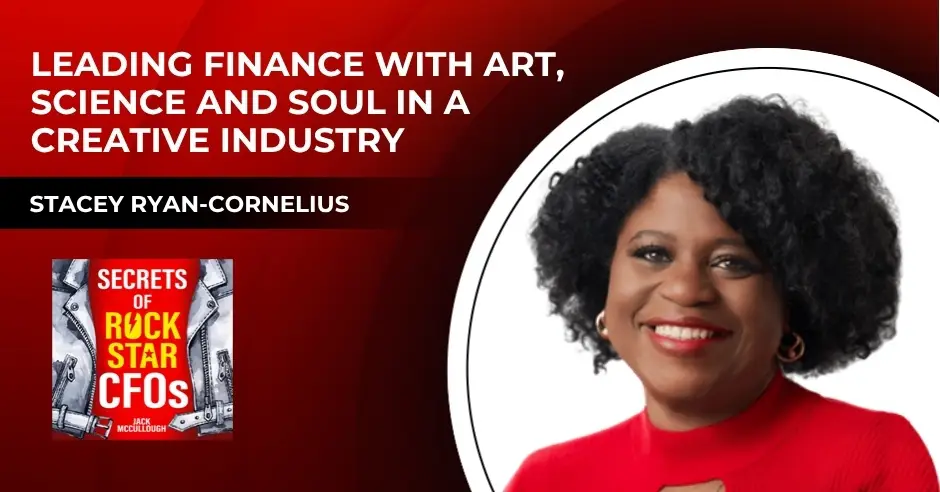
When this interview was recorded, Stacey Ryan-Cornelius was CFO at Ogilvy—a company she knew intimately after rising through its ranks and navigating leadership roles across the broader WPP network. Since then, Ryan-Cornelius has taken on the global CFO role for Burson, a public relations and communications firm also under WPP.
Her core message for finance leaders remains the same: Great CFOs must master both the numbers and the narrative. She joins host Jack McCullough to share her own leadership journey, and advice for how finance leaders can guide their companies through complexity while still leaving room for innovation. Listen by clicking below. The Q&A, lightly trimmed and edited for clarity, follows.
—
Listen to the podcast here
I’m particularly excited about our guest because she keynoted our conference back in the last fall. Unfortunately, I wasn’t able to interview with her then. My colleague did, so I wanted to make up for that by having her on the show. You’re all going to benefit from that. My guest is Stacey Ryan Cornelius. She’s the CFO of Ogilvy. I’m sure all of at least a little bit about Ogilvy, but at a high level, it’s one of the world’s leading creative agencies. It’s been creating impact for branch through iconic culture changing value driving ideas since the company was founded several years ago. Stacey, welcome to the show.
Thank you, Jack. A pleasure to be here.
It’s great to have you finally. We only met briefly at the conference. I did a decent job probably on describing Ogilvy but do you want to give me a few more details on the 2025 version of the company?
We are a company that is a global network of creative innovators who have, as you mentioned, been creating what I would call unreasonable impact for our brands, our client’s brands and their businesses from many years. We’ve operated in practically every country in the world that you would imagine. In all four regions, we have over 15,000 employees globally. It is a phenomenal place to work and learn the craft as well as to have a great opportunity to build relationships with key people both within the marketing industry and beyond. Basically, the ideas that we come up with impact the world that we like to say.
It’s such an important company and it’s fascinating. We’ll dive deep into that, but before we get into that, I want to ask a little about your personal background. You grew up in New York.
I did, born and raised in Brooklyn. I have lived there my entire life but New York is such a diverse epicenter. You feel like you live in a couple of different countries when you live in New York, which is part of the beauty of it. I come from a family where my father was from the Caribbean. My mother was born and raised in the U.S. My sister and I were first generation college students. I only have one sibling. They always instilled in us, as you would imagine, as my father being an immigrant to this country, hard work will get you everywhere.
Being females, especially, they very much invested in their children to make sure that we were pretty much overachievers. That always stuck with me when I saw him get up every morning. He was a plumber. He would get up 4:00 AM every morning and go out and do what he needed to do. I chose something because in our world it was Corporate America. Let’s do that route. As I was in school, I’m trying to figure out where my passion was and fell on accounting, to be honest.
It wasn’t something that I saw as a path until I got into high school and it was introduced to me. A small family but strong and very bonded family. Now, I am an empty nester. I have two daughters but my daughters are out living their best life. My husband and I are trying to figure out if we like each other anymore.
Good for you. What do you daughters do? Are they in business as well?
You’re going to let me brag. This is cool. Thank you very much for starting this way. My oldest is a music teacher. She lives in Rochester. She’s about to complete her master’s in music education at Nazareth University. She’s all set and done and my youngest is graduating with her master’s. That’s the other proud thing, I have both my children graduating with their master’s degree. She’s doing environmental policy in business. They both did something completely opposite than me, which was great and they got to follow their calling. I’m very proud of them.
That’s good. In very different ways, they’re both going to have very important roles in the world. What’s more noble than an educator? Not much. And working on the climate, it’s probably a good thing, too. Good for you. It wasn’t my intent, but I’m glad you’re able to enjoy your motherly pride there for a moment.
You mentioned that you almost fell into accounting and I don’t know if you met Davina Rankin. She spoke at the same conference. Oddly, she said the exact same thing and I teased her because she said I was pretty good at it. You’re a CEO of a Fortune 300, you’re probably more than pretty good but what was it about business and accounting that did it for you? It’s was a great choice. You’ve had a wonderful career.
You learn the basics. You can be a CFO coming from a lot of different avenues like accounting. Being a CPA, which I am, was just one route. It was the art of problem solving. A lot of times, they think people in our fields are very black and white. I never see myself that way, which is why I’m in a creative industry. The fact that when I first was jumping into it, using accounting theory to get to an answer was the byproduct of that. As I grew in this business, it was more, we need growth, what do we do?
We need to have a restructure. How do we do that? It was applying the skills of innovative problem solving. Using different tactics to get to a means of an end whenever you needed to. Relationship building was a very important when you had to do all of that. I found a way, especially starting out an auditing to pull all those particular skills together. That’s what like sparked my fire.
I like things to balance. I do I like analysis and data. I like to be rooted in a reason for something. That’s what just having the accounting background helps but I do hardly any accounting. I just had a conversation with our auditors but I always have to dust that part of my life off a bit because most of the time, I’m in a business conversation for growth.
I found it, when my first CFO job, I thought it was pretty interesting how infrequently I spoke to auditors. I was speaking more to deal people and lawyers and stuff like that. It was a bit of awakening because our backgrounds are similar. I worked at KPMG. You spent seven years at PwC?
I did.
Is that a good launching path for someone that wants to be a CFO?
I think it is. Why? It’s because if you’re somebody who’s restless and you’re not sure which industry you may want to work in, it gives you an opportunity to see a lot of different businesses, both big and small. If you’re lucky enough to be in a group where you have that flexibility. I always say, to be honest, my path was driven by the fact that I was in, what is now PwC, legacy Price Waterhouse and I was thrown into the entertainment media and communications group. It was like the stars aligned for me.
If I had went into financial services or more of the consumer products area, I’d have a completely different path. I was blessed by being around people who buck the trend of who auditors were and worked for some cool companies. Once I got in there, I started to learn what it took to run a business, it was interesting. One of the reasons why I left is because I felt like I had gotten as much as I could from that experience and I wanted to go deeper.
When I left PwC and joined Ogilvy, it was for that intent. It was to understand how a business was working. When you’re on an auditor, there’s only a peripheral and you get a lot of experience. I brought that experience to Ogilvy initially and that was around when SOX was coming around. I was prying for it at that moment but I used it just as an avenue to get deeper into the organization.
SOX came around. I know the exact date SOX was signed into law, July 30th, 2002. Do you know why I know it? It’s my son’s birthday. Not because I have photographic memory but when you said, I had shutters. You left public accounting and you went into Ogilvy. I’d love to understand a little bit about your early years, the transition out of public accounting. Maybe some skills were great and other things you need to learn, which is a wonderful thing. May I know some key mentors you had along the way?
First of all, it was a men’s culture shock because again, you’re used to things being more straight arrow and this and that. When you walk into more of a creative environment, there’s a little bit of what I call controlled chaos in how everything pulls together. I had to provide my expertise in the environment in which I had to work with. It was an adaption that I had to do, but in the same way, I brought the company along better than what they were used to working like. That was a situation where we exchanged a lot during those early years in terms of how we pulled it together.

When I started, I started as doing financial planning, which was not what I knew at all. I was used to reviewing companies and understanding what’s good or bad but understanding why things were happening. It was something that I needed to get to know the business and people better with. Those early years were a little bit interesting but I did use my skills because we were doing different mergers or acquisitions. I had done several deals while I was at PwC. Having somebody with that institutional knowledge to be able to talk to different advisors and lawyers and do what’s best for the company was very important at that time.
It was a lot of great work during those early years when the business was growing very rapidly. That was super great. In terms of mentors, it’s interesting because being to your point, I would say there wasn’t very many people who looked like me. I had people that were bits and pieces of them that I took advice from. I had what I would call a board of directors. Maybe that particular person I like the way they led. You’re a good leader. You make me feel like I’m somebody and you leave something with me when you go. There was other people where I was like, “You know how to present your ideas well. I need to be able to emulate and being able to be persuasive or inspirational.”
There hasn’t been one person in particular throughout my career that I found that was “a mentor” other than people in my family. When I got to a different point of my career though, I found CEOs to be the most inspirational to me because again, my focus is never been that I’m going to counting or a finance person. It’s always been on I’m a business partner.
I’ve always loved to work with people who I feel have our visionary. There’s one particular person who’s a very strong friend of mine. Her name is Monique Nelson. She’s the CEO of UWG or United World Group and she’s part of the WPP family. The way she handles her business and how she carries herself as an African-American leader is something that I always will aspire to. She was probably the person that I would call out the most.
That’s fantastic. You spent many years at Ogilvy and you referenced the parent company WPP. At least in the United States, Ogilvy is better known than its parent company. I’m not sure if I didn’t know you that I would have heard of WPP. Maybe I would have but you spent many years in the company that was Ogilvy and Mather. That was a heck of a run and then you went to a couple of WPP companies and came back to Ogilvy where you see the CFO. It’s a little bit of a boomerang. That must have been an amazing run.
It was. When I left the organization, it wasn’t intentional. To your point, I had been here a long time, had a couple of different roles and felt like I wanted to be a CFO. At that point, I was the worldwide controller of Ogilvy and looked around near the company well enough to know that there wasn’t anything that was going to open up at the moment. In all honesty, I was going to leave the group at that point and the then CEO of WPP came to me and offered me an opportunity. They were taking our health businesses around the world and we’re putting it together as a new structure. He felt, “Let’s put the rookie on it a little bit and see what she can do.”
I did that and it was interesting. We took all of our health businesses together. It was called WPP Health and it was the first time where I had to make my own decisions and be fully accountable for everything. It was the scariest part of my life but also the most rewarding because it was fast learning. We did that a year and then we had a leadership change in that strategy changed. I was sitting there. I was like, “I’ve been sitting in this organization and had this cushy job. Now I don’t have any job. What do I do?” It’s because I took it took a chance.
I had a good brand and a good reputation in the organization. They asked me then to go lead what was then our geometry business, which was our activation business at the time. I had created the activation business when I was at Ogilvy because that’s what we do. We swapped businesses around the network. I had familiarity with them. I started with a woman by the name of Beth Ann Kaminkow as the CEO. She and I both started on the same day.
Here we were, these two women trailblazing again with trying to revitalize the brand because it was having some issues and that was an amazing experience. The two of us working in partnership, changing the value of the brand, and making a lot of key changes and restructuring the business and getting it healthy enough for it to be repositioned into one of the other networks. I always said, when I left Ogilvy for that time period, I went on a three-year-long job interview to be honest because they were like, “Let me throw over here and see how she manages that. Let me throw over there and see if she does that.”
By the time it came from my predecessor to retire and again, once they had made that change with the other business, they were like, “Would you like to go back and now lead the company that you have done so much for?” We were doing a lot of change over at Ogilvy at the time and I was like, “Absolutely,” It’s a chance to take a business that was a very near and dear to my heart and take it to its next best self.
What a great story that is, to come back. I believe and do correct me from wrong. You predate the current CEO of Ogilvy. Devika joined about a year after you returned. What’s that like? You’ve got all this history with the company but she’s an icon in your industry. How do you develop such a valuable partnership that’s so critical to see photos in CEOs these days?
First, it starts with trust and mutual respect. We always assume positive intent whenever we do anything together. She was the right dose of, I would say ignition and breath for the organization. We had never had anybody external that came to be the CEO before. All the other CEOs were homegrown in the organization. To your point, she’s such an iconic figure in our industry. We welcomed her with open arms and creative is in her DNA. She feels like she’s been here from day one.
In terms of our partnership, she leveraged what I knew about the organization. She also challenged me about what I knew about the organization. That was very good. We challenged each other about what should be done differently in order for us to get to the next best version of this organization. We work together to bring in a lot of other key talent that is part of our executive committee as well as other key talents around the world.
Now, when we look back after being with each other and partnering with Liz Taylor, our global CCO, and then we have our chief people officers, are female as well. Our chief client officer are females. We have several other powerful females. There’s a couple of men in there, too, which is cool. It feels so dynamic to be part of this powerful team of very diverse people driving these wonderful human beings, these 15,000 human beings to do the best work of their lives.
I was going to ask you about two females at the top of the company but it sounds like this more of them. I just need to confirm if I heard this right. Even the beauty industry and your COO is named Elizabeth Taylor. What are the odds of that?
We always say Elizabeth Taylor.
I have been shouting out from the rooftop.
The irony is her middle name is Stacey, so we’re just completely symbiotic. It works out well.
One of the biggest challenge is I always hear from CFOs is around talent. It’s recruiting the best of the brightest and keeping it. I’m thinking your company maybe doesn’t have the challenges because you’ve got such an awesome brand. It’s the type of company a lot of people want to work for and have a career at but maybe I’m underestimating. What’s your philosophy on building a world class team, not only in finance but across the whole enterprise?
Our brand is very well-known. We consider ourselves a bit of a teaching hospital, so we like to bring a lot of people into the organization and we have a very strong alumni network. Even if you’re no longer with Ogilvy, you’re an advocate of Ogilvy. That’s very important. Talent is tough no matter what the situation is. There’s a lot of competition out there. We believe that we’re able to attract some good talent and hopefully, able to retain as much as we possibly can. We also have a lot of boomerangs because people are at different stages of their lives and their careers.
They come here and learn a bit. Sometimes they leave, and sometimes we have a lot of people coming back. Case in point with myself, Elizabeth Taylor is Liz Taylor. There’s another one. She worked for Ogilvy for quite a while. She went and had very strong career someplace else and then she came back. That does happen as well, which were very proud of. It speaks to the brand and the experience that we have. Talent is always going to be something that is on the top of anybody’s list and I always say that talent is our greatest asset that’s not on my balance sheet, so it’s very important.
You referenced earlier being a relatively rare Black female CFO. While I don’t have great numbers, if you read published reports about 16 percent to 18 percent of CFOs are female and it’s probably under 10 percent are Black. If you multiply those two numbers, you get about one and a half percent but how did you overcome the odds of becoming, not exactly a unicorn?
There’s that saying that, talent is, whether they believe it or not, fairly distributed but opportunity isn’t. Again, if I think about how I have gotten to my seat, clearly there’s a strong level of talent there. There’s an immense level of effort because if I didn’t do the work and be two or three times better than some of the other people that I was working with or amongst, then I wouldn’t have stood out. If I think about what started to jump my career when I was graduating from college and I was getting into one of the big auditing firms. It was through their diversity programming that they wanted to bring different people into their organization.
That was a path. The world might not have known who Stacey Ryan Cornelius is and what she could do if she didn’t have that opportunity to show it in that way. Once I got in the door, then it was all me. It was like, bust your tail. Do what you need to do. Make your relationships, deliver and all of that stuff. There was a program that gave me the opportunity to get into the door and I was very appreciative of that.
Being given the opportunity is one thing but, clearly that proves the importance. You’re living proof of the importance of DEI programs. I know it’s something at Ogilvy. The organization takes a lot of pride and by reputation, its executed very well. In your industry, you’d probably be crazy not to since so much of it is about creativity. How has your own experience is informed your perspective on the value of DEI both in the workplace and the fundamental product?
Again, we’re a business of ideas. We are people in a relationship business. Our client have all types of consumers all over the world. Their global businesses and we’re a global business. It’s very important for us to be able to have the combustion that happens with those ideas through different lenses. I’ve appreciated being especially in a global role what I’ve learned traveling the world and seeing the beauty of the work that we do in learning through that work, what a particular challenge of a brand or a community based off of the ideas that we produce.
You can only do that when you have different people working around the world. We have this mindset of borderless creativity when we’re trying to solve a business problem. You can have somebody in different parts of the world with all their different life experiences working on and trying to solve that business problem for that client. They’re going to get the best work from that. We need different people in order for us to get that. It’s diversity in all ways and shapes and forms that can be described. I believe that it is critical for us to be able to do our best work to have all those different life experiences and perspectives and our clients get better work for it.
That’s just the world we live in.
For me and my team members and everything like that, again, we have a relationship business. We’re very close-knit group around the world. The Ogilvy culture is very strong. I can walk into any Ogilvy officer around the world and feel at home. That just causes us to be overall human beings and with core values that we work with. It’s not a matter of who’s different. It’s a matter of the values.
That makes sense. I want to show a little about the company. What are some of not only the biggest challenges but the biggest opportunities facing the company in the next few years?
As you mentioned, talent is always a challenge and an opportunity. We see the industry contracting a little bit with some of the mergers that have been announced and things like that. There’s always that lens as to how that all will affect everything but we’re all good there. Everybody’s talking AI. AI is on everybody’s tongue as well as to see how our business is transforming.
Relative to that, our clients expect it. We expect it and our investors expect it, so it’s very important for us to keep on top of that. Innovation and growth is always something that we’re always at top of mind. We only grow when our clients grow, so making sure that that partnership is always a strong as it ever could be. We have our people who are energized enough to be able to create the next best level of work. I wake up every morning figuring out how do I help enable this business to do their best work.
That’s a wonderful philosophy and I’m glad you mentioned AI. I always joke I’m legally required to ask an AI question to keep my show license, but it is true. It’s fair to say marketing has embraced AI more quickly than finance just because We’re more cautious. We’re worried about cybersecurity threats and we have personal data that marketing does not host.
We do a lot with data in marketing. Everything starts with the creative idea and things like that but there’s a whole other way that we get to personalization and data is very important with it. It’s either our client’s data or industry-wise data. We use data very extensively and everything that we do either in audience planning or being able to make everything much more effective in how we do our business. All of that privacy stuff, that weighs heavy on us in terms of being able to use it.
That’s why our parent company has created a platform for us that’s insular and very monitored and controlled so that we don’t run into any issues, either putting our clients at risk or our business at risk. We have a play pit and a tool set that we are using in order to make our work faster, so to speed up the excellent work that we do. Also, to transform and enhance our creativity in everything that we do.
Again, it’s not just us as a creative agency. We have media business and our sister agencies. A lot of PR and other different integrated services. We all have this wonderful play pit that we go to that we call WPP open. It helps us optimize our work as best as possible. We’re all trying to get our arms around it and get into it but the amount of money that we’ve invested into it makes it all the worthwhile.
That makes sense. One of the things, a lot of CFOs and it’s becoming more aware of it but is aligning finance and strategy like some companies insist that they live in silos. I’m thinking for you, because you’re probably surrounded by a whole bunch of creative geniuses. You’re probably the only financial expert on the C-Suite. That must be a little bit more challenging for you than some other CFOs. How do you make sure that strategy understands financial reality and financial reality support the overall strategy of the company?
It’s a bit easier than you think because in our mindset, we call it having a commercial background. Even if I have the creative organization or the creative side of the business or the strategic side, their job is to work, come up with ideas, and sell it to clients. I may have a group of individuals who are commercially going to try to make sure that value is probably compensated. We talked more about how we grow and then the commercial strategy that goes with that alongside of it.
It’s not super difficult. It’s probably something that I think about day in and day out and they’re off trying to do the best thing they can do. I don’t find it that bad because to be honest, I can’t do anything financial unless there’s a strategy. There’s an alignment there that sits. Where it gets difficult is the actual decision making but the strategy is there. The objectives are there. Where we would probably test a little bit about the decision making. I have this great saying, “It’s never the what, it’s the how.” That’s the way we always have to debate.
I like that. You give me three quotes that I’m going to steal from you and I’m not going to attribute any of them. It just occurs to me that it’s the very definition of the intersection of creativity in business, your company. You need to instill financial discipline, you and your team but you can’t be the person that spoils innovation and I worked in tech in my CFO days. It was a different type of innovation. Innovation is just the same.
What it comes down to is, what’s your level of risk tolerance. Again, to your point, we need to be more risk adverse but if you hold the reins too tight then you don’t have any innovation for growth. The trust factor has to be there. I’m pretty direct in terms of how I communicate with our executive committee and saying, “You want this, you get this. You want that, you get that.” Scenario planning is very important in order for us to understand what the different options are and which roads that we go to. Also, when we need to pivot, because we can always try something that may not work. Having those levers so that everybody is completely clear on when we need to pivot is the most important thing as well.
That’s a great philosophy. One of the questions I like to ask particularly to CFOs. You’re probably not a CPA anymore but like me, you were, or have you kept your license up?
I have kept my license up.
Good for you. What are the popular KPIs, financial or otherwise that you use to measure business performance at Ogilvy?
One of the key areas we look at is what I call recovery. Again, we invest a lot into our clients and things like that. Sometimes, you work through your deals and you come up with whatever you’re negotiated pricing is but we also want to make sure that there is an adequate recovery, so that we have the talent in order to continue to invest in our clients in our business. Recovery is super important. We tend to match that.

Clearly, revenue growth and margin are table stakes in terms of how we do that. We look at the billability of our staff just to make sure that it’s at the threshold that we would expect as well as utilization to make sure that if we have the right capacity to do everything that we need to do. There’s a whole slew of working capital things that we look at so that we’re turning over cash.
If you ask me, when I open up my dashboard in the morning, what I’m looking at, it’s how is our job burn relative to what we’re trying to do to the scopes that we’ve aligned with our clients and what’s my recovery. All of that stuff only makes sense if I have my time sheets in, so looking at my time sheet compliance. A little boring morning things as I’m drinking my morning tea and then I go into problem solving for the day.
There you go. It’s good to get over the boring stuff early in the day and just focus on running a business after, at least that’s what I found. An obvious question to me is, every organization in the modern world is global but you’re very global and a different taste and different priorities in all of these countries. How do you do it from a financial leadership perspective? Different economic conditions, I won’t go into politics but there’s perceptions of American companies that sometimes shift. What are some of the challenges with that?
It’s interesting to understand each part of the world has their cultural differences. To your point, there’s laws that are different. If we’re looking to make changes from a people perspective, it takes a little bit longer in some places based off of work councils versus other places. It’s experience. If I’m looking at a set of data, I have a lens of, “This is what it makes sense for UK versus the U.S.” Even looking at the P&Ls. I can understand dynamics that way and/or I can understand client behavior that way.
Luckily, we do have several global clients. It’s a little easier than you think when I’m looking at it from a revenue perspective but even then, we have clients that are held. The way they’re organized is more global, so it’s top down in terms of how those contracts are set up. Some of them are local where it’s more about them up.
That’s the other complication that we’re looking at when we’re looking to navigate certain waters around the world. I love that. I love the difference. I’ve never worked in one region in the world before. My whole entire life, I’ve been in some a global landscape. If I’m not in any given day talking to at least three parts of the world, then it’s boring to me. I embrace those challenges full-on.
Being a child of immigrant parents and living in New York or Los Angeles, probably the two most multicultural cities surely in the United States, if not the whole world. It’s great that you’ll have that curious because I grew up in a town in Northern Massachusetts. Everybody was Irish-Catholic. That was just my reality. I didn’t appreciate the world for all that it offers until I reached a Delta but you’re born with that.
The tagline of this show is, “CFOs no longer record history. They make history.” The rules change quite a bit since I had my first CFO job. Although, I’m just realizing that was many years ago, but what do you see of the leader that would only see is the future of financial leadership? How it’s going to continue evolve and support the business community?
That’s an excellent question. I always see us as advisors and council because we have a unique lens in to several areas of the business because we need to understand that in order to manage the financial health of the organization. You’re always the person on the shoulder saying, “Don’t do that. Do that. Look here and do this.” Some people listen and some people don’t, but having that full grasp of being able to advise the business the right way, it’s like you’re not a no CFO. You’re a strategic CFO. We’ve heard that line.
I enjoy doing that type of work advising and getting to the next step. Sometimes, I’m right and sometimes I’m wrong. Most of the time, at least, I have a strong perspective and it’s a bit based off of what I call a little bit of art and Science. The science bit being rooted in the data, understanding and being able to read trends, and then the art part of it is just knowing the business, the clients, the people and being able to call something and just having the bravery to call it to be honest.
Sometimes, we’ve all been in those rooms where everybody’s looking at the same information and who’s going to be the one to stick their neck out and say, “We should go here.” I’m never shy to be that person. Sometimes, you need somebody to kick it off to get into a good discussion. I also feel like we’re catalysts in a way, so we can throw a bomb and see what happens.
I don’t think either one of us would have perceived that at the beginning of our careers.
You’re like, “Here’s the data,” and you walk away but now you got to show them in a different way.
It’s remarkable. More and more CFOs are becoming CEOs. Back then, that was only when the company was in financial distress and that type of thing. This has been a lot of fun and when I was preparing for this, I found out something unexpected about you that I wouldn’t have known. You are a big fan of MMA. Did you ever fight?
I never did but I enjoy. Maybe that’s one of the ways I get my aggression out, is to watching people do it. I totally am. It’s something that my husband and I like. When we were dating back in the Tyson days. At first, it was regular boxing and then when MMA came out, I was like, “This is fun. You can use more parts of your body. You can kick. You can do this. You can do that.” Yes, I do enjoy watching it. It’s exhilarating and I haven’t been to one in-person but that is part of my list to go see. When I was in Thailand, I was going to go and try to see something. It is something that I like. A little out of character you would think for me, but it’s still something I enjoy.
There’s a little bit of primitiveness.
A little bit of the roar I wish I could be in the ring every once in a while, and have a couple of people I don’t care for in there.
I don’t think I’d fear too well if I were to go in the ring at this point by my life, but I thought that was fantastic. You mentioned you have two daughters. Although, they’re grown. You’re still a mom and being a parent is always the most important role. How have you been able to achieve work-life and balance? You’ve had this remarkable career making an impact globally and yet, by all accounts, it sure sounds like you did a great job of raising your daughters.
I don’t know if there was ever balanced to be honest, but I did have a lot of help. My mother, God rest her soul, was the caretaker of my daughter as I was off doing what I needed to do. It made a big difference in me being completely comfortable with leaving my children with her and being able to work later than I would normally would have. Having the support of her also. When I came home and I probably might have been a little bit out of energy for her to use her wisdom to try to help me through different things. It was because of the support of my mom. As well as my sister. I have one sister. A lot of times, we shared the loads with our children. It was family.
Family can make all the difference. This has been a lot of fun. I just want to ask you. If you have any advice you’d like to pass on to the next generation of CFOs, things that they should be thinking about as they climb the ranks in their careers.
It’s not going to be what you think. I could say a lot of different things relative to the industry but it’s more personal. As you’re trying to do anything with your career, you’re so driven and you may or may not lose sight of what’s important in terms of your health, either mental health, physical health or whatever. Somebody asked me, “As you did all this. What are the things you might have done differently? What advice would you give?”
It would be to pause every once in a while. We have a wonderful campaign that we’ve done with Simone Biles and our Powerade client on the Polk, which is, “Pause is power.” Now, as I’m sitting here, some odd into the industry, I may move a little slower. My back hurts a little bit more than it should have, and I would tell everybody, you can still do it and not have to work until the wee hours in the morning. Be very particular about boundaries and make sure that you are taking time and taking care of yourself. Pause is power.
You mentioned Simone Biles very casually.
I haven’t met her.
You better. To me, she’s a good argument. She’s the Michael Jordan of 2025. To me, Babe Ruth, Michael Jordan and Simone Biles and a few other people that’s in that people will be talking about well after their retired from sports.
You point sports, I get a lot of inspiration from sports but that would be the best advice to tell people, set your boundaries. Still be the best that you can be. There’ll be times when you’ll have to dig in and over deliver. In order to make your name out, do the uncomfortable things but make sure that you take time because no matter what this is, it’s still just a career and your family is the most important.
That’s great. This has been wonderful, Stacey. I know you’ve got a lot going on, so thank you for your time. I’d love to give you the final word.
Thank you for the opportunity. Whatever you want to do in life, just always believe in yourself the most because you never want anybody to question. If there’s going to be people out there with questioning your value, don’t let that person be you. You are most the most precious thing to yourself. That’s the most important thing we can leave anybody with.
