


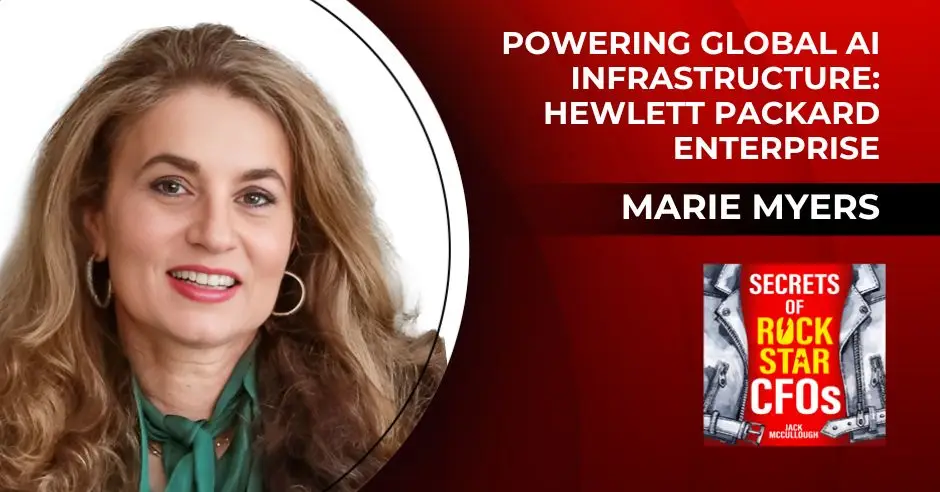
Marie Myers‘ first job was planting sugarcane on her father’s plantation in far North Queensland, in a rural town with few other options for employment, and a high school education carried out mostly through correspondence. But the grit she learned from hard physical labor helped lead Myers to the corner office as executive vice president and CFO of software giant Hewlett Packard Enterprise.
Myers joins host Jack McCullough to share her unconventional journey to leadership, navigating the complexities of AI infrastructure and her perspective on the evolution of financial leadership in the tech sector. Listen by clicking below. The Q&A, lightly trimmed and edited for clarity, follows.
—
Listen to the podcast here
Welcome back to a great episode of the show. Our guest certainly qualifies as a Rockstar CFO. Marie Myers is the Executive Vice President and CFO of Hewlett Packard Enterprise. HPE is a global technology leader focused on developing intelligence solutions that allow customers to capture, analyze, and act upon data seamlessly. The company innovates across networking, hybrid cloud and AI to help customers develop new business models, engage in new ways and increase operational performance.
—
Marie, welcome to the show.
Thanks so much. Glad to be here, Jack.
I may have oversimplified the description of HPE, and I’m wondering if you could give a little bit more of a robust description of your company.
Sure. Thanks very much, Jack. As you said, we are in, I would say, quite an interesting space in terms of business. For folks who aren’t familiar with us, we’re a company that is in the position to provide a lot of the AI infrastructure that you see going into enterprises and even into some of the big model builders and cloud service providers. We also have a very robust networking business and storage as well. I’d say what’s been particularly interesting is just for me, and what attracted me to come to HPE was actually just the growth of AI and how it’s transforming business today. Little-known fact: we’re headquartered in Houston, Texas. I don’t have a Texan accent. That’s something else.
Really? I definitely heard you saying something from the deep self. It’s funny because HP it’s thought of as like the consummate Silicon Valley company. It was one of the first that did that. The Hewlett Packard came, I think, from MIT and migrated, but now it’s a Texas company.
Folks have realized we moved a few years ago to Houston. I think we’re one of Houston’s largest tech companies.
Indeed, it sounds like it would be. I definitely want to return to that because it’s a fascinating story. Your story is fascinating, also. I know you grew up in Australia, but what part of Australia did you grow up in?
Jack, I grew up in probably not a spot that a lot of people have been to, up in far North Queensland on the Great Barrier Reef. I was born in a town called Mirriwinni, which most people cannot spell. I’m close to Cairns, which is one of the major arterial gateways to the Great Barrier Reef.
Fascinating because I Googled in preparation for this, not Google, I went to one of the AI platforms and I said, “Who’s the most famous person to come from there?” Perhaps unsurprisingly, you were identified.
No way. You’re kidding me. That’s funny. I came from a town you could barely have. I went over to high school. There weren’t even enough people, enough kids in the class. I did most of my courses by correspondence. It was a pretty small town.
That’s insane. I told them I was interviewing you, and it said I should identify you as your greatest export. Don’t fix it like that. Anyway, what was it like growing up in a rural area like that? I find it fascinating that you’re doing correspondence programs as a child, basically.
I couldn’t think of a better way to grow up as a kid, to be honest with you. Very isolated, but I think it gives you really good exposure to what grit looks like because I knew as a kid that there’s not much of a future, particularly for a young girl growing back up in those days. It was like all the guys I grew up with knew that they were going to go into plantations and go into farming. For the girls, there was really no option but to work at the local bank. I can remember as a kid, my dad’s friends telling him, “Don’t spend any money on her education because she’s going to grow up and get married.”
It was a really strong motivator for me to go on and become really well educated. I poured my time into studying, and I’ve always been outdoorsy. I’m a pretty, how do you say, I take on most physical challenges, and I love the outdoors, I love the beaches, I love hiking, I love mountains. As a kid, it gave me a lot of grit, and you learned that there was nothing that was an obstacle in life. We had lots of natural disasters. I grew up with crocodiles in the backyard. Not too much phases for me, to be honest with you, Jack.
I’ve seen one crocodile. I ran for my life when I saw it, but for you, that was just a normal thing.
Pretty much, yeah. As a swimmer swimming in rivers, you just learned how to navigate life. There weren’t any other options. Either you were all in, or you would be disappointed with the hand that life had dealt you. I decided it was better just to make the best of it. I worked for my dad. My dad treated me like the guys. He paid me well. I bought my first set of designer sunglasses, I think, working on my dad’s sugar plantation. It was all right. He paid me well.
I was going to ask you that. I often ask people what their first job was. A lot of times, you get fast food or retail or something like that. Your first job was on a sugar plantation, it sounds like.
I was planting sugarcane for my dad. I took that job. I embraced it because it was a highly paid job back then. It was hard physical labor, but it was extremely well paid. It allowed me to satisfy my fashion shopping, which in the bush was hard to do. At least I had plenty of money in the bank account.
That’s the hall of fame. We’ve had some interesting answers to that question, but that certainly is one that we will remember going forward. Sugarcaneer to CFO of an iconic tech company. Not exactly a common story.
Not at all, Jack.
That’s great. I know you went to college and where you got a degree in political science and a bachelor of economics from Queensland. I’m curious, at that point, were you thinking that you would have a career in finance?
To be honest with you, not really. I was really into economics that I actually thought I’d be an economy man. Suppose the broader world of finance, but I saw myself as an international economist. I went on to work in the Australian government for several years in that space because I was always interested in the national business.
Going to the University of Queensland, which was a great university, gave me that chance to really satisfy my intellectual curiosity around international business, but I never thought I’d ever be a CFO. I didn’t even understand what that job was, Jack, back then. I was like, “It’s great. I had a job, doing briefings for ministers working on economic policy.” I thought that I pretty much reached the pinnacle of my lifetime, to be honest with you.
You’ve had an absolutely fascinating career. What was your first job out of college?
My first job was actually in the government. I was a graduate economist for the trade industry department. That’s when I lived in a city called Canberra in Australia. I was there for about five years and decided that bureaucracy was boring. I realized that perhaps I should like all good Australians go walk about and left my country, came to the U.S., and I was halfway through my MBA, and I decided to finish up my MBA here. It was my MBA that transitioned me into the tech sector. I’m eternally grateful for that time and for that walkabout journey I made in my life because it forced me out of my comfort zone. I had to get a job because I was a broke, struggling student, and I took my first job at a company called Compaq and never looked back.
It’s funny. A lot of that was an iconic company in its day. Is it part of Hewlett Packard now? I forgot the progression.
It is. People forget, actually. The PC and server business and actually some of the storage business, were really cutting-edge businesses in Compaq, and HP bought Compaq more than 20 years ago, and those businesses were then integrated into HP.
It’s interesting because a lot of people don’t necessarily think of HP as acquisitive. In point of fact, in recent years, it has become much more so. That was one of the great, as far as I know, one of the great early success stories of an acquisition.
Exactly. Very transformative.
You had a great run, and I haven’t met a lot of CFOs who didn’t have key mentors along the way. When you look back upon your career, who were some of the role models or mentors that you had that influenced you to become the leader that you are now?
I’ve been fortunate, Jack. I think I had my first mentor in perhaps my first or second job in Australia. She was one of Australia’s leading-edge women back in those days in the bureaucracy. She picked me up, took me under her wing. I remember my first job I had working for her. I was in Sydney. She was shutting down this office. It was an investment arm of the Australian government. She said, “Going out for lunch, would you figure out how to get all these boxes and infrastructure out of here?”
She was joking, I think in some way she threw me back then, the yellow pages. Not sure if you remember the yellow pages, a big fat book. She goes, “Figure out how to pack the stuff up and get it out of here.” She left it. In those days in Australia used to have long lunches. She came back hours later, and I basically had the whole place packed up. She’s like, “What, what did you do?” I said, “I just called up a few people. Made it happen.” That was it. Ever since then, she’s now the godmother to one of my daughters, and we’re really good mates.
It taught me the lesson of mentorship. Once I started my career in the tech sector, I was very fortunate. I had another two or three amazing mentors. One of them was the COO of the company. Another one was the former CEO of Barclays, who was a chairwoman. Both of those people were just really instrumental in helping me in my career. They helped me through the hard times, the great times, but both of them were just like amazing mentors.
It sounds like you’ve been influenced by them. I’m assuming that whether you’re doing it intentionally or not, you’re probably a very important mentor to some of the people on your own team. I would guess that’s something maybe that you take very seriously.
It’s funny you should say that, Jack. It’s one of the things that gives me a ton of pride and joy at the stage of my career I’m at. I feel like this is a stage where you give back, and yeah, nothing makes me feel more proud when I get those messages, emails, texts, calls, “I’m doing this today. What do you think about?” I can look back and see the number of CFOs, controllers. Frankly, even one of the gals who work for me is now the CEO. I feel really honored that hopefully I’ve touched a lot of people’s lives.
No doubt in my mind that you in fact have. I’d like to explore your journey a little bit. Some of the big lessons learned along the way in companies you work for that prepared you for this truly global, transformative CFO role. Can you walk us through a little bit of that, some of the big places that you’ve worked and what you picked up along the way?
First job really in the tech sector was in Compaq, as I mentioned, and I wasn’t in finance. I was actually a product manager of a fairly large, important product back in those days in the storage business. I look at life, I look at my job, and say, “There are chapters.” There are just those moments where you did an amazing role that gave you a transformative experience that even today I look back and say, “Thank you. I’m grateful for that.”

Honestly, being a product manager for that business line was super important because I feel like in the business, I can relate easily to all the folks running different business units. I understand how it’s all wired. That was one of those big transformative jobs. The next one was perhaps I got involved in a detailed analysis that helped to understand how products were moving around the world. I became the head of internal audit for Compaq and ultimately for HP.
That was the job that got me into the boardroom. That experience at such an early stage of my career, I look back and I’m like, I’ve been in and out of the boardroom since I was probably in my early 30s. I’ve been doing the audit committee for decades. It just made such a big difference. When I’m preparing audit committees, I sit on audit committees, I’ve chaired audit committees, having had all that experience and then being close to board members, it just helped you understand how governance worked and how important that is as you go through your career, particularly when you get into finance or into a C-Suite role.
I’m grateful people look back in those days, “Why would you ever want to run internal audit?” It was one of the best jobs I ever had, Jack, to be honest with you. I want to learn so much more than I’m eternally grateful. The other one, I’d say is splitting the company. We split the company a decade ago. HP was a $120 billion company. It was the largest business split in history.
I got to work on the split team to help set up the PC company. That was once again one of those amazing, transformative experiences. It was like I said, I think I look back and I say there’s three or four jobs along the way. The last one was probably going to be the CFO of a startup. That was crazy, but so gave me the entree into digital transformation and whet my appetite for AI.
That UiPath?
Yeah, that was UiPath. I think you have to look at your career and say, “It’s those experiences where I took on something that I was perhaps unexpected and not what everybody else would have done.” I always tell people, “Look for the job that not everybody wants because maybe you’ll learn something that no one else will learn.”
Now, it’s interesting you’re reflecting on your role as internal audit and presenting to the board meetings, because the association I work for, we have a lot of first-time CFOs or people on a path to becoming a CFO. That’s the biggest fear they have, presenting to the board. When we have mentor programs, stuff like that, inevitably, that’s a question. How do I get ready for the board meeting? What’s my role? Do I shut up? Do I talk proactively? You said you were 31 when you were presenting. A pretty impressive board of directors, one would have to think.
The board back then was amazing. If you looked at the board of directors, there was like Mr. Perkins from Kleiner Perkins. It was like the who’s who of tech back in that decade. It was, look, that experience, like I said, you cannot replicate that very easily. I think you have to look for experiences in a role. I think people get hung up on promotions, building out this and that. I think it’s the experiences that prepare you. By the time you get to a job like this, I remember when I first became a CFO, it was like, “I think this was going to be incredibly difficult.” I realized that all those jobs I’d done before had prepared me. I’d done a big transaction. I had been on the board. You’ve run the business. It just makes it much easier for you to deal with the challenges that come your way, ultimately, when you get to a job like this.
I love the fact that you described the split of HP as a big transaction.
It was the largest business fit in history. It was an amazing career experience.
It’s one of those once-in-a-lifetime types of things. You referenced 2015, which I guess I knew. Man, that was a quick decade because I can remember that was like the biggest business news story for about a year and a half. That’s crazy. Let’s chat about the current role at HP. You’ve been there since 2021?
No, this is my second. I’m at the sister company. I did 2021 with Q, and then I joined HPE a year ago as the CFO of HPE. I’m the only person who’s probably been the CFO of both companies.
I’m certain that’s going to be the case. You’re relatively new in the current role. What led to your joining there? It seems like a great fit for what you’re doing before the split as well.
I think because of the exposure I got with my role at UiPath, I became very interested in technology and probably a bit of a closet geek. What I liked about the opportunity we had was really to be part of this AI period that’s going on in the world. There’s no doubt in my mind that AI is going to transform everything we do in our lives. It’s going to transform how we wake up, how we manage our lifetime, and how we interact, including business. I felt like HPE had this unique moment to really be a big agent in AI. That’s really why I joined, Jack.
Interesting. You described yourself as a closet geek. Technology to you is just a very natural part of financial leadership, it sounds like.
Yes, it absolutely is. I’ve been a CTO, a CFO. I’ve enjoyed it all. I think it’s so important today as a CFO. Many CFOs get to run tech, but I think a lot of them don’t embrace tech. They don’t decide that is something that they need to develop a skillset. I would advise any CFO today that if you want to be a really good, competent CFO, you’ve got to have enough technical chops. It helps you be a better CFO because, typically, technology is the backbone of most companies. If you don’t have a good understanding of how that backbone operates, you may miss a huge opportunity to drive business performance.
To me, digital leadership is not something CFOs can outsource anymore.
Yeah, you can’t outsource digital leadership. You have to be the leader of the company in many ways.
That makes a lot of sense. I’m probably required by law to ask you about generative AI, but I know when we spoke in Dallas, you gave a reference to a game-changing product that would be coming out relatively soon. I believe relatively soon was last week. Is Zora the product that you were referencing?
Yes, Zora was the product. We just announced that in conjunction with Deloitte at the conference last week, the GTC, Nvidia’s tech conference. Excited about it. I think that the Zora platform is going to be released on HPE technology, which is called PCAI, Private Cloud for AI. What’s great about it is that it’s AI in a box for a CFO on our infrastructure. It makes it so easy to plug and play on AI. We’ve been developing the platform with in conjunction with Deloitte, and my team is actually in finance using the platform and will really be the beta users for the platform. I think great on two levels. One, it’s on HPE architecture. Two, it makes it simple for a CFO. Three, we’re using it here at HPE and can become testimonial customers for the platform itself.
You said it was going to be a game changer, and it certainly sounds like you kept your word on that. How are you using generative AI internally, not only in finance, but within the business?
In finance, we’ve got a number of different use cases going on. I’d say the one that I’m like I said, I’m very excited about Zora because it gets to lift the tide for the whole organization. Everyone in finance will have access to the platform so they can use it to do multiple queries, to help them with business performance forecasting. Now we’ve also used gen AI even in investor relations to help us with our scripts, sentiment analysis and many productivity use cases.
I’d say the ones that are probably most understood outside in the business are really in the areas of software. I was reading an article by the Anthropic CEO who said that literally 90 percent of developers’ code in the next two years will come from generative AI. I was shocked by that. I kept that article very sitting right next to my laptop because I was like, “Wow.” I mean, that is, if that’s not a shocking amount of transformation in code.
The other reason just in, most of us have call centers, and the amount of transformation going on in call centers from gen AI is just remarkable. I think certain pockets are leading, marketing is another one, but the amount of transformation is picking up. I would say I had a fortunate opportunity to be part of Davos this year. I know, we were using agentic AI, but you’re starting to see agentic AI become at the forefront of everybody’s transformation as well.
It’s interesting because when I talk to CFOs, their biggest concerns with agentic AI and it may maybe holding them back a little bit from embracing it relative to other C-Suite members, data privacy and cybersecurity. Those are legitimate concerns for everybody, but particularly for CFOs. What are some ways that they can utilize this once-in-a-lifetime type of technology responsibly and address those concerns?
First and foremost, security, governance have to be right at the top of the list and top of mind. Why we’re confident about the Zora opportunity is because it’s on what we call our private cloud. You have the opportunity to have it on-prem. It helps to mitigate a lot of those data issues that you talked about. There’s a lot of reluctance, and I completely understand it to putting your data into the cloud or feeding your data into other people’s models. When we worked on the investor relations scripts that we did at HP, I didn’t want to share my data or my scripts with anybody else.
We built our own model and our own architecture. That gives you an enormous sense of belief. I think the security is pushing people to think more about on-prem architecture, which is a bit, if you think about it, Jack, it’s taking us back 10 years, because we’re all so cloud-focused for the last decade. It’s the right thing to be thinking about. I think just how you sort out and solve that problem is very different.
No, that makes a ton of sense, I think. I want to chat a little bit about there’s perception of finance that’s changed dramatically in recent years. CFOs for a long time have been calling themselves the strategic partner to the CEO, and it’s their most important relationship. In the last couple of years, I noticed it shortly after COVID, CEOs are saying the same thing. They’re saying, yes, the CFO is now my strategic partner. I know you famously have a fantastic relationship with Antonio Neri, the CEO of the company. I’m wondering, what advice can you share on how you build a meaningful relationship with the CEO? Sure, you work for him in this case, but it is a true partnership.
I look at it a bit like a critical relationship in your life. First of all, you want to make sure that you and the CEO get along. It’s important to actually like each other to start with. It’s not just that the CFO cannot just be a numbers person. You have to be a valued strategic partner. That means that you need to bring to the table more than just a view on your numbers, but a view on the business and how you see all aspects of the company coming together.
I feel that’s why we talked about the digital part as being important, because in order to bring in a strategic view, you need to have a really good understanding of the business, which means you probably need to understand the technology or understand what your products are. You need to also understand how the business is wired, and you need to understand the external environment.
It’s a much more complex set of factors. I think typically in the past, the CFO might’ve gotten away with being the custodian of the numbers. It’s just not good enough. You need to understand the market. If you can bring all that context in and lay it out in a way that the CEO can feel one, that they have trust in you. Secondly, you’re looking at the business in a much more constructive manner. I think that’s how you build a basis for a solid partnership.
That takes time because I mean, you have to also be willing to invest in the external. You have to be willing to understand the competition and some of the more strategic aspects of your job, like what’s going on from a digital perspective, which a lot of CFOs maybe haven’t taken the time in the past to invest in those areas.
I think the fact that you have a background in economics, because at some point in my career, I was a traditional CPA. I publicly control it to CFO. Somewhere along the way, I realized that it was really the economic understanding that was more important than following a rules-based system. You’ve had such diverse experiences. I think now there are probably a million ways to become a CFO, but I do think that the fact that you’ve done so many different things along the way has made you better at the CFO role versus somebody that maybe was a little bit more narrowly focused?
It probably helped a lot. I’ve had a girlfriend who’s an amazing CFO, and her background was like a high neuro engineer. Yet you would never imagine that background making a great CFO. Once again, I think she’s hyper-analytical. I think to your point, I can get those analytical skills from different degrees or different training. I think, just to your point, I’ve done a lot of accounting, I almost finished up a master’s in accounting, and it was useful. Don’t get me wrong. I think to be a great CFO, you also need to know and understand accounting as well. You cannot underestimate how important that is, but I think the analytical skills are really what you need. You have to find a way to get that. You can get that through a bunch of different backgrounds.
It makes sense. The tagline to this podcast is CFOs no longer record history, they make history. I’m not knocking the controllership path. That was mine. It served me well, but you’re out there. You’re actually making history as a CFO.
I think you’re absolutely right. I think the typical path that many of us might have gone through, where you relied on your CPA background, is it’s a rules-based way of thinking.
Interesting. I want to ask you a question. I forgot to ask it during the AI discussion, but I did a question on social media to CFOs, and it got a lot of banter going on, but I’d love to get your take on it. Do you see a day when generative AI could replace CFOs?
Great question. I’m thinking it’s true. I think there is a lot of what we do that will be replaced by generative AI. Yeah, I do. I mean, does it take the strategic part away? Maybe not that piece, but there is a lot that I think will go away. A lot of the predictive analytical financial part will be in some ways, done by AI in the future, if it’s done well, Jack. I mean, that assumes that AI gets us there, but I think there’s a lot of opportunity for that to happen.
It’s a scary world. That technology is it’s just changing the very nature of work. I want to ask a question that I know you personally are very proud of, both for yourself and for the company, but sustainability, NESG at HPE, I know famously you guys you’re all in on this, you’ve made the commitment to it. What are some of the areas of focus for you and your role as a CFO to make sure that you’re not just saying, “We have a sustainability program, that this has teeth and that you’re making an impact?”
I’d say the history of HP it’s been a pillar in the history is what I would say. If I look back, I think for 20 years, the company has published sustainability reports. Even the Hewlett-Packard Foundation is probably one of the most well-recognized foundations for a lot of environmental support throughout the world. This company has a long history that comes from its founders. When you have that historical context, it just becomes part of the DNA.
You don’t have to force it into a conversation. You don’t have to build a new process around it. It’s just always been part of how we got things done. That makes life a lot easier for folks like myself, because you’re not having to force people to view how to run a business differently. It becomes part of the way you do business. I think that’s the distinguishing characteristic for HP.
Somebody I spoke to compared it to Sylvain. Eventually, you started and you adopt best practices, and you don’t think about it after a while.
It becomes natural. We don’t call it out because it’s just how you do business.
Indeed. Another initiative that I know is a great source of pride for you and important in the company is diversity, equity and inclusion. One thing I noticed when we spoke in Dallas, you had the exact same number of men and women across the leadership team. I think there’s been a shift since then. You also have an equal number of men and women across the board of directors. I’m curious, and so obviously it’s a world-class team, but what’s it like being part of an organization that, again, it’s not just a buzzword. You’re truly making the commitment to DEI.
Look, I think you’d have the best athletes at the table. I think that’s to me the number one way to think about life. We’ve been fortunate once again at HP just because of our history. I think we’ve had a very inclusive environment for a very long time. That history has served us well, just like sustainability. When you’ve got that heritage, it just makes a big difference in a company. It’s part of the reason I stayed in the company for such myself for such a long time.
That’s fantastic. I want to ask, so just a little sneak peek, what are some of the biggest things that we can see coming out of HP in the next year or so? What are some of the great opportunities you have? What are some of the biggest challenges?
I think the big ones are some of the gen AI that we just discussed recently. We’re excited about the work we’re doing there. I think moreover, just the pace at which enterprises and companies are going to adopt AI over the next couple of years. We’re very well positioned to be an important part of most companies’ fabric around gen AI. That’s the one that gets me excited. We’re also doing a lot of the networking space. We’re optimistic about closing a transaction in that space. That’ll be very transformative for the company. There’s a lot to look forward to, Jack.
I’m going to continue to follow it closely for sure. I want to get back to your own career a little bit. You’re on the board of directors of Qualcomm. I didn’t look, but I’m guessing you must be on the audit committee. They would be foolish not to put you on there. How does being on the board of a company like Qualcomm, a world-class, does affect how you approach your role as a CFO at HPE?

I wouldn’t say it’s changed anything. One, first of all, I’m very honored to be part of the board of Qualcomm. It’s an incredible company, amazing engineering. I learned so much by being part of that board in terms of thinking into the approach that the company has to engineering. It just makes me proud as a CFO of HPE to be on the board of Qualcomm as well. It’s my third public board. I’ve been at two other companies. One was called F5, the absolute leader in security.
Also on the board of a perhaps not as well-known company, but an amazing company called KLA that’s important and part of the semiconductor industry. Both those boards prepared me well for Qualcomm. I think it’s just great when you have the opportunity to learn and your job as well. I feel like I can give both ways, like even as a CFO at HPE, I learned so much from being at Qualcomm. Also, I feel like at Qualcomm, I can bring a lot of what I learned at HPE. It’s a really important part of your own development to have these experiences.
May I ask what your relationship is like with the CFO of Qualcomm? Do you have a mentor-mentee type of relationship?
Yeah, I’d say we’re just getting to know each other, but it’s always easy when you’re on the board of a company that you have a very natural relationship with the CFO. I’ll be honest with you, Qualcomm, I’ve got to know a couple of the business unit general managers, and they’re absolute delights, and enjoying those relationships this time around. I just say the CFO one is a much easier one to navigate because you’ve got so much in common, and you’re both dealing with a lot of tactical issues that you discuss typically on the side at a board meeting or in between board meetings.
It’s fantastic. I want to ask, because you’re also on the board of the University of St. Thomas in Houston, and I think somehow you’re still doing some stuff with Queensland, America. In addition to being a CFO of one of the best-known companies in the world, certainly an iconic company, you’ve got a lot going on. How do you find a healthy work-life balance?
The universities are something I don’t consider work. I feel that’s part of giving back. We talked earlier about mentorship. I try to support the universities, my alumni, and help them out. I do as much as I can, and sometimes it’s not enough, but I do try to dedicate time every year to give back to places that really helped change the destiny of my life. I look at it through that lens, Jack. In terms of work-life balance, look, I’m an early riser. Get up at usually most mornings at 5:00, 5:30, and go work out. That keeps me mentally sane, and I have a busy day. I tend to be very well organized. I use my time wisely, and nowhere to draw those boundary lines. You do get to give a lot to your work, Jack.
It’s very difficult to do. You mentioned earlier that you’re just an outdoorsy, very active type of person. It sounds like you’ve been able to keep that up a little bit.
Yes, I do. I absolutely value that time. I enjoy it very much. My kids are all athletes. I enjoy taking them to their games, watching them play and then trying to keep up with them, which is not easy.
Yes. You talk about a wonderful role model for everybody. I know you have two daughters, and they call you the boss babe.
Yeah, true. They gave me a cup with the boss babe, “You’re the boss mom.” They get a kick out of it. My youngest daughter, who is a bit of a hoot after every earnings call, always asked me, “Mom, did the stock go up or did the stock go down?” She goes, “I told you the stock would come back up, Mom.” It’s always fun to see your kids right into the details of what you’re doing at work.
How old is she if she’s asking those sorts of questions?
She just turned 13, but she has a twin brother, and both of them monitor the Wall Street Journal very carefully to see if Mom’s being quoted.
I don’t know if it’s the same. You have a son who’s in an ACDC band?
Yeah, he’s a headbanger. He sings. He’s the lead singer and has this amazing guitar. He plays electric guitar and is a hardcore Metallica fan and ACDC fan.
You may recall I took the stage to Metallica and we played Thunderstruck.
I remember. My oldest is a DJ, and she loves Thunderstruck. There’s a lot of Thunderstruck and Metallica in our house.
Are you into that particular kind, or do you just put up with it because of your kids?
I got into it. I think I’m having this renaissance again with all that music. I haven’t grown up with that, probably like you did, Jack. It’s like that era came and went. We did our thing. It’s wonderful to see that the teenagers they absolutely love the music I grew up with.
It’s a remarkable thing. My nephews and nieces know all of the music that I liked. I cannot say that it doesn’t go the other way around. I don’t have time to keep up with pop culture to the extent some people do. If I mentioned the Beatles, everyone knows. If I mentioned AC/DC, Springsteen, Prince, which are artists I love, young people love them. It’s crazy.
I couldn’t believe how popular Thunderstruck is in my house. Put it that way.
My dad used to make us listen to Bing Crosby and Frank Sinatra, which great artists, but I cannot say I particularly appreciated them in my youth. I want to get back. I always like to close, particularly when I have a guest of your stature with a little bit of advice on future CFOs. Before we get into that, how do you see the nature of financial leadership changing in the years ahead? Obviously, embracing technology, you’ve touched upon a little bit, but are there any other things you can think of, and maybe some areas that CFOs need to involve themselves in that are a little bit outside their comfort zone?
I think we touched on, as you rightly said, the technology, the AI. I think that’s super important. I do think obviously your talent and your team are critical in times like this, a lot of uncertainty out there in the world, grooming your talent for the next generation and understanding what your talent looks like and how to build the pipeline. I think a lot of us took for granted, over the last few years, the typical recruiting cycles, but today, just getting that digital acumen into your team and then keeping relevancy.
A lot of re-skilling, what I call it today, is re-skilling your organization. You’re not going to go hire a whole new team that’s got digital acumen. You have to bring your people with you and re-skill them. I think a lot of focus around talent and building the relevancy of your organization. The normal working with your peer base and being able to become the strategic partner that I think CFOs need to be.
Fantastic. I’d like to ask you just in broader terms and because we have a lot of data that suggests we have a lot of Gen Y readers and they’re on the cusp of maybe getting their first CFO job or they’re in their first CFO job but what’s some advice you can give to the next generation of financial leaders and keep these good prosperous times going.
I think you need to remain relevant. That’s crucial. That means you need to be able to be a lifelong learner. You cannot leave school or your first or second job and think, “I know it all.” No, you need to continue to reinvent yourself. See, I look at my own journey. I learned RPA. I learned how to code bots ten years ago. I’m playing with all the models. You just need to be a lifelong learner, and you need to open yourself up to what’s happening in the world and market, and take that knowledge from the outside into what you’re doing, whether it’s a CFO or whatever finance role you’re doing. I think that relevancy piece, lifelong learning, they’re the tips that I would pass on to the younger generation.
Makes sense. Intellectual curiosity. I know very successful people who aren’t. Marie, this has been a fun interview and just a great one. She has some great information for our readers. I know you’ve got a lot going on. Thank you for your time. I just want to give you the final word.
I just want to say thank you, Jack. It’s been an absolute pleasure. I had fun, and I think we covered a lot of territory, and I’m wishing all your readers the best. Please go out and play with some models if you haven’t tried. Always believe the best thing you can do is be an example for your own team. The thing that I’m doing and spending time on is I’m trying out all the models out there in the gen AI space to see which ones I like. It helps me be much more productive as a CFO and actually helps me in my home life as well. Don’t be scared, jump in and you’ll learn too. Thank you very much, Jack. It’s been a lot of fun.
