


The 2026 Director Thinking Survey and the latest Director Confidence Index survey results were both conducted by Ltd. corporate director and the Diligent Institute show that directors are moving towards more sustainable and forward-looking governance, although a gap between ambition and practice remains.
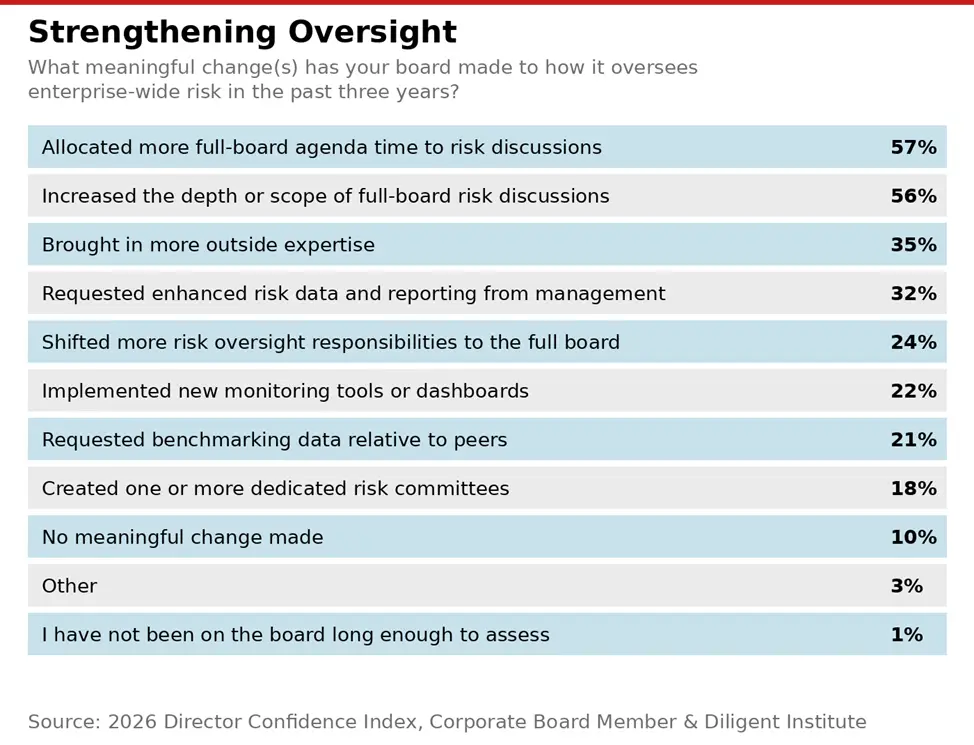
Meanwhile, 84% of the more than 200 public company board members surveyed as part of the 2026 Board Mindset program said their boards have changed their approach to scenario planning over the past five years, expanding the scope and breadth of scenarios, increasing the amount of time they spend on scenarios, and bringing more voices into the conversation.
Boards are now more likely than in previous years to stress test their strategies against economic shocks, regulatory changes, cyber events, supply chain disruptions, technology-related disruptions, and AI-related risks.
However, board structures have not fully caught up with this expanded risk lens. Less than half of directors say they regularly receive real-time or near-real-time business performance data between meetings. Only about 12 percent say their conferences are “mostly forward-looking,” with the majority still leaning toward balanced or retrospective reporting.
Our latest Director Confidence Index shows the same thing. In the first quarter of 2026, directors' ratings of current business conditions declined from 6.0 to 5.6 out of 10, and their 12-month outlook also fell from 6.0 to 5.5, indicating less optimism amid tariffs, trade policy uncertainty and geopolitical risks.
Still, 73% say they are very or very confident in their board's ability to oversee future risks and opportunities, with many companies corroborating some level of confidence by changing the way they monitor risks between meetings.
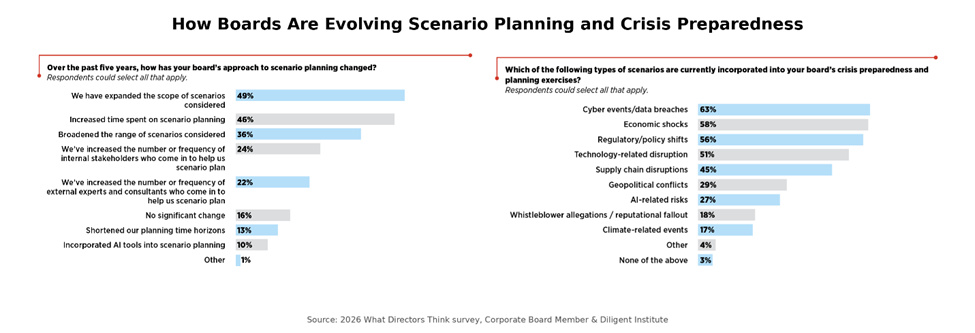
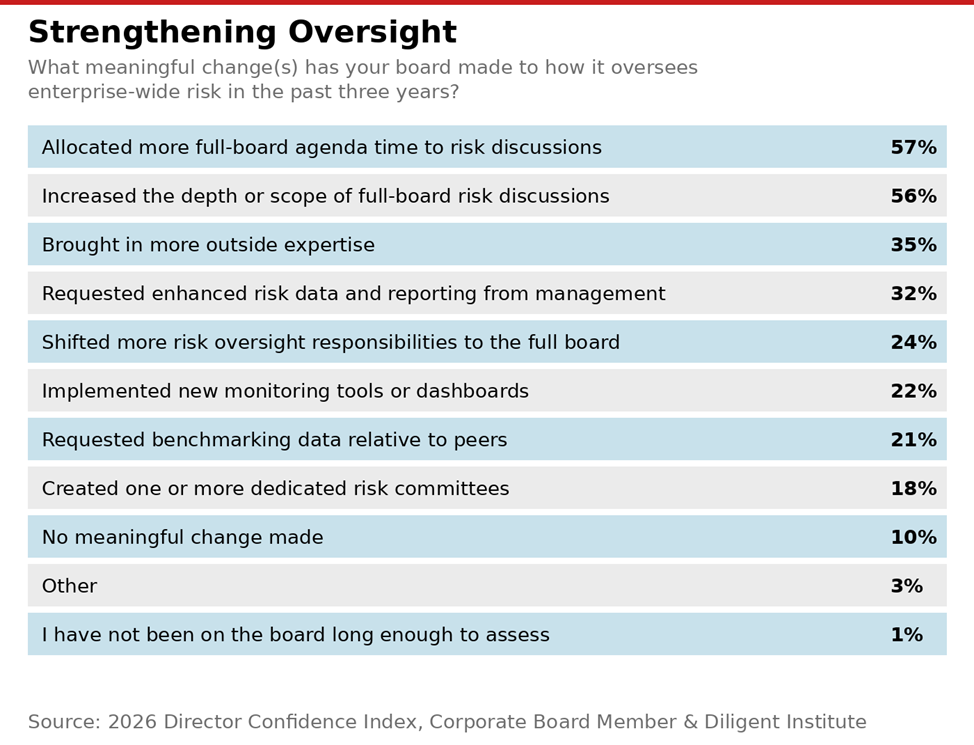
About half of the directors surveyed reported that they are allocating more board-wide agenda time to risk and increasing the depth of discussion, while about a quarter said their boards are implementing new monitoring tools or dashboards, including AI-enabled tools, and shifting responsibility for risk oversight to the entire board. Only 10% said their boards had not made meaningful changes to their risk oversight approach in recent years.
Taken together, these findings point to a clear evolution. Risk oversight is becoming an ongoing, company-wide discipline rather than a quarterly checklist item, but many boards are still modernizing the data and processes necessary to maintain that change.
Design a more forward-looking board agenda
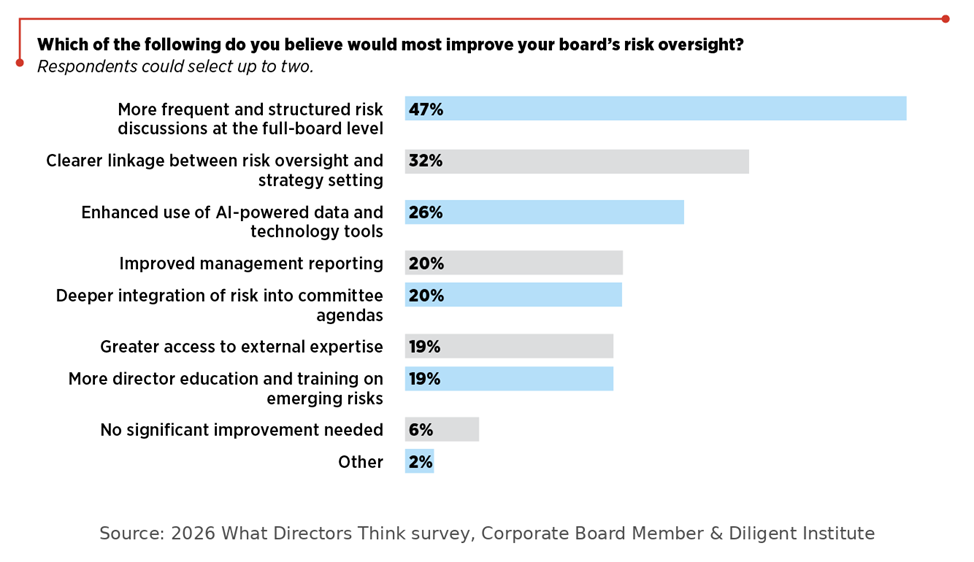
When asked to optimize broader governance processes, directors return to the same themes and spend more time looking ahead. 58% said they would increase time or add dedicated meetings for strategic planning, and 42% said they would cut back on presentations in favor of deeper discussions.
Nearly half want more interaction with external experts, and 40% specifically want access to AI-powered technology for board operations and oversight, indicating that directors are looking for a richer, more forward-looking stream of insights than just thick board books.
For many boards, that means rethinking the pace and structure of meetings. Here are some practical trends that emerge from the data:
- Rebalancing your agenda streamlines forward-looking financial and operational reporting, allowing you to spend more time on strategy, scenarios, and emerging risks.
- By incorporating scenario planning as an ongoing practice rather than an annual exercise, we focused on economic shocks, regulatory changes, technological disruptions, cyber events, and AI-related risks.
- Use dashboards to process routine reports, have live time to explore management assumptions, and test resiliency under multiple futures.
Turn AI and data into governance advantages
AI is at the heart of this transition. 'Deploying AI technology across the business' is one of organizations' top priorities for 2026, with technology adoption and integration a key focus for capital investment, cited by 42% of directors.
At the same time, half of directors expect AI and technology-related regulations to demand the most attention to compliance in 2026, and 41% say it is the most underrated compliance risk facing boards today.
Despite its focus, AI is still not fully integrated into risk surveillance. Only 3% of boards say AI is widely integrated into risk oversight and decision-making, and just 20% report regularly using AI alongside traditional approaches. A whopping 40% say they don't use AI at all in this context.
The implications for boards seeking to move towards continuous, forward-looking governance are clear. AI should be treated as a decision support layer for governance, not just a business unit experiment. In other words:
- Ask executives to integrate AI-powered risk and performance metrics into existing dashboards.
- Use these insights to support more frequent and shorter touchpoints between meetings when metrics spike or scenarios change.
- Ensure boards have appropriate policies and guardrails in place regarding the use of AI, especially as directors begin to use AI tools directly for board work.
Structure and culture for always-on governance
Finally, a more sustainable and forward-looking governance model depends on who is in the room and how they work together.
While 'AI expertise' has emerged as the top quality boards are looking for in their next director appointment, cited by 28% of respondents, only 8% say their board currently has strong AI expertise, the lowest level of all areas surveyed.
Directors also prioritize industry-specific financial and business expertise, reflecting a desire to combine technology fluency with operational depth.
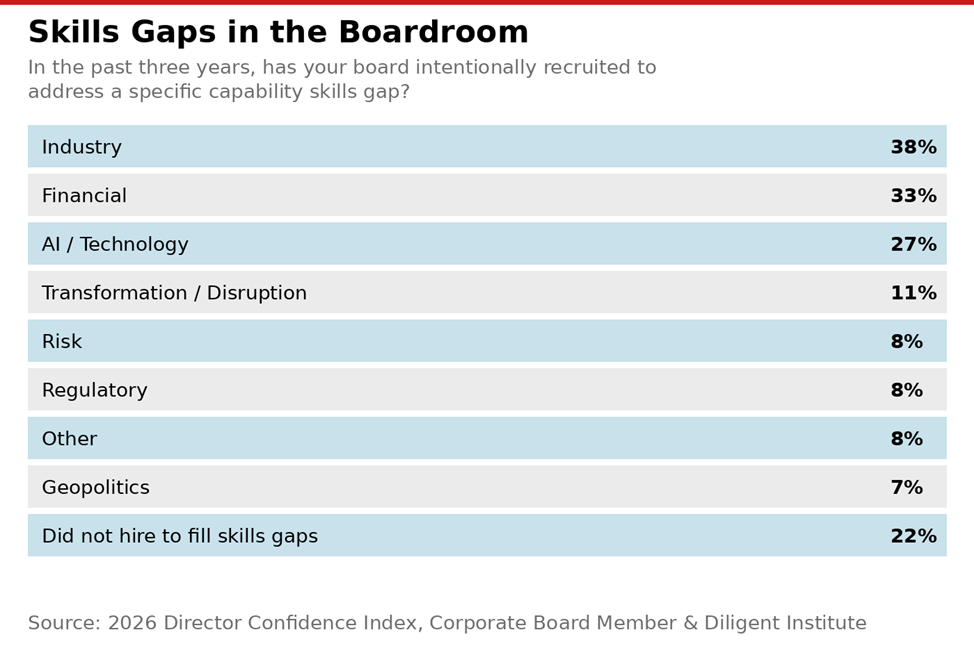
Our data shows that many boards are already addressing these priorities. Over the past three years, more than a quarter have added AI or technology capabilities specifically to address skills gaps.
Taken together, the findings are clear. Boards are already moving toward more continuous, forward-looking governance, but the next steps will require bolder changes to agendas, data, tools, and talent.
Boards that successfully make this transition will treat risk oversight as an ongoing discipline rather than a quarterly ritual. Leverage AI and real-time data as core inputs to deliberations. And ensure that the right expertise is there to challenge assumptions and connect the dots across more volatile situations.
