


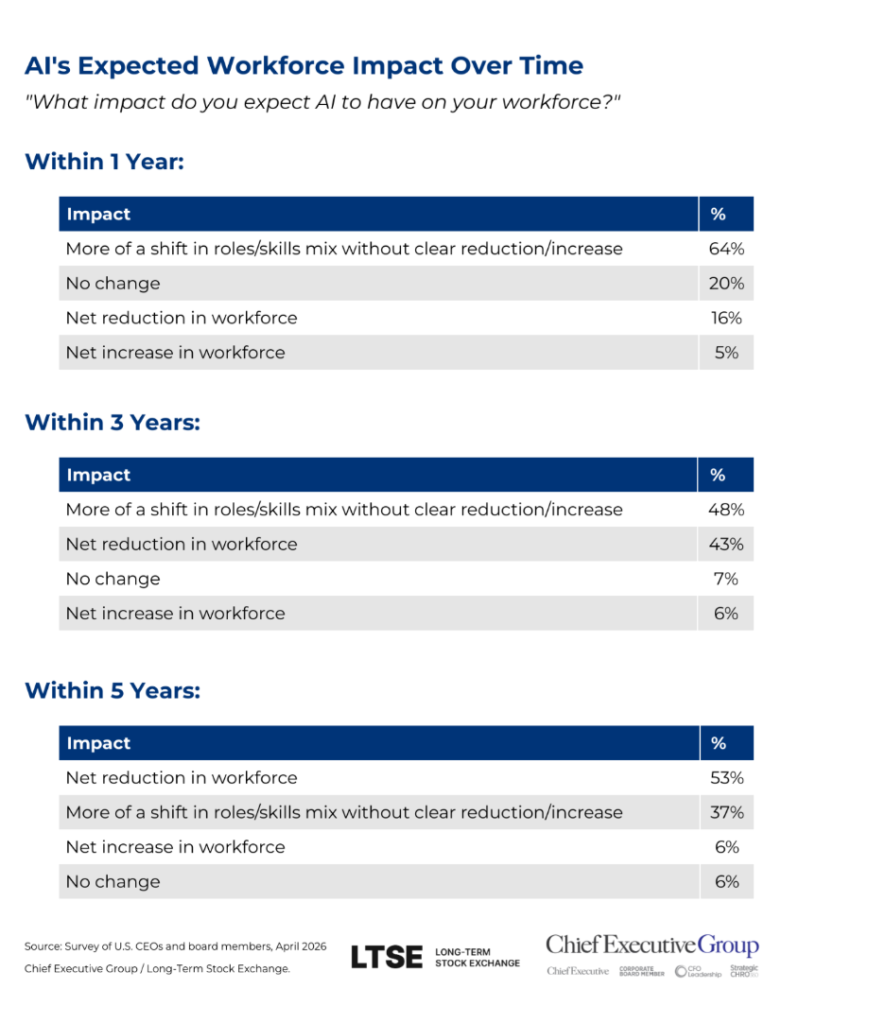
If you ask a CEO or board member how AI will change the workforce next year, the answer, at least on the surface, will likely be: Not much. Roles are evolving and skills are changing, but for most companies, the AI revolution will not change the existing workforce any more than expected in an uncertain economy.
That won't happen in three or five years.
A new survey of 109 CEOs and board members of U.S. companies conducted in early April by the Chief Executive Group and Long Term Stock Exchange (LTSE) found that 43% of those surveyed expect a net reduction in workforce size due to the use of AI within three years. After five years, this number rises to 53%. Only 16% expect a net reduction in the number of employees over the next 12 months, while 64% expect AI to change roles and skills over that period.
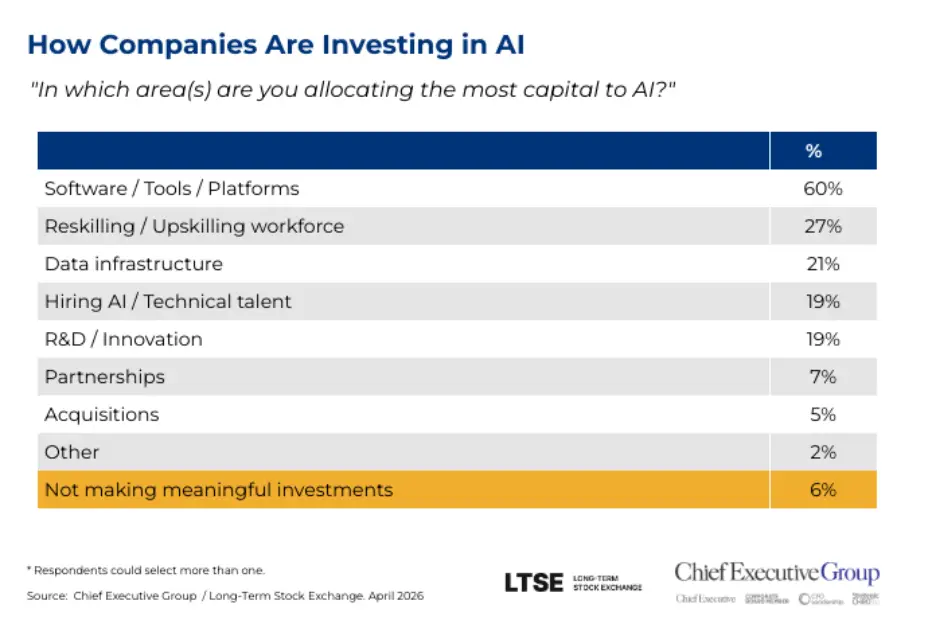
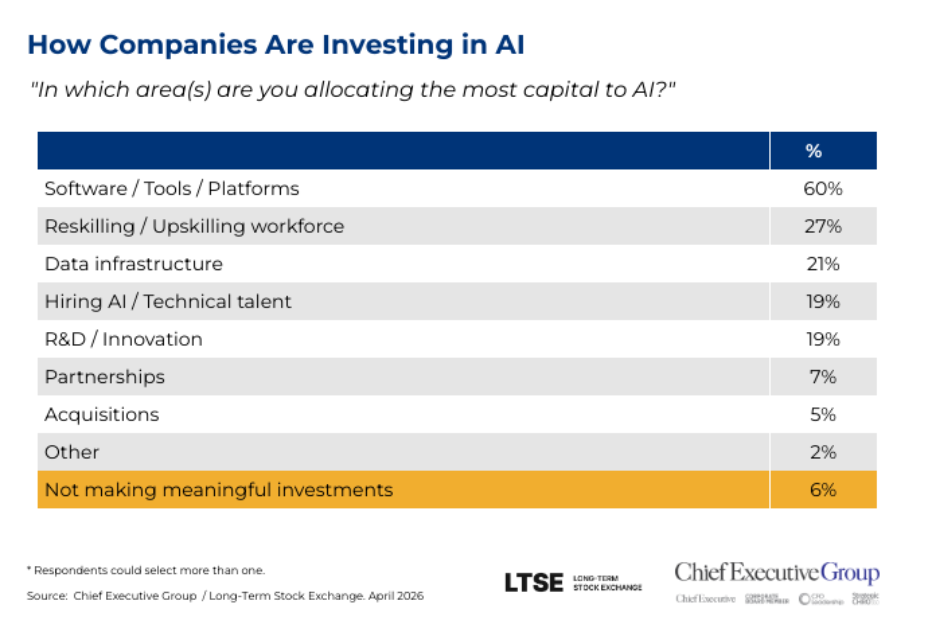
This outlook becomes clearer as spending begins to increase. Approximately 60 percent of survey respondents have so far described a gradual or gradual shift toward AI-related investments, and while only 3 percent say AI is a top capital allocation priority, their spending is primarily focused in one area (60 percent): software, tools, and platforms.
Retraining and upskilling existing employees lags far behind at 27%, indicating that workforce development is a secondary focus so far. Investment in R&D and new AI or technical talent is 19% each.
There are differences depending on the type of company. Respondents from private companies were more than twice as likely as their public company peers to report actively investing in AI talent (33% vs. 15%) and more than three times as likely to say AI is core to their competitive strategy (28% vs. 9%), demonstrating disparities in how organizations prioritize AI in both their talent and strategy.
Mariz Beams, Chief Executive Officer of Long Term Stock Exchange and Chair of the Long Term Stock Exchange Group Board of Directors, sees a familiar pattern here. “More established organizations tend to underinvest in workforce adaptation relative to technology, and will be at risk as AI adoption accelerates,” he says, noting that companies that combine strong governance with long-term strategy are likely to be better positioned to drive sustainable value creation through periods of rapid change.
Trust in AI governance is limited
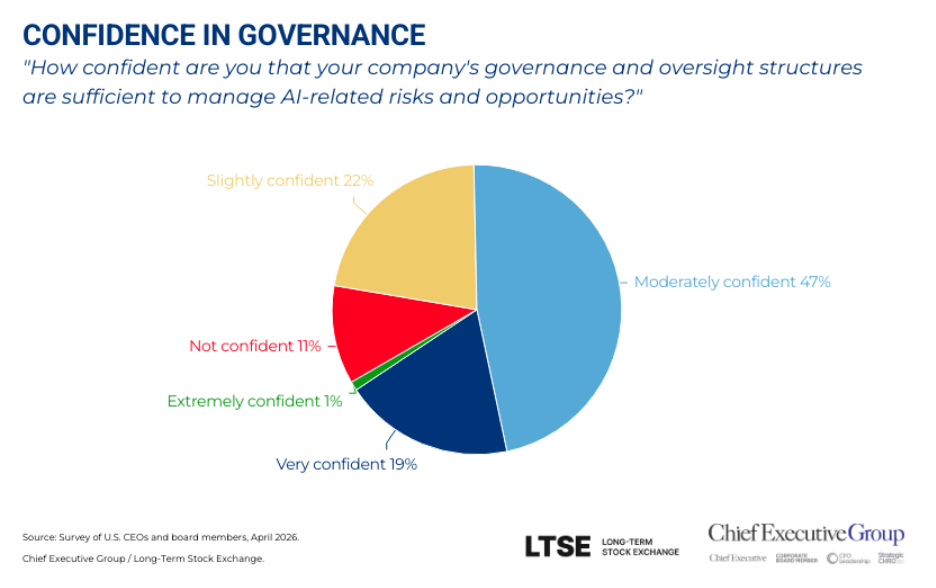
Despite the rise in AI activity, few respondents express high confidence in technology governance and oversight frameworks.
About one in five say they are “very” or “extremely” confident in their organization’s ability to manage AI-related risks and opportunities. Almost half said they were “moderately” confident, but 33% said they were only “somewhat confident” or “not confident.”
Board involvement in AI strategy and risk remains uneven. Seventeen percent of respondents said their boards consider AI-related issues on an ongoing basis, and 52 percent said they consider them quarterly. 13% reported no formal reviews.
As you might expect, the frequency of reviews varies depending on company size. One-third of companies with less than $100 million in revenue report not conducting a formal review of their AI strategy and risks, compared to 6 percent of companies with $1 billion or more in revenue.
Respondents also pointed to a variety of barriers to AI readiness. Directors often cite strategic clarity as a top concern, while CEOs often cite execution-related challenges such as cultural resistance and speed of decision-making.
long term perspective
The planning horizon is one of the clearest boundaries in your data. Among respondents from companies with long-term strategies spanning six years or more, 89% said the following about investing in AI: additive 62% of companies with a planning horizon of five years or less are prioritizing existing priorities rather than sacrificing other long-term strategic priorities.
The same group is also less likely to expect workforce reductions over five years (33 percent vs. 55 percent).
Companies with longer planning horizons also report the following common characteristics:
- Integrating AI into corporate strategy
- Invest in both technology and talent development
- Maintain regular board-level reviews of AI risks and opportunities
“Companies that approach AI with a long-term perspective tend to simultaneously integrate AI into strategy, governance, and workforce planning,” said Michelle Green, director, president emeritus, and former interim CEO of Long Term Stock Exchange. “These collaborations will enable us to more effectively manage risk and capture value in the long term.”
