



Audit committee responsibilities have become significantly more complex as companies face increasingly sophisticated risks, particularly those stemming from technology-driven and cybersecurity needs. To remain effective and efficient in this evolving environment, audit committees must continually adapt. Audit committee meetings are no exception. Audit committee meetings now address more important issues than ever before, despite a compressed schedule.
of 2025 Audit Committee Practice Report (ACPR), a joint publication of the Center for Audit Quality (CAQ) and Deloitte's Center for Board Effectiveness, asked audit committee directors about their current committee priorities, challenges, and opportunities. To dig deeper into respondents' strategies for increasing meeting effectiveness, CAQ and Deloitte partnered with Dr. Andrew J. Ferro of Susquehanna University and Dr. Stephen A. Solieri of Queen's College to conduct follow-up interviews with 27 audit committee directors. Their insights are Supplementary report, Voice from the Audit Committee.
Together, the two reports outline opportunities for audit committees to improve the quality of their meetings, deepen member engagement, and strengthen governance practices.
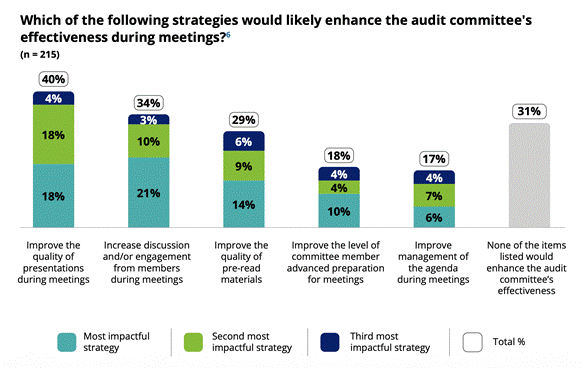
Chart source: 2025 Audit Committee Practice Report (CAQ and Deloitte Center for Board Effectiveness)
Here are four strategies identified from our interviews that distinguish high-functioning committees from others.
1. Improve the quality of your presentation
Improving the quality of presentations was identified by the ACPR as the top strategy for increasing effectiveness (40%), with 22 out of 27 directors interviewed saying that presentations often take up a lot of time and leave little space for discussion and questions. Solution: Skip reading each slide, assuming the member has read it beforehand.
The most effective presentations reveal important insights and alert you to situations at stake. The 1/3 rule is a useful tool. Allocate one-third of the meeting time to prepared remarks and two-thirds to discussion. Chairs can support this effort by enforcing time limits and redirecting presenters who get stuck in recitation mode. “Focus on what’s important, not on the mundane and mechanical…Tell me what’s new and important.”
2. Increase member engagement
Improving engagement was the second most cited strategy for improving the effectiveness of audit committee meetings, with 34 percent of ACPR survey respondents responding. In follow-up interviews conducted for the supplementary report, 25 of 27 board members said their fellow committee members were highly engaged. However, more technical topics are less likely to result in discussion.
The chair's job is to increase engagement by briefing members on important issues in advance of the meeting, eliciting quiet voices during discussions, and maintaining a culture where disagreements between management and external auditors are resolved rather than swept under the rug. “We want our members to leave believing that they gained added value by attending the conference, and to be glad they came.”
3. Enrichment of already read materials
Approximately 29 percent of ACPR respondents indicated that the quality of prereading could be improved, and the most common complaint in interviews was the large amount of material received. Adjustments include requiring executive summaries for all reports, moving details to appendices, and clearly highlighting changes from previous periods. The audit committee chair may also meet with the financial reporting team in advance to discuss materials.
By improving your pre-read material and ensuring predictable delivery times, meeting attendees will have enough time to review and understand what's on the agenda. “It's better to create an incomplete draft a week before the meeting than to create a complete document the day before.”
4. Manage meeting time
Effective committees treat meeting structure as discipline. One area that has not been adequately explored is attendance. According to ACPR, 82 percent of companies allow non-committee board members to attend, but the chair must decide in advance whether the guest will be an observer (49 percent of audit committees) or an active participant (46 percent of audit committees). Ambiguity in this approach can impact the length and effectiveness of meetings. “Sometimes we have to remind members that our job is to oversee the business, not manage it.”
As the oversight role of audit committees continues to expand, effective meetings ensure structured time to address a wide range of topics impacting audit quality and capital markets. Respondents pointed to leveraging internal audit, addressing cybersecurity oversight, and discussing emerging technologies such as AI as topics for future discussions. For more information, read the full audit committee practice report here.
