


This summer, the United States will celebrate its 250th anniversary. At the same time, this generation's most disruptive technology is rewriting the meaning of work. Boards are asking which jobs will survive. Employees are asking if their employees would do that. Politicians are asking who is to blame.
The right questions for CEOs are different. “What happens next?”
The honest answer is that we've already lived through this story not once, but six times. The American economy at its founding bore no resemblance to the economy we operate today. And what we pass on to our successors will look nothing like ours. Every transition comes at the cost of important jobs. Every transition has built more than what it destroyed. That's not lucky. It's a generational operating system of free enterprise built on the world's most adaptable workforce.
The 250th anniversary is a useful opportunity to remind ourselves, and our boards and teams, of what that operating system actually does. And how we can all thrive from it.
1776: Country of Peasants
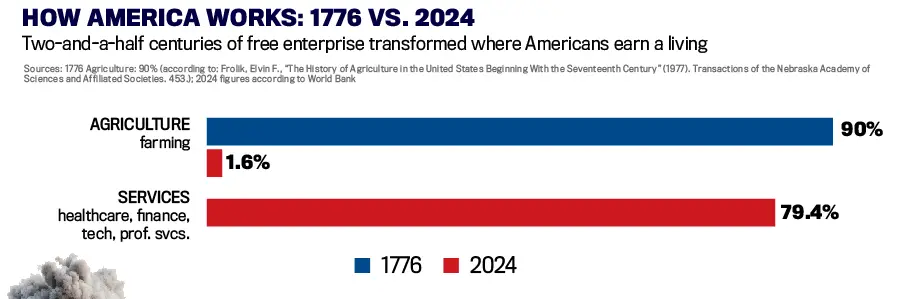
When the Founders signed the Declaration of Independence, approximately 9 out of 10 working Americans worked the land. The colonial economy was a patchwork of regional agriculture: tobacco and rice in the South, wheat and corn in the Middle Colonies, and fish and timber in New England, held together by a small merchant class and thousands of artisans. There was no treasury, no continental currency, no factories worth the name. The national balance sheet of July 4, 1776 listed millions of pounds of crops, several ships, and an idea.
Ideas, after all, were the key asset.
Compare that starting point to the employees you will be reporting to today. The U.S. Bureau of Labor Statistics counts approximately 170 million Americans employed. Less than 2 percent of them are engaged in agriculture. Approximately 19% build, manufacture, mine, or move physical things. The remaining 79 percent, nearly four out of five working Americans, produce services that did not have meaning as a category in 1776. health care. software. finance. education. logistics. Entertainment. Professional advice. The work that fills our calendars.
If you had told a Pennsylvania farmer in 1776 that his great-great-grandchildren would be making a living writing code, curing cancer, and managing pension funds for retired autoworkers, he would have asked what an automobile was. Categories didn't exist because productivity didn't exist to support them.
Then it happened. And the entire structure of American work bent around new possibilities.
Three eras, one pattern
The transition from the blue bars to the red bars in the “How America Works” chart above did not happen by chance, nor did it happen smoothly. It happened in waves, each driven by entrepreneurs who recognized and refused to accept the inefficiencies that people in other parts of the country had become accustomed to.
Carnegie and the Age of Steel
When Andrew Carnegie opened the first steel mill in 1875, the United States imported most of its rails from England. Within 25 years, American factories were the cheapest and most productive in the world, and steel became the foundation for building skyscrapers, railroads, bridges, and the entire industrial workforce. Carnegie didn't just sell steel. He created the conditions for the vertical rise of cities and the linking of continental economies. Agricultural workers displaced by mechanized agriculture, numbering in the millions, have found work in factories, rail yards, construction workers, and the supply chains that feed them. The country has not become poorer. I can no longer recognize it.
Ford's democratization of the middle class
Henry Ford didn't invent the car. He invented the proposition that working people should be able to afford it. A moving assembly line reduced the Model T's manufacturing time from 12 hours to 90 minutes and the price from more than $800 to less than $300. Ford then doubled its workers' wages to $5 a day so they could buy what they made. Critics called him reckless. He created the American middle class. The children of blacksmiths, saddlers, and harness makers who lost their jobs during the transition became mechanics, mechanics, dealers, road builders, and, a generation later, suburban homeowners. Entire industries that didn't exist in 1908, from auto insurance to motels to fast food, exist thanks to a single factory in Highland Park.
Jobs, gates, and the knowledge economy
By 1976, when Steve Jobs and Steve Wozniak were building the Apple I in their garage and Bill Gates was writing the operating system that would define the personal computer, the heavy industrial economy built by Carnegie and Ford was already draining jobs through automation and global competition. Factories were closing, communities were being hollowed out, and entire generations feared they would never reach the standard of living of their parents. What followed instead was the largest expansion of high-skilled, high-wage labor in human history. Software, biotechnology, financial services, telecommunications, and the professional services ecosystem that support them now employ more Americans at higher real wages than the manufacturing economy did at its peak.
Three names, three industries, three centuries, and one throughline. Each of these eras began with breakthroughs in productivity that destroyed established jobs, encountered honest predictions of mass unemployment, and ended with economies that were substantially larger and more diverse than the previous era. The cumulative effect is not subtle.
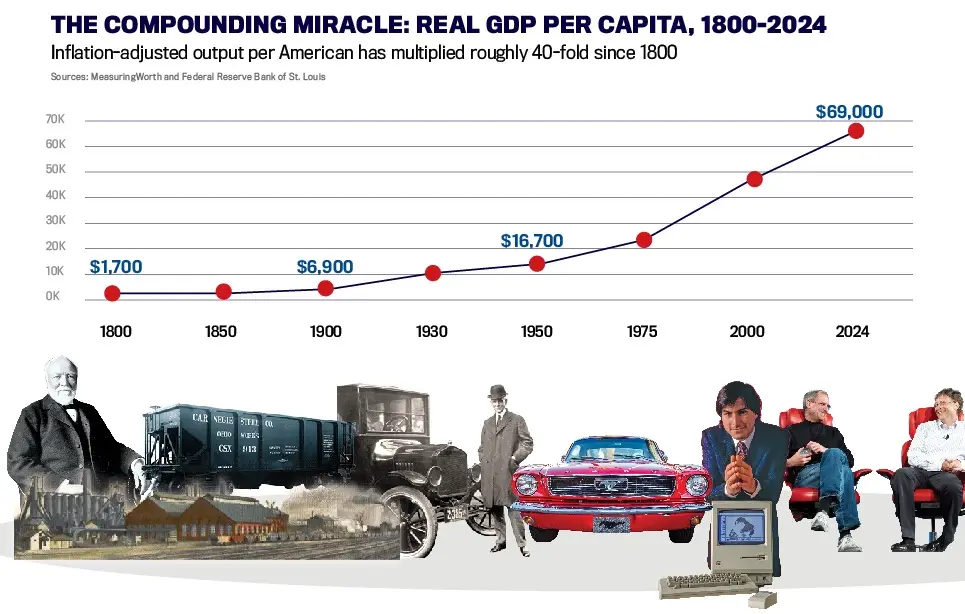
The composite miracle chart above represents the story in one line. Inflation-adjusted output per American was about $1,600 in 1800, rose to more than $8,000 around the beginning of the 20th century, $18,000 by mid-century, and is now nearly $70,000, about 40 times as much. Each doubling required a wave of destruction. Each wave required a generation of CEOs and entrepreneurs willing to bet on what was coming next.
Put AI moments into context
This brings us to the technology that is on every CEO's desk.
Artificial intelligence is honestly the most important general purpose technology since electricity. That would eliminate the category of work. That's already the case. The question is not whether AI will put us out of work. Just as cotton gins, steam engines, assembly lines, container ships, and personal computers will eliminate our jobs, so will we. The question is whether fear of that transition will rob us of much greater opportunities on the other side.
History is clear on this point. Every technology to date that has destroyed jobs has created more jobs than it destroyed, in categories that the despairers of the time could not have imagined, and at higher wages. The U.S. Bureau of Labor Statistics currently projects a net gain of 5.2 million new jobs in the United States over the next decade, with the fastest growth expected in health care, professional and technical services, and especially occupations directly enabled by AI itself. This prediction assumes that we get out of our own way.
Pessimism is always more reliable than optimism. It's always been that way. In 1900, there was great fear that immigrant workers would never assimilate. In 1950, it was believed that automation would lead to permanent unemployment. In 1980, the idea was that Japan would eat up American manufacturing. In 2000, the Internet was a bubble with no real economy behind it. All of those fears were rational. Even if they were right about the confusion, they were all wrong about the destination. The American economy has lost a certain number of jobs nearly every decade since its inception. The ability to create them has not been lost.
What is required of a CEO
The 250th anniversary is not just a moment to celebrate. It's time to take stock of what we owe to the systems that created us. Three promises are worth saying out loud.
First, we don't build around technology, we build with it. Companies that treat AI as a cost-cutting tool will improve efficiency once and then be flattened by competitors who use the same tools to build something new. The winner was not the 19th century textile mill that bought the most efficient loom. The winners were those who asked what an industrial economy could create that didn't exist before. Let's apply that question to this quarter's business, not next year's.
Second, invest in the workforce you have now, not just the workforce you will hire. American workers have adapted to every previous wave of technology. This is not a coincidence due to national characteristics. It was the result of employers being willing to retrain, reskill, and trust people to grow into roles that didn't exist at the time of hire. AI gives every CEO the chance to become that employer at a scale and speed never before possible. Please take it.
Third, protect the conditions that made the miracle possible. Free markets, the rule of law, property rights, open capital, talented immigrants, and a culture that celebrates entrepreneurs rather than hates them – these are not the natural state of the world. They are inherited wealth, and inherited wealth can be squandered. CEOs are one of the few voices in American life that stands up for themselves. Take advantage of that position.
next 250
Pennsylvania farmers in 1776 could not imagine our world. We cannot imagine a world run by our great-grandchildren. All we can know, because 250 years of evidence says so, is that if we continue to trust the system that provided us with the first 250, it will become richer, more productive, more dynamic, and filled with work we have yet to imagine.
The American business miracle was never inevitable. It was built decision by decision by people who chose to bet on a future when it would have been easier to falter. That's the job description of an American CEO. It's always been that way. It's still there.
