


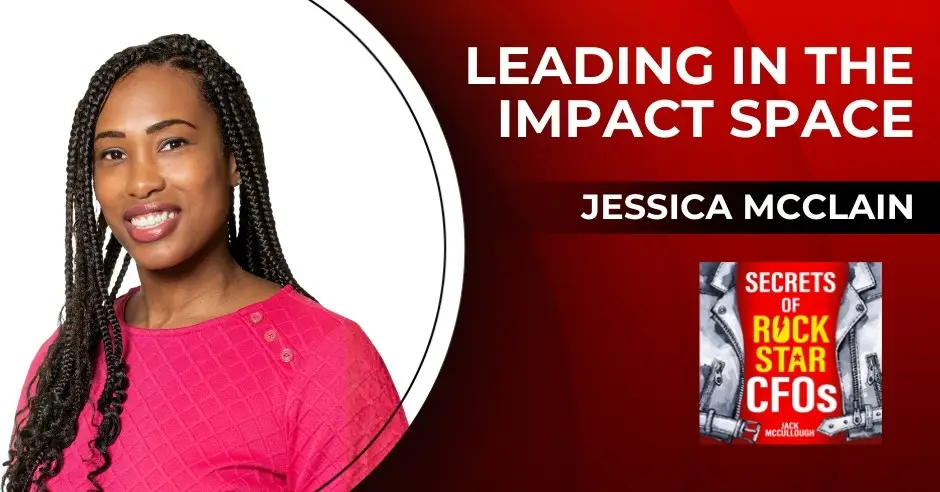
Jessica McClain, CFO of the American Staffing Association, had an inkling since childhood that she would work in accounting. But after over a decade as a Big Four public accountant, she knew it was time for a shift. “I knew I wanted to do work that was more than just worried about the bottom line,” says McClain. “I’m all about business. I’m all about making a profit. I understand that’s important, but I wanted to have another piece of that and have some purpose in the work that I was doing.”
From that moment on, she has worked in what she calls the “impact space,” leading mission-driven and impact-focused organizations like Girl Scouts Nation’s Capital and the American Staffing Association.
She joins host Jack McCullough to share insights into her career journey, how to build trust with every stakeholder and leading with confidence and clarity. Listen by clicking below. The Q&A, lightly trimmed and edited for clarity, follows.
—
Listen to the podcast here
I’m excited by this guest because she’s someone I’ve known for a while, and I know she’s a rock star CFO. I’m happy to welcome Jessica McClain, who’s the CFO of the American Staffing Association. The American Staffing Association is the voice of U.S. staffing, recruiting and workforce solutions industry. Jessica, welcome to the show.
Thank you, Jack. I’m excited to be here and pumped about the episode.
It should be a great one. I am Mr. Oversimplification. My description of your organization is probably a little short. Maybe you could round things out a little bit for our audience.
I like to say that our mission is to empower and to advocate for the staffing industry. It’s our why. Why do we do it? We want to fuel the growth of our members. We want to help them thrive. We’re doing that through advocacy, research and education, but above all, in an ethical and professional manner. Our job is to support the industry. We want our members to grow and succeed.
That’s fantastic. We’ll get into your career in a moment, but you’ve always worked for mission-focused organizations. It’s great that you found another one that you can bring that same passion and energy to. We’ll return to that. Before we get into it, I’d love to get a little bit about your background. Can you share where you grew up?
I was born and raised in the Washington, DC area. I love to take a step back when people sometimes ask me about where I grew up. I share this part because it plays a role in who I am. I love to say and share that I am two generations removed from women who picked cotton as children. My family is from the deep South. I share that story because my grandmothers didn’t have the opportunity to finish school and go to college. They were denied a lot of those opportunities. It drives me to succeed and take on every opportunity that I can because of the opportunities that they weren’t given.
My family has roots from the South, but I grew up in the Washington, DC area. I grew up in a military household. I’m an Air Force brat. I grew up in a household full of discipline, but also love. My parents pushed me and supported me, and I’m forever grateful for the childhood that I have. I’ve been in the Metro DC area for most of my life. It’s where my husband and I are raising our kids.
That’s an amazing story. Probably, your family two generations back, it wouldn’t have even been imaginable to them that their granddaughter would be CFO of a well-respected nonprofit organization in the DC area. You are a great American story.
Thank you.
Did you have many brothers and sisters growing up?
I have one younger sister, a few years apart. I’d love to share that. It’s interesting. We each have our own children. She has a son and a daughter, and so do I. It’s interesting to see how we’ve grown, especially now that we’ve become mothers and see siblings go back and forth, argue with each other, play with each other or not share, and say, “That used to be us many moons ago.” I am proud of where we both have come, honestly.
That’s great. I know when you went to undergrad, you studied business, and you got a master’s degree. What about that field was attractive to the 17-year-old Jessica?
I initially thought I was going to be an accountant as a kid. People said, “How did you know that?” I always love to share this story. I was somewhere elementary school age. I had a substitute teacher, and she had a wad of money in her pocket one day. I said, “What do you do to have so much money?” She says she was a tax accountant. I knew from there that that’s where I needed to be because that’s where the money was.
When I got to undergrad at Towson University, I changed my major from accounting to business. I did that at the time because I took a few accounting courses and said, “This is boring. I don’t like this. This is not it.” I ended up getting my bachelor’s degree in business. I’ll tell the story later of how I came full circle and still became an accountant and a CPA specifically, but I started down that path and thought, “I’m not sure about that.” I wanted something that seemed more exciting, but I still made my way back and am still in the profession to this day.
You mentioned being a CPA. You’re one of the more well-credentialed guests that I’ve had. I was looking at your LinkedIn profile. You list several things after the last name. I guess I was lazy because I stopped at CPA. You’re a CITP, CISA, PMP and CGFM. Clearly, you’ve got a very high level of professional intellectual curiosity.
I have a love of learning. I tell people I’m a nerd at heart, and I’m perfectly fine with that. That has helped me throughout my career, having that curiosity, wanting to learn and seeing things differently. It has been an eye-opener for me as well. I always say I’m done with my certifications, but I don’t know. I may have a few letters more after my name in a year or two. Who knows?
There you go. That’s exciting. I’m curious. When you were perhaps in high school, what was the first ever job that you had besides babysitting or a paper route?
I grew up in a military base for a part of my life. I had my first summer job probably in college. I worked in a communications office on the base. I was doing administrative work at the time. One of the things I learned was the type of boss not to be, how to speak to people and how to communicate with people. I enjoyed meeting the colleagues, but the supervisor wasn’t the nicest person. That was my first experience and understanding, “That’s how not to be when I become a boss one day.”
Sometimes, you learn a lot more from jerks than you do from nice people, through the negative lesson that they don’t know that they’re teaching you. That’s great. When you came out of college, did you start with KPMG?
Yes, I started with KPMG. When I left undergrad, I went to work for the federal government. I only did it for about six months. It wasn’t fast-paced enough for me. I didn’t want the day-to-day to be the same. There was a colleague there at the time that I worked with, and she was a CPA herself. She said, “You have a curious mindset in how you look at things. Have you thought about being a CPA, specifically auditing?”
I had not thought of that. I didn’t know that auditing was part of the accounting profession. I went back to school. During the few months I was with the federal government, I took the time to study for the GMAT. I got accepted into George Washington University’s accounting program. I got my master’s degree, and then went to KPMG full-time and started my career in public accounting.
We were very briefly coworkers. I was at KPMG in Boston, though, from 2010 to 2015. It’s quite unlikely we would have ever gone to the same circles, although we did go to that office twice. It’s certainly possible we passed each other in the hallway back in 2011.
It’s a small world. You never know.
KPMG was a wonderful experience. It prepares you to do a lot of different things. You came out of KPMG, and I believe you’ve always worked for nonprofit or mission-focused companies since leaving public accounting. Is that a fair characterization?
It is. You’re right. I spent time in public accounting. That was about the first 11 years of my career. I worked at Big Four. I worked at a small niche firm in the Washington, DC area. A couple of years ago is when I transitioned to what I would call the impact space. Some people say nonprofit, but the work we do is impact-focused and mission-driven.
I’m going to try to use your nomenclature going forward on that stuff. I met you at the Girl Scouts of Nation’s Capital. That’s about as mission-driven as any. I know from our conversations at the time how much you loved that organization and how you were able to put your heart and soul into it. Was that something intentional when you left public accounting that you said you wanted to work for these impact companies, or was it the first interesting place to work, and you decided to stick with it?
When I left public accounting, I knew I wanted to do work that was more than just worried about the bottom line. I’m all about business. I’m all about making a profit. I understand that’s important, but I wanted to have another piece of that and have some purpose in the work that I was doing. I worked at a different trade association as a controller before making the move to be the CFO for Girl Scouts. I’ve bounced around between your 501(C)6 world and the (C)3 world, but have stayed again in that purpose-driven work.
When you look back, including your time in public accounting, very few people get to the level that you’ve achieved without critical mentors along the way. When you look back, were there any people that you were like, “I learned a lot from them.” As odd as it sounds, that fellow in your first job was a little bit of a mentor in spite of himself. Are there any who were proactive mentors who mentored you, and you learned so much from them?
The one person that I have been fortunate to have known and still know and stands out for me is Kimberly Ellison-Taylor. She was the first person of color to serve as Chair of the AICPA. She has been a cheerleader, a supporter and a trailblazer. This woman has made history. One of the things I truly admire about her is how she leads with excellence and generosity. She has shown me what is possible in this profession. She has shown me what it means to pay it forward and support others.
I’ve learned over time that you’re not successful on your own. You have to have mentors. You’ve got to have coaches. You need your sponsors and supporters. Hard work could get you there, but you don’t move the needle unless you have people who are advocating for you and showing you what’s possible. That has been her. It has shaped who I am and how I make sure I make time to give back and support the next generation where I can.
That’s fantastic. That’s a question that I ask several times. You’re only the second person who has ever identified a mentor whom I previously had heard of. That must be a phenomenal mentor to have.
She is.
This is a very highly visible CFO role and a great leadership position. When you look back upon your career, what are some of the lessons that you’ve learned, not so much that they make you better at the technical aspect of your job, but make you a better leader and maybe even a role model to younger professionals?
I tell people, “If you’re going into the accounting profession, public accounting is a great place to start. You can even stay in your career there.” It built the technical foundation, discipline, curiosity and attention to detail. It has helped me learn how to ask the right questions, how to manage risk and do that while upholding integrity. It’s the high-level standard of ethics in doing that.
I can say that when I moved to the mission-driven space, the leadership strength is what has helped me in this seat. It’s not about just the numbers. I’ve had to learn how to influence and build trust with various types of stakeholders. Your staff, your board, leadership, donors, members and volunteers. You name it. We’ve had to work with them.
Another thing that has helped shape me, and this is a big piece of being part of a CEO, is translating that financial information to make it clear, understandable and digestible for those who don’t have that financial background. It sounds easy to us, but to others, it’s like, “What in the world did she say?” It has taken practice. It has taken intention to be able to do that. Those experiences between public accounting and the work that I do now have made me both strong from a financial steward standpoint, but also a strong partner, someone who is focused on people and long-term impact as well.
It’s interesting. I’m a CPA as well. I don’t have all of your credentials, but the things that you’re talking about are what some people call the soft skills. I suspect, for you, only because it was the case for me, that they were the hard ones. I was pretty good with numbers at a relatively young age. You were inspired by a tax accountant when you were a little girl, so you were probably pretty good at it, too. You made it so simple. It’s the soft skills that are difficult for finance and accounting people, but so critical.
It is, and it has taken time to do that. I like to tell people that when I present. They say, “You come off with a level of confidence and clarity,” and I say, “It has taken a lot of practice to do that.” I want to be a CPA who has personality. I want to be credible, but also relatable to humans. What I’ve done intentionally is take on speaking opportunities and be on shows such as this. This has helped me in becoming a differentiator for me as well.
That allows me to help translate the complex financial topics or areas of consideration, and to make it clear and understandable, but also engaging. People look at what we do, and it’s easy to fall asleep sometimes. We love it. We could talk about it all day, but it is about making it engaging as well. That way, you’re able to have an influence on decisions and not just be the person who reports and shows numbers.
I’m pretty sure I heard you wrong, but I thought I heard the word CPA with personality.
That’s me.
You certainly do have one. You know me a little bit. I have that clownish quality. There were people who simply didn’t believe I’m a CPA. We come in all types of personalities. I want to talk about American Staffing a little bit. First of all, you were as passionate as anyone I know about the Girl Scouts job. This might have been an intriguing opportunity. I’m curious. What was it about the role that made you say, “This is a great career move for me?”
I love Girl Scouts. I’m still connected. My daughter is in Girl Scouts, so that connection will always be there. Once a Girl Scout, always a Girl Scout. That doesn’t change. I am mission-driven, impact-driven, but also very business-minded. This role brings that together. I feel like the work that we’re doing at the association supports an industry that’s having a positive economic impact. Being in this seat, I can convert mission and strategy, along with the financial piece of it, to help achieve sustainable results. That’s what drew me to the opportunity.
That makes sense. You’ve been in the role for 6 months or 8 months, something like that.
It’s a little longer some days, but it’s been about six months.
I know for the longer-term plans, you have some ideas for some digital transformation. What is your IT environment like? If I understand correctly, you’re about to become much more involved in that in the near term.
Within the organization, we’re always working to do what’s best, as far as not the latest and greatest, but what makes us efficient and effective. We are ensuring that we have strong controls in place and are always moving forward. IT is going to be shifting under me, which isn’t unusual. As CFOs, we take on a lot more than we have in the past. It’s going to give me a bigger view of what’s going on within the organization from an IT and a data standpoint. I’m excited to see where that goes and how much more I get to learn about the organization and what it means to support our members.
I’m required as a host to ask this question. I’d like to chat a little about what the organization’s AI strategy is. I understand it hasn’t been fully fleshed out, but I’d love to see what the roadmap might be like.
I will start by saying that we’re at the early stages in what we’re doing, but we have a directive from our CEO that we should be using it. He’s not afraid of it. It’s one of those that we can use as a competitive advantage in helping with the decision-making that we’re doing and the support that we’re doing as well. We’re looking at foundational training for everyone. We’re putting together an AI policy that’s about done to make sure we have those guardrails in place.
I always like to say that we want to use it ethically and responsibly. That is a top priority of our CEO. When we use it, we’re using it in that manner. We are in the early stages, but I’m excited that we have a CEO who embraces it and wants us to use it. It’s going to make the investment in our team members to make sure we’re on the same page moving forward within the organization.
That’s a great philosophy. I’ve noticed that CFOs are a little bit lagging in embracing AI, but there’s a good reason for that. It’s the highly confidential nature of the data you’re holding. Imagine a marketing person gets hacked. There are companies that fake it. They want to get news out early. They’ll let someone steal it so that it gets out earlier than they want. There are some companies that have done that. It’s an interesting thing. The whole data privacy and security thing is job one when it comes to technology for you, I would imagine.
I approach AI, and I use it. I am scratching the surface, but I use it with discretion. That’s a big piece of it. I start with the ethical and responsible use. That means I’m very thoughtful in what I put in. I want to protect sensitive and confidential information. That is a priority. I’m very clear on the other aspect of it that AI can maybe help with drafting and summarizing, but the human judgment that’s involved, like taking something and running with it. I’m making sure I’m looking at it and putting the eyes on it. I am being mindful of what I put in, but being even more mindful of what I’m looking at when it comes out.
That’s a great approach. That’s what people expect out of you as a CFO. CFOs who are cowboys generally don’t succeed all that well.
We don’t have that trust when we do that, and that’s important in what we do.
I want to chat about the organization generally. You’re new here, so you must have seen some wonderful opportunities. You also want to get involved in some challenges. I’m wondering what some of the big things on the horizon for ASA are.
Being in an association, it’s very interesting how we have to work with our members and understand what’s important to them. What it is that they want to see, what it is that keeps them engaged, and what it is that keeps them coming back is vital in what we do. When we think about the horizon, how do we continue to effectively not just recruit and retain the members, but keep them engaged?
We want them talking about what ASA does, whether it’s the research we’re providing or the education opportunities we’re providing as well. Let’s face it. Member expectations are changing. They are when it comes to working in the association space, so you have to continuously prove your value. You have to communicate that value to make sure it is clear what your members are getting.
I also think what’s important is the relevance, which is interesting. Some people may say, “I can get some of this by asking ChatGPT.” We’re working to show the relevance that we have as an association that you can look to us as a trusted connector, providing that community and being a source of insight for our industry. We have to stay close to our members, understand what they want and then adapt where we need to do that. We’re providing real value to them, and that strengthens our impact and financial stability as well.
That’s great. One thing I like is the fact that you’re a CPA, and yet you’ve done a lot more outside of that. I’m always curious about what organizations’ KPIs are and the way they measure success. Given that you’re in a nonprofit space, you probably measure a little bit differently than companies that I’ve worked in the past. What are some of the most meaningful KPIs in your world?
I look at it in two parts when I think about KPIs and measuring success. We have to look at the financial metrics. Beyond that, and this is some of the data that I look into with our chief membership officer, is member value signals. I talked about that with how it’s changing and how it’s shifting. We’re looking at member engagement. There are numbers behind that.
We’re looking at participation in programs, the events that we have, the conferences that we have, and various touchpoints. Engagement is a leading indicator of retention and long-term stability. We look at Net Promoter Scores overall with our members, whether it’s specifically at conferences, because we know that’s where the real value is. We want people to talk about what the association has done for them and their firm. Word of mouth is so important.
Another thing we look at, as well as outside of traditional KPIs or some other numbers, is what’s happening outside of the walls of our organization. We’re looking at the growth, health and stability of our member firms and the industry overall. If our members are growing, if they’re placing people in jobs, and if they’re expanding their impact. That is a very strong signal of the value that they’re delivering. It gets back to our why. Our purpose is to fuel the growth of our members and their firms.
It’s an interesting thing because in a for-profit space, it’s not all about the bottom line, but it’s largely about the bottom line. Everything you described is about the impact that you can make.
We got to that bottom line, too. I always tell people that the numbers are important. We have to make money and then have a profit, but this is another big piece of it as well.
One thing I like to explore because it’s the most common question that I get asked by members, other than about generative AI, which I’m not qualified to answer some of those questions, are about the relationship between the CEO and the CFO. One observation I’ve made is that CFOs have said for a long time, “It’s my most important professional relationship.” Undoubtedly, it has been.
CEOs haven’t necessarily reciprocated until recently. COVID might’ve been a tipping point when CFOs were putting large portions of the company on their back to survive. It’s like, “This isn’t just a numbers geek type of thing.” You’re in your first year. Your CEO is a very well-respected person within the industry. I’d like to know you know what it is you do to cement that strategic partnership with him.
The biggest piece I would say with the CEO and CFO relationship is trust. A part of that is making sure that we’re in sync. That alignment is so important, and that we are in sync and that we have one story. When there’s alignment in our narrative, our staff, our board, our members and various stakeholders, that part is so important.
We all know that the CFO role has evolved. We’re not just reporting numbers. We are business partners. We are expected to connect the dots, whether it’s across finance, operations, risks and the people. We’re putting all of that together because we have to understand the business in and out. It’s not the silo here of finance. It’s understanding what’s happening over here with membership, what’s happening with learning and development, and what’s happening with research. I have to understand how all of that works because all of it has, in some way, a financial impact. By doing that, that breadth of knowledge is what I can use to help support the CEO in the decisions that he’s making.
It’s such a critical thing. Yours is interesting because he hired you. There’s a lot of research that shows you’re better off that way because you were his decision. He is invested in your success. Where it gets tricky is when the CFO proceeds to CEO because all of a sudden, you’re being evaluated. You might’ve been doing the job well for five years, but that means nothing to the incoming person. He has made the investment in you, and both of you are going to find a way to make it work.
Our CEO took the round or took the head beginning of January 2026. Our other CEO had retired and had served the industry and the association with high regard. As the new CEO and fairly new CFO, we’re working to build that relationship together. It’s off to a very positive start. I appreciate his open-mindedness. He wants to hear people’s perspectives. He doesn’t come in, saying, “I have all the answers. I know everything.” He’s like, “I want to hear from all of you.” That’s from myself down to our staff. That open-mindedness, wanting to hear those perspectives and viewpoints to understand the blind spots that may be out there, is critically important. He has laid that as a foundation early on as the new CEO, and that’s going to help our success.
I want to chat with you about your life outside of being a CFO. One thing that caught my attention is that you’re a limited partner in an organization called How Women Invest. The name gives a decent description of what the organization’s vision might be, but maybe you can share a little about that and how you got involved with them.
I wanted to get into the venture capital world. I wanted to take my personal dollars and have an impact. That’s what How Women Invest does. We’re investing in early stages of women-owned companies. I’ve weathered from tech to healthcare to sports. I got started a few months ago and am still learning the ropes of dealing with pitches and the due diligence that goes behind funding these companies.
I love the mission and what they’re doing because so few VC dollars go to women-owned companies. It’s very little. Part of this group and part of this organization are passionate men and women who are investing their money, wanting to see women-owned companies grow. I’m excited to see where many of these companies land and what they do in the next five to 10 years. I am starting that journey, but excited.
That’s still true that the majority of money is still going to men.
Single-digit numbers still go to women and women-owned companies.
It made sense early in my career, but that was the 1980s. A lot of them were started by engineers. There were a lot more male engineers than female engineers. Many years later, that’s still the case.
We still have work to do.
As an unapologetic feminist, I’m counting on you to make the impact that I know you will make. Getting back outside of work, do you have any hobbies or passions that you pursue?
My hobbies are my kids’ hobbies. I’m at the stage where you pick them up and drop them off here, and you pick them up and drop them off there. They got this practice and that practice. With that, I try my best to take care of myself and find time to go to the nail salon or go have dinner with friends. I try my best to do that, but it’s hard at this stage. I know many parents can relate. I have two kids who have different activities. The shuffling and chauffeuring that has to go on week-to-week takes its toll, and that’s fine. It’s something I signed up for and enjoy. I enjoy seeing my kids grow in what they do.
How old are your kids?
I have a daughter who turned seven and a son who will be five.
As I mentioned before we jumped on air, I saw a video that you had made with your husband. It was you walking down, apparently, your driveway, holding hands with your children. It’s such a guy thing. Your husband is a very large man. I immediately thought I would not want to be the fellow dating your daughter in a few years. He is going to scare the heck out of everybody.
That’s his job. They should be afraid of me, too. Don’t get it wrong. Those are my babies.
That’s true. The Mama Grizzly in all moms. You’re nice in our world, but you could adopt a different world. I have sons, so that’s not a worry of mine, but I have several nieces. My brothers-in-law are too nice. It’s like, “Come on. Someone’s got to scare these young men.” That falls to me. I can be a little scarier on occasion. I say that without apology and take great pride in it. I always like to conclude, especially in this case since you have chosen the nonprofit or the impact career, with some advice that you can give to the next generation of CFOs. What are the things that they can expect if they do follow in your footsteps and go for the impact?
One of the biggest pieces of advice I give is to invest in networking. I know some people don’t like the word networking. It makes some people cringe. They may say, “Maybe you’re going to make connections and build relationships.” That’s another way to put it. It’s not just about meeting people. That’s not what it is. I cannot tell you that if you don’t have people who are speaking up for you in a room when you’re not there, you will not know the opportunities that exist.
It’s important that you take that time to build those relationships with people, showing up for them, adding value and staying connected. I’m glad I’ve done that over the years because it has opened doors for me that on my own I wouldn’t have thought of. I’ve done a good job when people say, “So-and-so brought you up in that discussion. It would be a great opportunity for you.” People are willing to do that because of the work that I’ve done and the impact that I’ve made. Invest in that network.
My colleague, Kristin Todd, whom you may know, always says, “Your network is your net worth.” I suspect she didn’t invent the phrase, but it’s a good one. I want to take a moment to thank you for your time. I know you’ve got a lot going on with family, a high-impact job and all of those things. I’d like to conclude by giving you the final word.
One of the mantras that I have to leave the audience with, which I live by and continue to live by, is that great things don’t come from comfort zones. Get out there. Stretch yourself. You’re stronger than you may think.
