


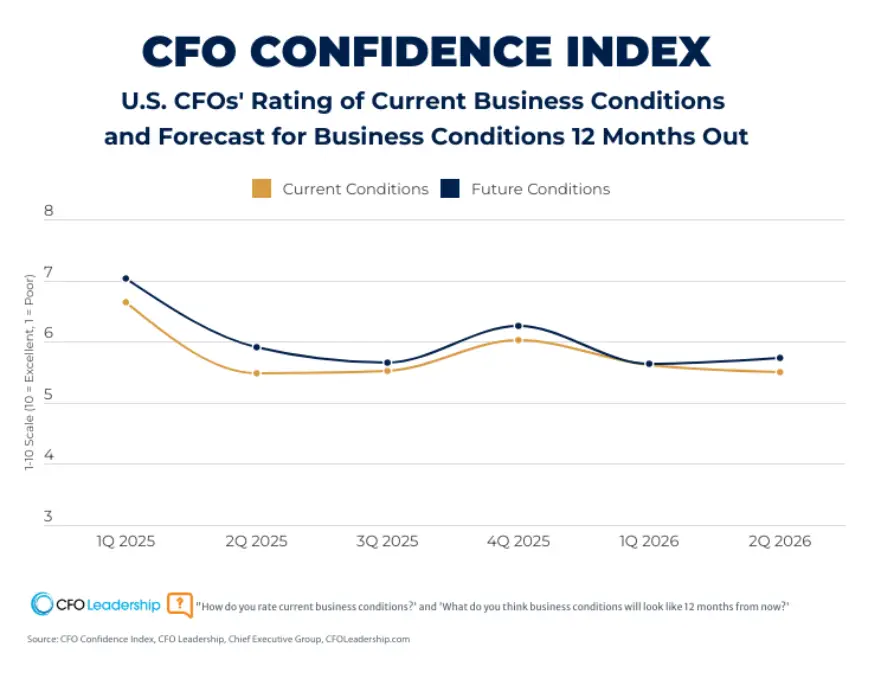
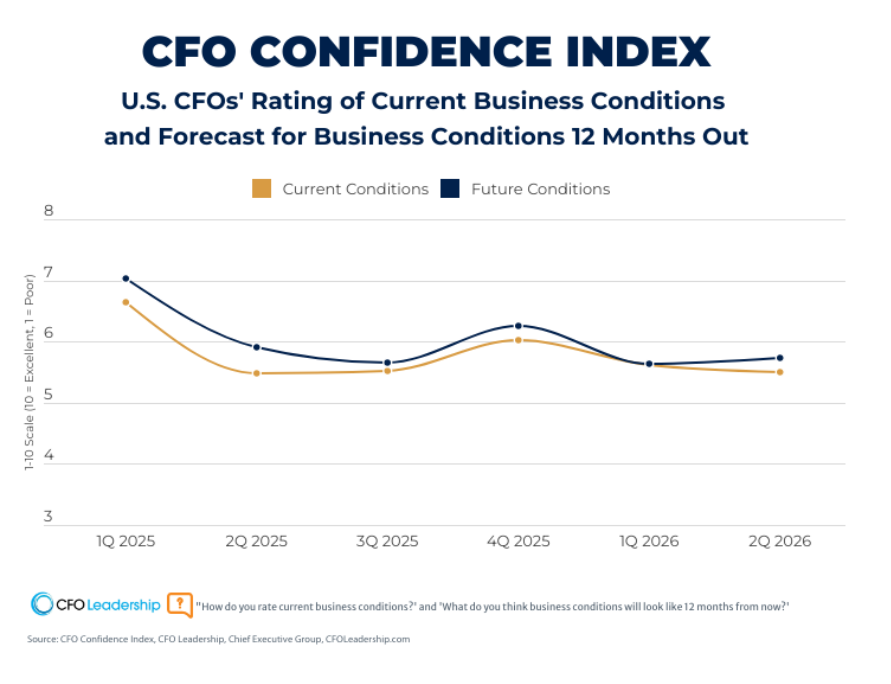
After a volatile start to the year with double-digit declines in CFO confidence in the first quarter, CFO confidence stabilized in the second quarter and is trending cautiously upward.
CFO Leadership's Q2 CFO Confidence Index is based on a survey of 126 finance executives conducted April 22-26 and shows that sentiment about current business conditions is roughly flat (-2%) sequentially, while expectations for the year are up by a similar amount (+2%).
CFOs rate the current business situation at 5.5 out of 10 (on a scale of 1 being 'poor' and 10 being 'excellent') and expect the situation to improve modestly to 5.7 over the next 12 months. While not a huge change from last quarter, the data suggests that cautious optimism is starting to rebuild.
Almost half (47%) of CFOs now expect business conditions to improve over the next 12 months, up from 37% in the first quarter and back to year-ago levels. Among these executives, the expected increase is significant: from their current average rating of 5.0 to 6.5 in one year, a 33% increase.
But that outlook is often tied to internal growth efforts rather than broader market improvements. Dan McAllister, Avantiico's chief financial officer, said the combination of rising costs and flat service fees is driving a push toward AI-enabled services. “We're realigning our team to create and deliver more AI-oriented professional services.”
Others point to similar efforts. Commenting on the firm's ability to grow revenue, Caitlin O'Brien, director of financial operations at Corderman & Company, said, “The next stage of value creation will depend on improving operational consistency, strengthening cost controls, and institutionalizing best practices across the organization.”
Meanwhile, some CFOs are hoping for relief from macro pressures. “When the war is over, [we have] New Fed chair hopes for 'peace dividend', inflation subsides [and] All of the lower interest rates are spurring consumer and business confidence,” says Michael Pechet, CFO of GB Manufacturing, a large industrial manufacturing company.
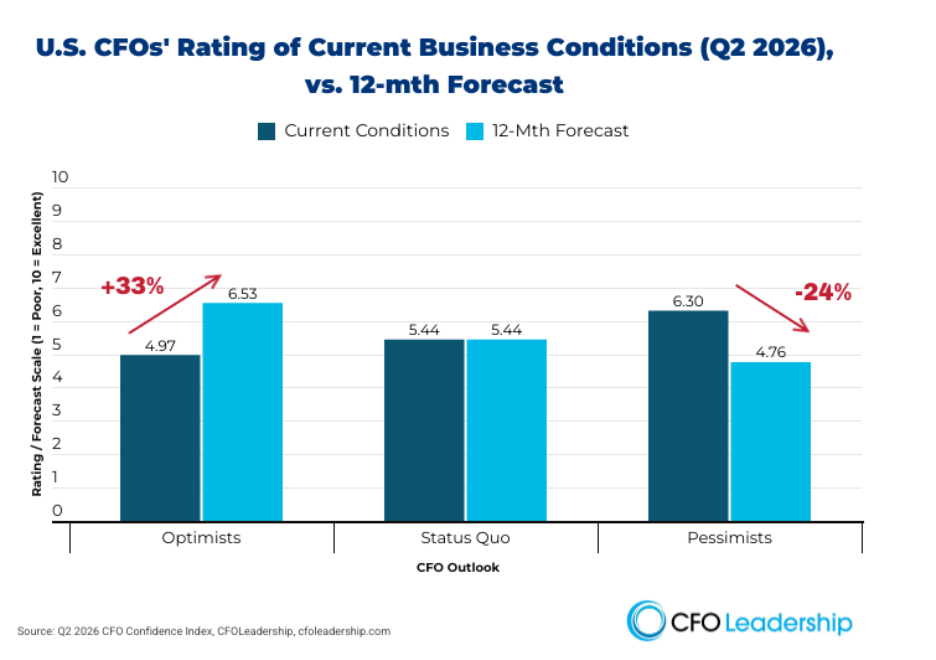
At the same time, fewer executives expect the situation to remain the same, dropping from 28% in the first quarter to 20% in the second quarter. While much of that change is in an optimistic direction, the share of CFOs predicting a worsening has remained relatively stable (33 percent vs. 35 percent in Q1). However, among these leaders, the expected decline is also significant, dropping by 24 percent from the current 6.3 to 4.8 over the next 12 months.
These CFOs were more likely to point to external pressures shaping their outlook. Mark J. Türkel, Kishbank's chief financial officer, cited “continued market volatility, rising energy costs, and slowing job growth” as well as persistent inflation. Others expressed similar concerns, such as, “The Iran war and economic disruption caused by AI will lead to a decrease in disposable income.''
Cooperation between CEO and CFO
CFO sentiment in Q2 closely mirrors CEO sentiment, although the tone is a little more muted.
chief executive's April CEO Confidence Index also showed stabilization in sentiment, with confidence in the current situation rising 2% to 5.5 and expectations for the year ahead improving as well. Like CFOs, CEOs appear to be finding balance after a rocky start to the year.
Both groups have become slightly more optimistic, due in part to changes from neutral expectations. Among CEOs, 52% expect the situation to improve, up from 48%, but fewer expect it to remain the same. CFO responses show a similar pattern.
At the same time, emotions remain divided. Even though more executives expect improvement, a consistent share predicts worsening, reflecting a more polarized outlook.
That tension is reflected in the issues raised by both groups. CEOs pointed to tariffs, war and energy, while CFOs highlighted volatility, rising costs and slowing job growth.
Company forecast
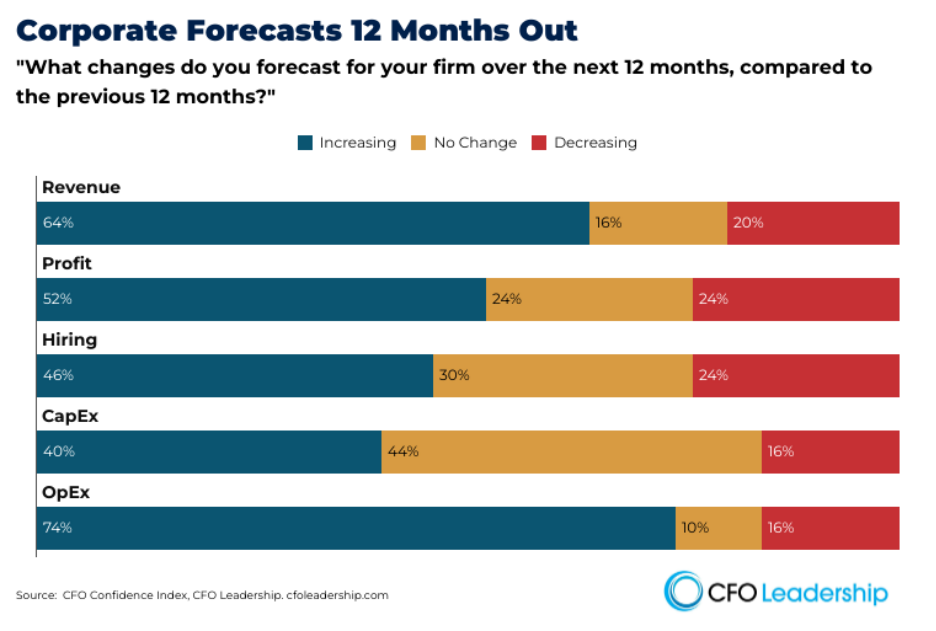
This polarization is reflected in CFOs' expectations of their respective organizations.
- 64% prediction revenue Growth this year (down from 73% in Q1)
- 52% expect profit Growth rate (down from 56%)
- 40% expected to increase Capital investment (up from 38%)
- 46% plan to add Number of people (up from 44 percent)
- 74% expect Operating expenses Increase (unchanged from 1st quarter)
About the CFO Confidence Index
Each quarter, CFO Leadership surveys hundreds of CFOs from organizations of all types and sizes across the United States to provide the CFO Confidence Index, a real-time, forward-looking tracker of CFO confidence in the current and future business environment, as well as forecasts of a company's revenue, earnings, capital expenditures, and cash/debt ratios for the year ahead. For more information, please visit CFOLeadership.com/cfo-confidence-index/.
