


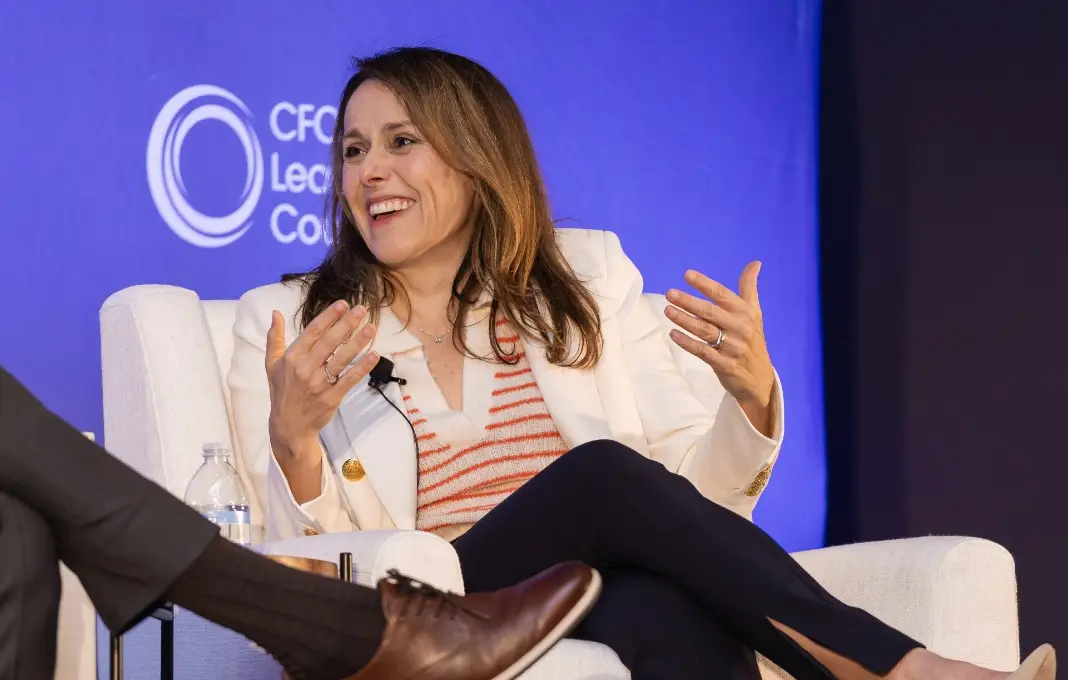
Karen Walker has grown finance organizations at some of the technology industry's fastest-growing companies, including Uber, Pandora, PagerDuty, and cloud security company Sysdig, where she currently serves as both the CFO and a member of the CEO's office.
This last role is a new problem. When Sysdig's co-founders needed an operator to go to market and run the company while focusing on product and engineering, Walker stepped in.
At the CFO Leadership Council's Spring 2026 Leadership Conference in Boston, she shared what she learned about scale, influence, cyber risk, and what it takes to grow beyond the finance chair.
Before investing in AI, understand what you're protecting. Because Sysdig's business is cloud security, Walker thinks about AI risk differently than most CFOs. The speed of AI-powered attacks—threats that unfold in minutes—means defenders need AI-powered tools to stay even.
However, internally, the company is equally focused on governance. Shadow AI is a serious problem. An employee swipes a credit card to get a tool, a lawyer loads a plugin on a laptop, and the data is sent somewhere no one can track it.
Her solution is a center-led approach. Rather than an employee one-off, be sure to have an enterprise-grade AI setup that provides zero-day retention protection and ensures that corporate data is not used to train models, while helping the CISO set guardrails. “As a CFO, I don’t think you can keep track of your spending by just having people swipe their credit cards. You’ll be surprised after the fact.”
Measure AI outcomes before scaling up AI spending. Walker is skeptical that companies will go “all in” on AI without defining what success looks like. Productivity gains are real, but they are often difficult to see at the company level. Also, no one is yet claiming dramatic improvements in financial profile or time to market.
Her approach is to sit down with heads of engineering, CMOs, and other business partners to agree on the outcomes they want to drive and build accountability for spending before it escalates. “I think it's absolutely important to take a programmatic approach and think seriously about risk assessment. If you don't, you're going to have big challenges.”
Influence is driven by curiosity, not just data. As CFOs take on broader operational roles, the ability to shape decisions, not just validate them, becomes essential. Walker's take: To gain that influence, you need to show a genuine interest in how other parts of the business work, rather than driving every conversation from a financial perspective.
She attends client meetings, engages with the field and uses it as a two-way interaction with bankers and investors. “I always like to say, and this is what I try to instill as a mantra in our finance team: If we wake up every day and think about what's best for our customers and act like that, then we're doing the right thing.”
Want to try a broader role? A leader with vulnerability. When Walker joined the CEO's office, she suddenly found herself leading departments she had never grown up with, including sales, marketing, and operations. Her advice for CFOs taking on more responsibility is to “be honest about what you know and don't know, ask the leaders around you what they really need, and find people you already trust to help fill in the gaps.”
“I think the advice I would give to someone who is stepping into such a broad role is to be very vulnerable and candid about what you know and what you don't know. People appreciate that honesty.”
You may need to leave to reserve your seat. Walker has a direct message for pre-CFO leaders who are waiting for an internal promotion. “Don't expect a promotion to come.” The CFO-CEO relationship is a close bond, and incumbents often simply expand their authority rather than pave the way for their successors. Be clear about yourself, ask for clear feedback on the path forward, and be willing to take the leap externally if you can't find an answer. “You may need to take action. Internal promotions are less common.”
The CFO and CEO partnership is the job. Walker came to Sysdig primarily because she looked at relationships with CEOs from the beginning, which she believes is the right filter. The best CEO-CFO pairs are built on complementary skills and a willingness to be candid, even when it makes you uncomfortable.
Her role is not to validate the CEO's ideas, but to be a partner who says what others won't. “Aside from the CEO, I think we have the broadest insight into running and operating the business of anyone on our executive team. So I think this position is a very strong place to start.”
