


For CEOs, the initial response to cash flow shocks is often easy. The more difficult question is how long the balance sheet can absorb it.
In a survey of 321 U.S. CEOs conducted in early July, respondents were asked how they would respond if they were randomly assigned an unexpected one-time change in cash flow (increase or decrease) equal to 5 percent, 10 percent, or 20 percent of annual revenue. This scenario did not reflect any real changes in performance. It was a test of instinct.
While this question may have been hypothetical, the importance of understanding this important and understudied leadership behavior is not. Of course, the impact on specific businesses is beneficial. But more importantly, when corporate leaders face a crisis en masse, as we saw during times like COVID-19 and the 2008-2009 financial crisis, there are potential repercussions for the entire economy.
Damjan Pufajfal, director of the Cleveland Fed's Center for Inflation Research, said cash-shortage scenarios help show what tools companies might use when cash becomes tight, such as drawing down reserves, cutting spending, delaying debt payments or turning to borrowing. “This data provides useful information about the magnitude of corrections and the financial sector's role in cushioning short-term shocks,” he said in a statement provided to Chief Executive Group Research last week ahead of the Fed's blackout period.
ownership issues
The biggest surprise is how central a company's ownership type plays in how CEOs react to ups and downs in cash. Things don't always go in the direction you expect.
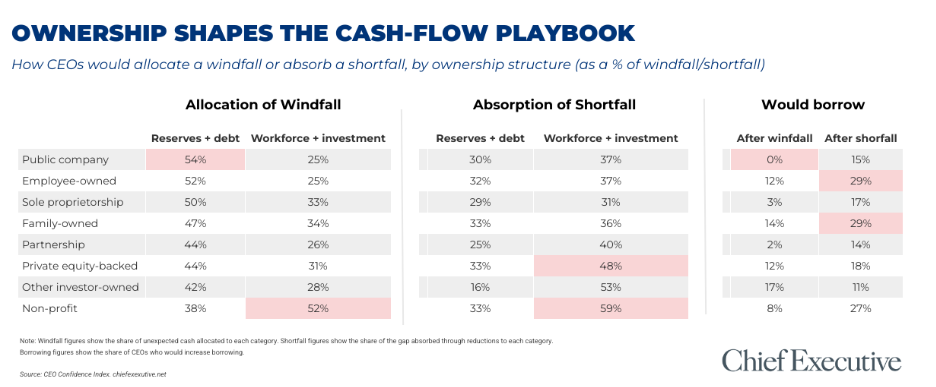
For example, nonprofits are the most growth-oriented companies in this study. These CEOs will spend 52% of their windfall on spending on employees and investing in the business, more than any other ownership type. It would also absorb 59 percent of the shortfall through cuts to the same two categories. This may reflect the absence of dividends to shareholders, with much of the adjustment going to operating rather than dividends or debt.
Public companies are on the other end of the spectrum. These CEOs end up putting 54% of their windfall into reserves and debt, the most of any ownership type. None of the CEOs of listed companies surveyed said they would borrow money if they received a windfall, and 15% said they would borrow money to make up for the shortfall, lower than the survey average.
While private equity-backed companies might be expected to be more aggressive with the windfall, CEOs surveyed said they would allocate 31 percent of their windfall proceeds to employee spending and business investments, similar to some other ownership types. The difference between the two is on the negative side. PE-backed companies reduce their distributions to owners by just 5% of their shortfall, the lowest of any ownership type, while family businesses, partnerships, and sole proprietorships reduce their distributions by far more, at an average of 22% for all three.
big picture
Overall, based on the two scenarios outlined for participants:
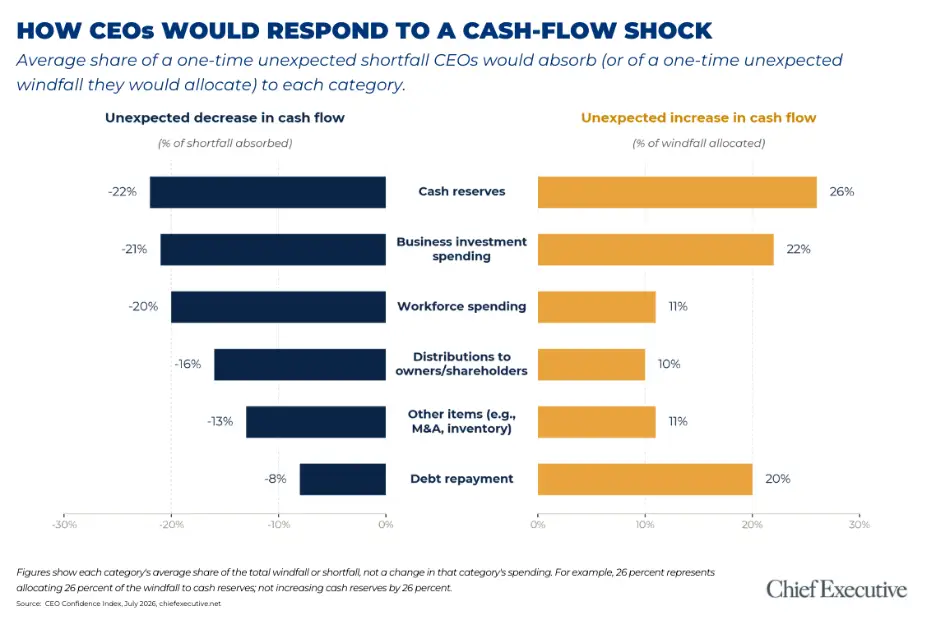
more cash givenCEOs say they will allocate almost half (46%) of that money to cash reserves and debt repayments, and about a third (32%) to business investments and headcount expenses.
When cash is lowyou don't protect something at the expense of everything else. The shortfall would be absorbed by roughly even cuts in cash reserves, business investments, and headcount spending, but debt service would be reduced by just 8%, making it the only lever CEOs seem most likely to follow in either direction.
Allocation pattern refers to balance. CEOs will spread the shock across multiple instruments rather than relying on a single response, especially when cash is scarce.
“In either scenario, my approach is to balance immediate financial discipline with long-term sustainability,” said Maurice Ware, president and CEO of the Kenneth Young Center, a behavioral health and senior services provider that participated in the study. “The goal will be to protect the mission, stabilize operations, invest where there is measurable return, and avoid decisions that solve short-term problems while creating larger structural problems later.”
Liquidity is the turning point
Sentiment plays a role in this allocation decision: CEOs who expect a recession or slowdown in the coming months say they will allocate 52% of their windfall profits to reserves and debt repayments, compared to 44% of CEOs who expect economic growth.
That defensive instinct becomes even more important when the cushion is thin. Roughly a quarter of CEOs surveyed have three months or less to run through their current cash and available credit facilities, making liquidity one of the clearest boundaries that determines how CEOs respond to a cash crunch.
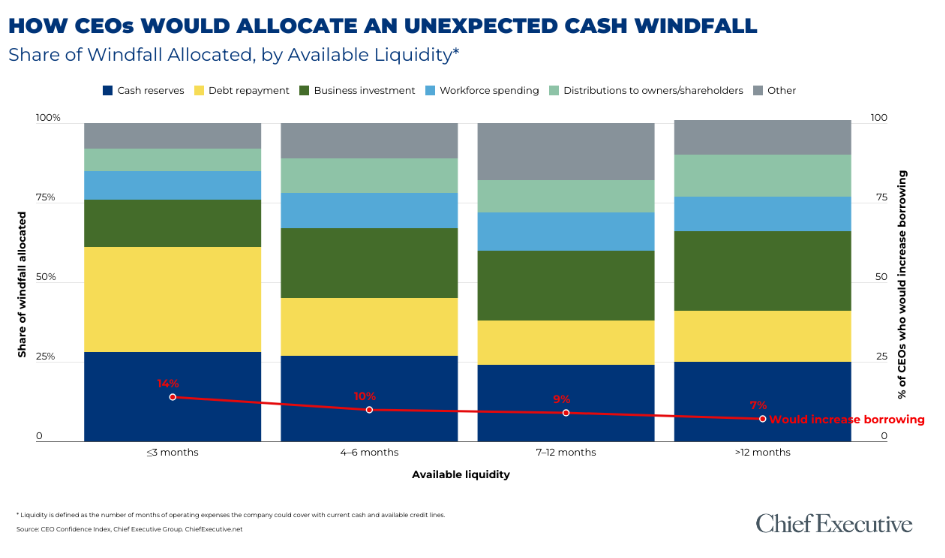
When faced with a cash windfall, CEOs with three months or less of operating cushion spend 61% of the windfall on reserves and debt repayments. Companies with more leeway, such as 4-6 months, 7-12 months, or over a year, will allocate closer to 38-45 percent for the same use.
Debt reduction accounts for much of the gap. Cash-strapped CEOs are likely to use 33% of their windfall income toward repayments, nearly twice as much as CEOs with seven months or more of liquidity.
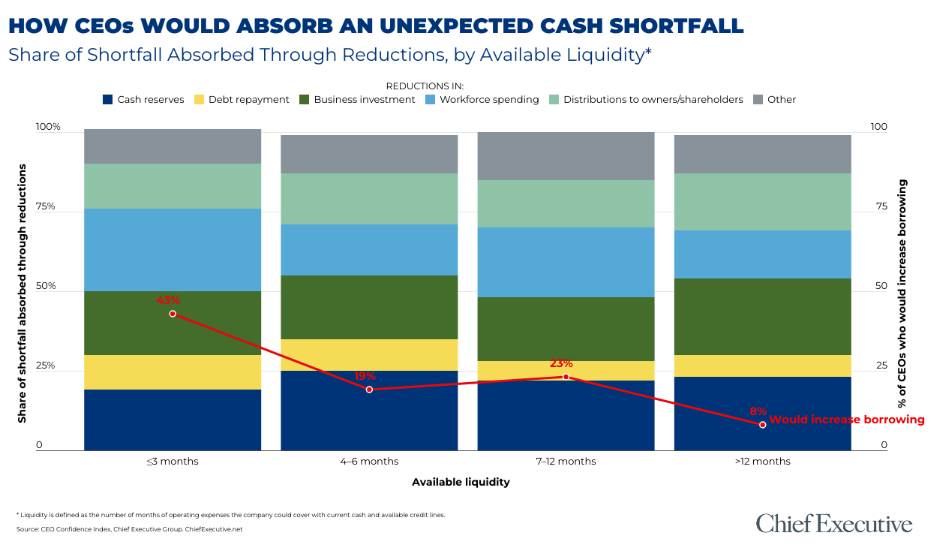
Companies with thinner cushions will instead face a shortfall, but companies with thinner cushions will absorb about a quarter of it through reduced labor spending, compared to 15% for companies with runways in use for more than a year. Additionally, 43% of cash-strapped CEOs say they would borrow to cover a shortfall, compared to just 8% of the most liquid companies.
One CEO directly linked liquidity discipline to operational flexibility: “We use cash flow windfalls to enhance our ability to grow, but not at the expense of liquidity.The biggest constraint for our business is not just demand; it's our ability to carry adequate inventory, protect product quality, support our dealers, and manage fluctuations in input costs without overextending.''
rent as a last resort
CEOs are more reluctant to take on additional debt when cash is growing than when they are short on cash. If it's only 10%, your borrowing will increase after the unexpected cash increase. Some may view the additional cash as support for larger investments or growth opportunities.
More than twice this proportion, 22%, would result in an increase in borrowing after a decrease, and this number increases with the magnitude of the shock. 17% are facing a 5% shortfall, 22% are facing a 10% shortfall and 28% are facing a 20% shortfall.
Still, those who say they will borrow money are still in the minority. More than 70% think they will absorb the blow through other means rather than adding to debt.
Company size helps shape the response. Companies with revenue between $250 million and $499.9 million are the least likely to borrow to cover shortfalls at 5%, but they are also the ones allocating the largest share of windfall profits to employee spending and business investments at 36%.
By contrast, CEOs of companies with sales of $1 billion or more are taking a more defensive stance, directing 48% of their windfall proceeds to reserves and debt repayments. 11% said they would borrow money to cover the shortfall.
“I like my company to have a lot of assets and a lot of cash,” said James Loftis Jr., CEO of Loftis/Robbins, an Alabama machine manufacturer. “I'm borrowing money based on two scenarios: Opportunity and debt recovery calculations.”
