


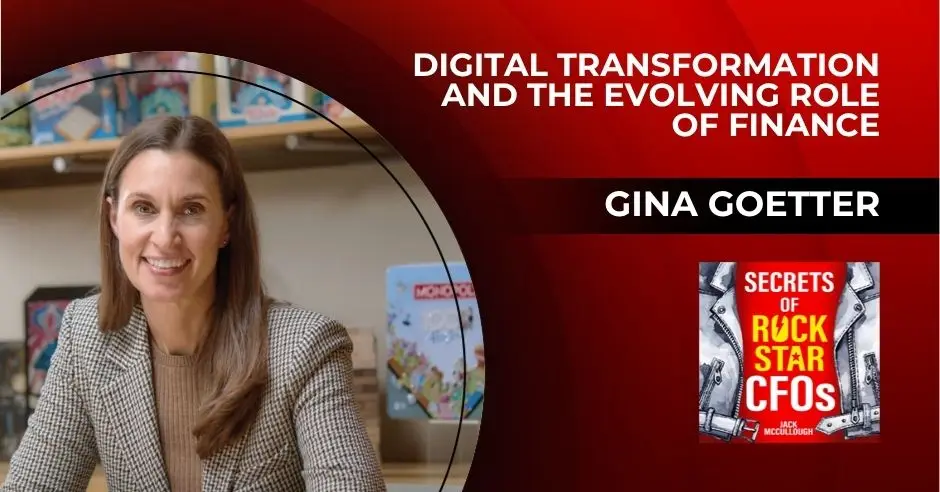
Forget the image of a simple toy company. Hasbro is undergoing a massive transformation, evolving from the home of Mr. Potato Head and Monopoly to a global digital IP powerhouse.
As part of a new strategy unveiled in early 2026, Gina Goetter, Hasbro‘s CFO and COO, is helping the world’s fifth-largest IP licensor fuel future growth in digital games while honoring beloved legacy brands. In conversation with host Jack McCullough, she shares exactly how she is steering this multi-billion-dollar ship: strategically allocating capital, creating a trusting partnership with the CEO and experimenting with AI in the game space. Listen by clicking below. The Q&A, lightly trimmed and edited for clarity, follows.
—
Listen to the podcast here
I’m really excited about the guest. I’ve been looking forward to talking to Gina for a while. Gina Goetter is the CFO and the COO of Hasbro. When I was a kid, Hasbro meant toys. Pretty simple. Mr. Potato Head, Nerf, Monopoly, Play-Doh, G.I. Joe. Things are a little different now with digital gaming technology becoming more important than traditional toys. Although, as a person my age would say, the traditional toys will always have a place in my house. I do want to introduce the guest. Gina, welcome to the Secrets of Rockstar CFOs.
Thank you, Jack. Thanks for having me. You’re right, everyone always goes Hasbro toy company, that’s what everyone always equates us to historically, but that is quickly changing here. Definitely more of a game digital IP powerhouse. That’s what we’re transforming into.
It’s an exciting transformation that I want to touch upon. One thing I do like to ask guests a little about the company, and I’m going to go on a limb, you’re somewhere near 100 percent name recognition with the readers.
We’re pretty high. It’s Hasbro, but then some of the IPs, yeah, our IPs themselves are very well-recognized.
Yeah, absolutely. I’m curious, is there something you can share with the readers about Hasbro that maybe they’d find a little bit surprising to learn?
I would say we are the fifth largest IP licensor in the world, behind Disney, Warner Bros., like some big powerhouses, we’re number five. Our brands and our IP, the reach that we have is quite broad. We actually just completed a reach survey and we thought we would reach about half a billion, like when we went into the study, we think probably half a billion people know of Hasbro, know of our brands, interact with us in some way, shape or form.
We way underestimated it, and that study came back and basically said one in eight consumers globally has had some interaction, purchase, experience, you name it, with Hasbro, which over a billion consumers we are in the homes of in some way, shape or form. We think that is a really cool stat and just speaks to the power of our business, and frankly, we think is a big piece of the fuel in our momentum right now.
I’m shocked that you’re fifth, and I feel like I had some appreciation for the IP just in preparing for this episode plus just living my general life, but fifth? That’s shocking.
One of the top five is like an apparel license, licensor. Not even in the toys and game space.
I think of Hasbro and I’m in New England, so I’m a little bit biased, but I put you in the category with name recognition with McDonald’s and Disney and other brands.
For sure. Everyone has their favorite game and their favorite character. That’s for sure.
They really do, so, and mine will forever be Mr. Potato Head.
You’re a classic.
I’m old school. I’ve noticed your title is CFO and COO, but I’m wondering, is the CFO job just not challenging enough for you, Gina?
It is plenty challenging. I see the two roles as not being two roles, actually. The two titles are not two roles. It is very much one and how we operate the business. This is the first job that I’ve had that has had both in the title, but it is not too dissimilar with how I’ve operated in many of my other more pure CFO-titled roles. I think there’s so many decisions that a CFO makes that directly link to the operation, and vice versa.
Every single operational decision has a linkage back into the financial statement. I actually find it it’s not like I come in on Mondays, Wednesdays, Fridays, I’m going to be the CFO, and Tuesdays, Thursdays, I’m going to be the COO. It’s very much blended in how we operate here, and I find it quite complementary, actually.
Yeah, that makes sense. If I were to look at just your educational background, then in the positions you’ve held by titles, classic finance, classic CFO. We knew each other just a little bit when you were at Harley-Davidson, and I knew back then that you took on responsibilities outside the scope of traditional CFO type stuff.
I would root it back to my beginnings at General Mills. I spent 20 years there and the role of finance within that organization is very much to be the COO, the right hand of the business and the business partner or the functional leader. We didn’t have COOs there, but that was the role that finance played. It was just a very natural when I have left General Mills and gone to other companies, I, frankly, didn’t know any other way to operate. There was never a world at General Mills where I had to just stay in a finance track. Finance track there was defined more like financial operations than a pure dollars and cents and just doing reporting and that type of thing.
It’s interesting how it’s changed. I haven’t been a CFO now for many years, but when I look at job descriptions for chief accounting officers or controllers, those are actually closer to the job that I held. You’re more the prototype for the modern financial executive, I think.
It’s interesting you said, when I came to Hasbro, you’re getting a lay of the land of the team and what function capability existed, and as I was interviewing, I kept asking, “Do we have FP&A?” Just thinking that’s the way we talked at my in my prior roles. “Yeah, we have FP&A everywhere,” and soon getting in and very quickly seeing, no, their definition of FP&A is accounting and controllership.
Probably the first thing I did in my first six months, I said, “Okay, there is a role and a need for really good accounting.” That doesn’t go away, but there was a whole discipline that didn’t exist at Hasbro which is now what I call financial operations. These are the people that are actually sitting with the businesses and the functions and helping them see around corners, helping them make strategic decisions, providing them with the insights that create the different scenario analysis or decision trees. That really didn’t exist here, it was very firmly rooted in accounting. Again, important, but I think the role of finance goes beyond the accounting realm.
I want to return to your career path, but I always like to get to know the guest a little bit. Can you share where’d you grew up?
I grew up in Milwaukee, Wisconsin, a small town outside of Milwaukee, Wisconsin. Right there is where I’m from. I’m the oldest of seven kids. There’s a lot of love, a lot of chaos now since all of us have families and lots of grandkids. Not my grandkids, my parents’ grandkids, but we grew up there. About half my family is still in the Milwaukee area. When I was working for Harley, there was a nice little fun connection there. That’s my background. My mom was a schoolteacher and my dad was a civil engineer.
I know you studied finance and economics at the University of Wisconsin. I guess your first foray into New England, perhaps, was getting your MBA at BC.
That’s right.
It’s interesting because I knew precisely zero CFOs who majored in economics, and I know you majored in economics. It seems now like understanding economics is an invaluable skill for a CFO. Is that fair to say?
I think it’s super fair to say. In fact, my oldest daughter is studying at Wesleyan in Connecticut, and I have told her, “You have to get a degree in economics or at least just minor in economics.” Obviously the theory of economics, but the strategic thinking and reasoning and judge, all of that becomes such a good foundation when you’re sitting in any job within finance, but particularly within a CFO seat. I just think it teaches you to think critically about problems.
Yeah, no, that makes a lot of sense. I like to ask this question because sometimes the answer is fascinating. What was your first job?
My first job, besides babysitting for all my siblings, so I’ll set that aside because my parents did not pay me, I did that out of love. My first job was an I had the job basically from eighth grade all the way through I graduated from college, I worked at a bakery, a grocery store, and in the grocery store, a bakery. It was part deli too, so I think I worked on both sides of it, but I really enjoyed working in the bakery.
It was the job that during the summers I would work there, lots of hours, but it was perfect because I’d come back from every school break and they would just plug me right into the schedule. Once I turned eighteen, I was completely off the payroll. Working for me and working a lot of hours young was important so that I had enough money to go to college and not exit with a ton of debt.
That’s a fantastic thing to be able to do. It’s interesting because early in your career, you were with some food-based types of companies, too.
I hadn’t made that connection beforehand, but yes, you’re right.
Yeah, it may just be coincidental. I did want to talk about your career journey, because you’ve certainly worked with some of the best-run and best brands in the game. You worked at General Mills, Tyson Foods, Harley-Davidson, which I still think is one of the coolest of American companies, and now Hasbro. Along the way, very few people get to your position without mentors who take an interest in your career journey. When you look back, are there any that stand out as like, “That person made a really big impact on my career?”
I have had the good fortune of I would say, good mentors. I spent 20 years at General Mills, and the program that they have for, frankly, all functions, finance included, it was a very rotational nature. I got the chance to work across many disciplines, across many different leaders within the company. The few that I would call out, one of the gentlemen there really taught me I worked for him in several different stints along the way at General Mills, and he really instilled in me this, “You need to be the advocate for your career, and you need to be thinking about moves beyond just the next thing. Think about what the next five, 10, 15 years need to look like.” as I got more senior in the organization, the conversation was, “At what position, what do you want to retire from?” chart your moves around that.
He really helped me critically think about declaring, “Yes, I want to be a CFO one day, and yes, here are the experiences that I that I need to get to be able to be qualified to be a CFO.” He really then became an advocate, a champion, a pusher of like, “Are you thinking about things the right way?” I credit him a lot for being in this seat, because it was his push of like, “Declare. Tell yourself that you’re going to be the CFO one day.”
I learned from him really how to advocate, but then how to leverage a mentor or a champion to help some of those aspirations come to fruition. I’ve had a good fortune of a gentleman that used to be my boss many years ago and is now probably one of my closest friends. He and I have seen every career pivot from leaving companies, joining companies, getting promoted, not getting promoted. We have seen each other through so many scenarios.
What I’ve learned from him started in a boss-subordinate relationship, and it quickly developed to one of mutual trust, respect. We know each other super well and can speak truth to each other. Sometimes the truths are hard, sometimes the truths are when you when you need a boost, he can give you a boost. I feel like having those people in your life that know you so well that can coach you through some of life’s tougher moments are invaluable.
The CFO that I had at General Mills, I often wonder if he knows how often I think, “What would Don do in this situation?” He definitely was somebody that I wanted to emulate and aspire to be. What I always admired about him was he never was flustered. He never raised his voice. I never really saw him get angry. Trust me, there were moments where he had plenty reason to be. What I learned from him is just the role that the CFO and the voice, and the posture that the CFO carries really can trickle down and impact the rest of the organization.
As he always projected that very calm confidence out, it really helped to set the tone for how we were approaching problems or thinking through some tougher situations. I learned from a lot of leaders at General Mills, but those were the three types of personalities that I would call out. I’m sitting at Hasbro surrounded by great people. I have a great board. We’ve brought on some new board members who worked in industries that I am not familiar or had not been familiar with. Digital gaming, video gaming is a new industry for me. I have found that these gentlemen have come in and really helped to educate, coach me, push me, “You’re not thinking about it the right way, here’s the risk that you’re not seeing.”
I have found that every time I meet with them, I feel like I’m getting developed. In any mentoring relationship, for me, it’s all about that push and pull. I want someone that is not going to tell me everything is great and rosy. I want honest truths, I want tough coaching, but I also want a safe space to know where I can bring a problem and somebody is not going to judge, they’re going to help you, they’re going to help you think through it. I have found with all these individuals, that has helped round me out. Hopefully, I’ve been able to pass that on to people that I’m mentoring as well. Definitely, I have tried to emulate their leadership and mentorship of me to others.
That sets me up for a question I was going to ask anyway. What is your philosophy about building a world-class finance team? The last three jobs have been in large companies, but very different industries. There’s got to be some core philosophies that you’ve taken to all three.
As I build my teams, and it’s funny, like even at Hasbro, I have people that are working for me that worked with me back at General Mills. Some of my philosophy is when you find good people and strong people, bring them with you. I have my controller. I hired him from Harley after the appropriate time, I didn’t violate any non-compete clauses. When I find good people and you have that chemistry and you know what their potential and their aspirations are, I like to pull them and bring them with me.
I also am very clear of who I am as a leader and where my strengths and opportunities are, and I hire around that. We talked about, I have come up through finance and economics. I am not accounting. I understand accounting. Obviously, I have a great appreciation for accountants, but I hire really good accounting people because I know that’s just a discipline that I will never be as conversant in as some of the others where I’ve just have worked and have all my career experience in. I try to be super mindful of me as a leader, my strengths and ops, the team that is already in place, their strengths and ops, and then I fill in to really create positions and roles and experiences that are bringing out the best of everyone in the team.
I think that’s a great philosophy. I think General Mills and Hasbro are going to get flooded with resumes from finance and accounting professionals.
I just got to get them out of Minnesota. If I could get people to leave Minnesota, it’s amazing how many people love living in that cold climate.
I found 22-year-olds leave Minnesota, but they come back when they’re 28 or 29. People are like, “Let’s get out of the cold,” then it’s like, “What a great place to start your family. No place better in the United States.” I wanted to chat a little about Hasbro and why you took the job. She’s obviously very passionate about Hasbro, and we can tell from what’s on her wall. What drew you to the opportunity, if I may ask?
I’ve always been drawn to big businesses, big brands. I love putting stuff out into the world that I am proud of, that my family is proud of and can recognize. As you heard me now say a couple times, I worked for General Mills for 20 years. I don’t think the entire time I worked there I ever bought a box of Kellogg’s cereal. In fact, how I told my girls that I was leaving General Mills is I put a box of Kellogg’s cereal in the cupboard. I was like, “I wonder if any of them will notice?” My oldest, she’s a smarty-pants, and she figured it out pretty darn quick, like, “Why is Apple Jacks in the in the cupboard?”
I love that connection to businesses, both as a consumer as well as somebody that’s working on these brands. That’s one thing, I’ve always gravitated there. The second piece is I always gravitate towards businesses that are either in need of transformation, change, redesigning of the business model, rethinking. I actually love the word transformation. I know that’s a big, scary word, but I love the idea of continually looking for what’s next and how to continually create value.
For Hasbro, it was the intersection of both of those things. Company, brands, we talked about the brand recognition. My games cupboard is all Hasbro. Even before I started working there, I should say, it was all Hasbro. It was a it was a business that was absolutely in the midst or early days of either a transformation or a turnaround. Choose your word. I think it was a little bit of both, frankly. That was what really piqued my interest when I got the call.
As I started learning more about where the business was, it was absolutely both of those words. We had our Wizards and our magic business in particular that was definitely in transformation mode. What do we want to be when we grow up in this gaming business? There was the toy and game business, the like the board game business, that was absolutely in a turnaround mode. I just thought it was a really unique opportunity putting together all the ingredients of what gives me energy and where I think I can create the most amount of impact.
Earlier, I referenced the wall behind Gina. I see Chutes and Ladders, Monopoly, Clue, and is that the Game of Life?
Yeah, Game of Life, Monopoly, Scattergories is way on the end. You heard me say I’m the oldest of seven. We spent our summers, like we didn’t have big fancy vacations when we were growing up. We would go once a summer for a week up to a chalet in Michigan. Basically, all we would do there besides hike and all the normal stuff you do in Upper Peninsula, Michigan, we played games. Lots and lots of games.
When I started at Hasbro, we have an archive here of every game, every toy that has ever existed. I spent some time walking those archives and then I messaged my brothers and sisters and I said, “Okay, give me the memories, give me the games.” Every game that you see behind me here is a game that we would play in our chalet in Michigan. The game edition is tied to the year that, so there’s a lot of ‘80s and ‘90s games behind me.
What you can’t see is I’ve got a couple shelves full of toys all representing my brothers and sisters. My sister loved Cabbage Patch Kids, so I have Cabbage Patch Kid dolls. I have younger brothers who loved Battleship, so I have a Battleship game that’s in here. My whole office is basically an ode to my childhood. Eventually, I’ll gift them to my brothers and sisters, but for now, they sit in my office.
I now really feel dumb for asking why you joined Hasbro. It seems like as a teenager that you were destined to do that. It’s funny how that’s such a similar experience, because you were talking about the place in Michigan. I basically have the same stories, me and my sisters and my cousins next door on Lake Winnipesaukee, New Hampshire, and for a million rainy days and nights, we were playing Hasbro-type of games. I used to cheat at Battleship something fierce. I would track the moves that they were calling, I’d simply move the battleship.
You were already strategerying your way out, that’s funny.
Yeah, I was the only boy. I think I was expected to be a little bit, so anyway. Cool. One of the questions I get asked a lot, particularly my younger members and first-time CFOs is how do you build that meaningful, trusting relationship with the CEO? I actually saw a video with you and Chris, and you seem to have mastered that. Tell us a little about that relationship. I know he started about a year before you did and you’re doing the double-t’s, turnaround and transformation, and what’s that been like? It feels like you’ve done a lot in just a couple of years.
We have absolutely done a lot in a few years. I think a part of it is that. Chris was the CEO about a year before I joined him, and frankly, I don’t wish his first year as a CEO on any new CEO. He came into a tough situation, we had an activist investor, like there was a lot that was going on. The business wasn’t doing great. When he and I started working together, we jumped into the fire. He was already in the fire, I joined him in the fire, I guess, together.
That bonded us pretty quickly. We were able to establish trust because we were working through some pretty urgent and some big things to help stabilize the company and get it back on the trajectory. Chris was looking for a business partner. He didn’t want just a finance person. He wanted a strategic business partner. We very quickly fell into a nice rhythm of trust, communication. He sits right next to me, and has always sat right next to me.
We officially have a weekly meeting where we have lunch together, but there is not a day that doesn’t go by that I’m not talking to him multiple times a day, just on all things relating to the business. He is my most trusted partner, and I think that he would say the same to me. Part of it is just our lived experience that we’ve had stabilizing the company the first couple years that we were we were working together.
We launched Playing to Win, our new strategy, last February 2026. While he is absolutely the primary author on that document or on our strategy, I was running right alongside him with it. The way that our partnership works, I take a lot of pride in it, but I get a lot of energy from that as well. I like that we play this role with each other. There was urgency, there was communication, and there’s a lot of trust.
I also think how I approach the business, I don’t approach him with dollars and cents. It’s that strategic reasoning, it’s the strategic scenario analysis. He is a creative mind, so it’s being able to take all of that creativity and innovation and put some structure around it and help figure out how to operationalize it. I just think that how he and I work together and where our strengths and they’re very complimentary of each other.
In the video, the mutual respect was incredibly apparent.
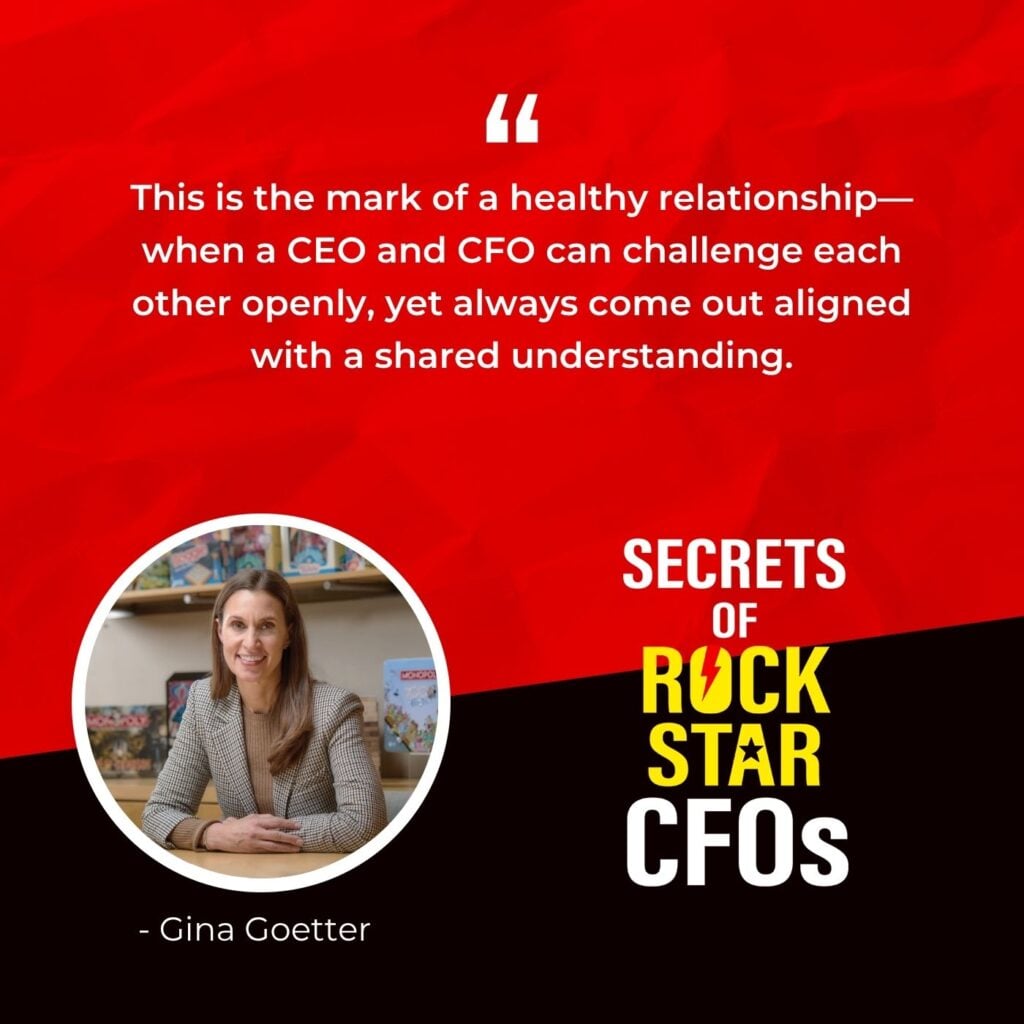
And we have fun, and we laugh. We also debate a lot. At first, when we started working together, that would make people uncomfortable because we’d be in big rooms and we had no issue debating both sides, and people would worry if mom and dad were fighting. It’s like, no, this is actually a sign of a very healthy relationship. It’s when you can have your CEO and your CFO tossing things around. We always come out aligned. We always come out with a mutual understanding of each other’s points of view. We are a team, and we’re going to do the right things for the company together. When we first started working together, people didn’t know quite what to do with healthy debate in a room.
You both had interesting situations. I know his situation was perhaps a little more challenging, but the CFO whom you replaced, she was iconic. She’d been there for a long time. She is one of the best CFOs in the game, really. Really big shoes to fill.
You’re right. I remember my first couple of weeks here, I’m like, “How many goodbye parties are we going to have for this woman?” She was very well-respected and regarded by the organization. Absolutely.
I want to change gears a little bit. You’ve got a different business, and you’re not a GAAP accountant, so I like asking people this. What are the KPIs that you use to measure and report business performance? It doesn’t sound like GAAP is necessarily your strength, and that’s great. What are the ones you use?
Mine are pretty simple. Is revenue growing? Is operating margin improving? What does our cash flow look like? Those are like the if there’s three numbers that I want to look at every single quarter, it’s revenue, operating profit and it’s cashflow. Obviously, now leaning into the COO, there’s a gazillion KPIs that you measure on the operation itself of the business. Again, it all ladders back into the financial statement. Are you growing revenue? Are you improving your margin profile? Are you generating enough cash flow to be able to continue to invest behind the business and return cash to shareholders? That is where my ultimate litmus test is.
Your answer’s great and they’re anticipating my follow-on question, which is good and bad. I was just thinking, as the company grows from a traditional toy company to more of an IP and gaming company, has your definition of growth changed a little bit? Are you thinking of the same way? Is it more just about top-line expansion or you’re prioritizing margin quality and recurring revenue? What are the big things in there?
It’s the and. To have this flywheel, you need both. You need top-line to be growing and you need your operating margin stable or growing. For many years, that was not the case for the company. The guidance that we put out here for 2026, we are into that flywheel where we think every single one of our business segments is going to grow in 2026. That’s the guidance that we said that we put out in February 2026.
We believe that our margin is going to continue going to continue to grow. For me, it’s not one or the other, it is and. Now, underneath that, there are absolutely areas where we’re taking profit dollars or cash and putting it against businesses that have faster or bigger growth. Not every single business within Hasbro follows that same formula, but in total for the company, revenue growth and operating margin growth.
It’s interesting because it occurs to me, it’s not like it’s two different companies, but in my simple mind looking at the outside, you’ve got this legacy company, with beloved products and games, you and I clearly love all of the old-school Hasbro stuff. You’ve got this new cutting-edge company as well. Investment dollars are finite for any company, so is there any tension between those two things, growing the future companies but you got to take care of these things that people still love?
Absolutely. The short answer, and probably picking up from my last one, capital allocation, that’s the name of the game. It’s taking your dollars and, I guess, human capital allocation and putting it against the biggest growth drivers. For us, that has absolutely to your point has been on our Wizards business including Magic and our digital games. We are also continuing to invest in our toy and game business. We’re just doing it in a way that is much more focused.
In our last earnings cycle, we got the question of, “What do you think the toy category is going to do?” Everyone wants all of us toy companies to tell what we think the industry is going to do. As we were preparing for that question during earnings prep, our cheeky answer that we wanted to give, we didn’t necessarily give it in this way is we don’t know that we really care about the total industry growth.
We know that the categories where we’re choosing to play and where we think we have a right to win, we think those categories are going to grow. There’s a lot of our iconic brands that fall into what we’re calling our Gems Squared categorization of the toy industry. Within that classification, we are investing behind that business because we think we’re going to be able to grow.
For certain categories where we think the growth prospects are more limited, we’re actively looking at different ways that we can continue to monetize or support the IP that sits within those categories. It’s not like we shifted all of our dollars and all of our resources over to Wizards. We’re just being more choiceful of within our very big broad portfolio that is the toy and game business. What are the ones that we know are going to have the strongest growth potential and how do we keep investing behind those?
One of the questions I have the future going forward. Again, as I was preparing for this, I read an article and there’s some speculation that the Game of Life might become a movie on Amazon. An exciting development where the old school is meeting the modern age. What are some of the other things that we have to look forward to in the next few years out of Hasbro in terms of innovations and maybe some new products?
I can’t give you our product pipeline. I’ve been sworn to secrecy on that. We’ve talked a bit on our launch into digital games. We’ll have our first two digital games launching in 2027. One is a completely new-to-the-world IP, and then another is a digital game or video game based on our D&D, a known IP. That’s going to be super exciting just to see put those out into the world. We’ve been working on them for many years. I know our teams that have been working very diligently to bring them to life are nearing the finish lines on them and it’s getting super exciting.
I think digital games, you’re going to continue to see us investing there. As I said, within some of our core IP, we’re constantly looking for ways to move into how do you age them up? So how do you make something for Play-Doh that isn’t just for kids? How do you take some of our more kid-orientated brands and move them up the curve? Collectability is a big one, a big trend right now. How do we lean more into that collectability consumer need?
We’re starting to experiment with how AI can come into the toys and game space. We believe that there is a joyful and a playful way that we can bring AI to life. Still early days as we’re working through different product iterations and what that could be. For sure, over the next few years, you’ll see flavors of that showing up for Hasbro.
Your predecessor, like you, spoke at the MIT Sloan CFO Summit. I suggested to her that to get back nostalgia, they should bring back Mr. Potato Head’s pipe. I think there are a lot of people that would actually buy Mr. Potato Head with a pipe. I actually have my Mr. Potato Head from a child. My nephews and nieces think it’s appalling.
I’ll add that to the suggestion box outside in the lobby.
I got to tell you, it’s a winner. Absolutely cool. I want to chat a little bit on Hasbro. You’re also on the board of another what I would consider an iconic company. It might be one of those companies where the products are better known than the company itself. I’m curious, you’ve been on the board a little bit now, and has being on the board affected how you approach your day job? Do you think you’re a better CFO?
Absolutely. It’s a great question. In fact, I joined the board when I was at Harley and at the time, my CEO and I were talking through what would be the benefit of me joining. It’s a private company. It’s a family-run company. It’s fifth-generation family-run company. I said to my CEO at the time, “I would love to see a company that isn’t living for the quarter.” when you’re in these public companies, you’re just it’s one quarter to the next.
That is absolutely one of my biggest takeaways that I have from Fisk and the management team. They are continually looking not for things that are going to grow the business in the next six months. It’s what are the right decisions, what are the right moves that we want to make that set us up for the next 10 to 15 years. They also are a family-run business that the value system, how they treat employees, how they treat the communities that they are in, how they think about what they’re adding back in terms of the environment, there is so much good that that company is doing.
I’ve really taken away the long-term thinking mentality. There’s always going to be a need to make some short-term decisions when you’re in a public company, but there is so much benefit to thinking beyond even just one fiscal year. I’ve seen the benefits of that from SCJ, and I also think it’s really admirable their value system. They always do the right thing by their people, by the communities that they’re operating in, and I think that that’s super admirable. It’s good business.
How old did you say the company was?
I don’t know the exact number of years, they’re in the fifth generation of leaders.
They may have started in the 1800s then?
I’d say it feels like 1900s.
Still, there’s a lot to be said for that thing. That’s fantastic, and do you have a good relationship with the CFO there? I’m thinking that person probably would find you to be a valuable mentor.
We do some best definitely some best practice sharing between the two organizations. We actually are just trying to coordinate one now on AI and how they’re thinking about leveraging AI across their operations and how we’re embedding it here at Hasbro. There are definitely learnings that go both ways.
You mentioned, of course, you have a large family and you’re the CFO of a highly visible publicly traded company, plus on the board of SC Johnson. How do you do it all? Are there any secrets you can have to work-life balance?
I don’t know that I have a secret. I think even the phrase work-life balance or the notion of it is highly personal. I actually don’t think there’s one canned definition. For me, it has ebbed and flowed. I see work-life is more fluid than it is static. There are periods at least in my life where one side of my being needed more of me. When my kids were super young, there would be some moments that it was all about the kids. Obviously, as my career started growing, there were moments that it became especially when I made the transition to CFO, that took a lot of my time and focus. I definitely leaned into the work side.
For me, it has always been about keeping anchor into the end goal and the aspiration and having a partner in life. I’m celebrating my 25th wedding anniversary to my husband in 2026 and along the way, he and I have approached my career as a partnership. There is no pivot or move that I have made that has not been with his full support. That has allowed us to create balance on both sides of the spectrum. He’s been able to help me lean out when and into job more in those moments. To me, that’s how I’ve stayed sane.
The advice that I always give to individuals is that you have to define what work-life balance means to you. Only you can define that. It’s got to be grounded in where you want to go. If you want to be a public company CFO, you’re not going to hear me say that you’re going to be able to work 30 hours a week to be able to get to that chair. I don’t think that’s realistic. If that’s where you want to get to, make the moves in your work-life balance and how you define it to set yourself up for success there.
Once you define your definition of work-life balance, put the boundaries in place and only you are the one that is going to be able to enforce those boundaries. When my kids were young, it was 6:00 to 8:00, don’t even bother calling me because I want to go home and be mom for a while. That was a boundary that I established for myself when my kids were young. Now they don’t want to hang out with you as much between 6:00 and 8:00 p.m. I’m a little looser on that boundary as my kids have gotten older. I think it’s such a personal definition. For me, it’s always been grounded in where I want to go.
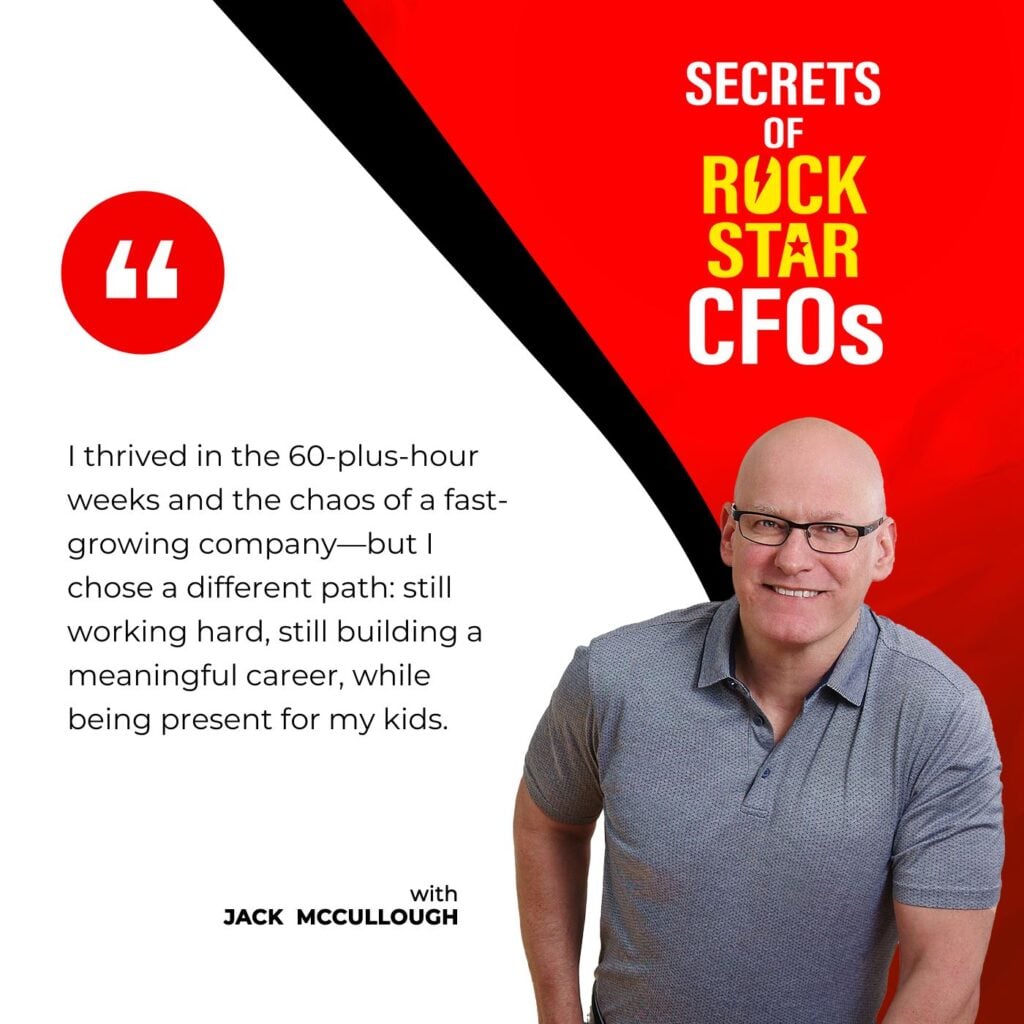
I like the way you put that because I’ve always struggled to articulate it because earlier in my career, I was one of those super aggressive people. I was a CFO for venture-backed startups. I became an autism parent twice. It’s not a one-person job, either. It’s like I couldn’t work the number of hours that I was working and frankly, I liked it. I liked working the 60-plus-hour weeks. I liked some of the craziness of working with a fast-growing company and I just said, “I’m just going to have a different career path than I thought I did and I’ll still work hard and have a meaningful career but I’m able to be there for my kids.”
It’s personal and it ebbs and flows. It’s very fluid.
We discussed earlier you being CFO and COO, and it we’re seeing more and more of that, whether or not the title is acknowledged, it’s just taking up operational and cross-functional type of roles. Aside from that, how do you see the nature of financial leadership evolving in the years ahead?
You’re right, I feel like it’s morphing into less of the backwards-looking reporting, I do the budgets, all of that will still get done. I think the role of finance is going to shift to more of a strategic business partner operator where again you’re helping the business see around corners, you’re providing the insights and the information that help inform decision making or help inform scenario analysis.
I think the role that finance is going to play is more of that financial operator COO type role. Our seat at the table through the lens of numbers and data and being able to leverage that into what are the insights that we take forward to craft the next the next level of business decisions. That, I think, is going to be absolutely critical as we keep moving forward here.
Some of the some of the advancements that we’re seeing with AI, the core of some of my early days as a finance analyst, that now is all going to start being done in a much more efficient manner. The value is now going to be in the judgment that we all take and bring and bring to that information and that data and how we help navigate the businesses.
The tagline to this show is, “CFOs no longer record history, they make history.” That seems consistent. You’ve had a really successful career working for some great companies, building great teams, just accomplishing a lot. I’m curious, what advice would you give to the next generation of financial leaders? I’m thinking of those professionals who are on the cusp of getting their first CFO job or maybe even in their first CFO job, still figuring it out a little bit.
For early in the career, my advice would be say yes. Say yes to new experiences and new opportunities. Every big career moment or trajectory change that I’ve had was not something I scripted. It was not in a job description. Some instances a role that had existed. Stepping into things that were gray or felt a little bit off the path is frankly what led to more opportunities. I would say, say yes more, especially early in your career.
For the new CFOs, I would suggest that you continue to keep in mind what are the strengths that you’re bringing, what are the experiences that you’re bringing to the table, and hire really good people around you. Once you get into the CFO seat, it’s less about what you did as an individual contributor or the results that you posted for your business if you were a segment finance leader, if you were a corporate finance leader. Your role as the CFO now takes on an enterprise view, and so you want to have the best team of lieutenants around you that are driving all of those individual functions or individual business results that you need to allow yourself to elevate at that and become really that enterprise strategic partner for the CEO.
I think that is wonderful advice. Gina, I know you’ve got a lot going on right now, so I want to thank you for being part of this show.
Well, thanks for having me.
With that, I’d just like to give you the final word.
Thanks for having me, it’s fun going down the historical nostalgic roadmap of my youth in this session. I think that the path for finance, there’s lots of fun headlines out there of the role that AI is going to play within any discipline, finance included. I think it’s super exciting what is to come and what it’s going to allow finance and accounting professionals to be. Forever we have been searching for how do we move the value of these functions up the impact curve, and so I am super excited about the disruption and the potential that we will all have as finance individuals. Our role and the importance of our roles is only going to continue to grow as business continues to stay as complex as it is.
