

CFOs have gotten a better feel for the business over the past year.
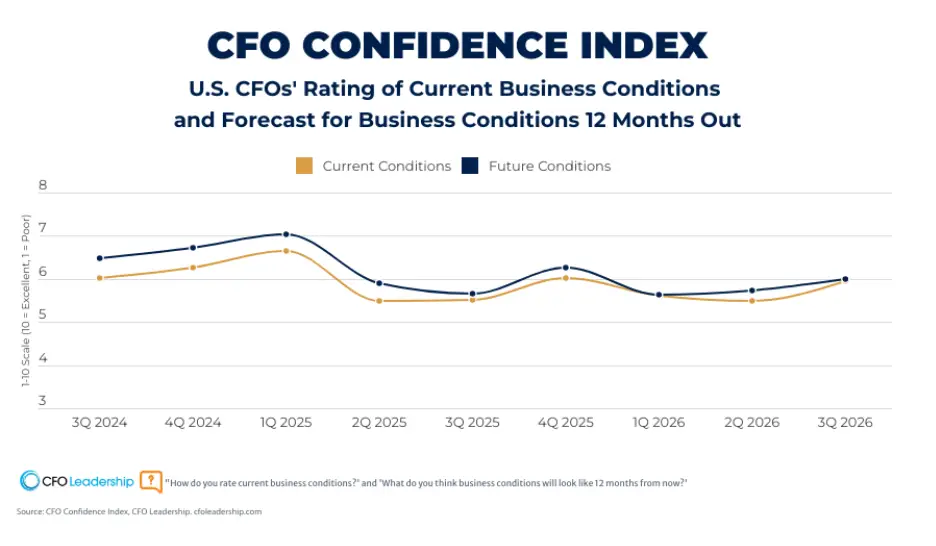
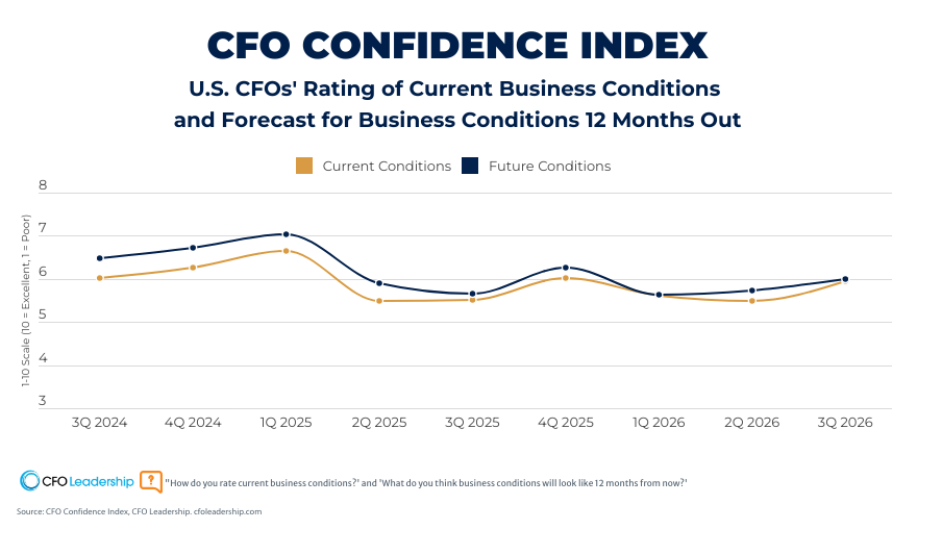
In CFO Leadership's Q3 CFO Confidence Index, financial leaders rated current operating conditions at 6.0 out of 10, up 8% from 5.5 in the second quarter and returning to confidence levels at the end of 2025. This is the highest level since Q1 2025 (6.7) and returns to 'good' territory according to our 10-point scale.
Looking ahead 12 months, CFOs expect this to continue, with the situation remaining at 6.0. While not an improvement from the current situation, it was still 4% better than CFOs' expectations for the second quarter (5.7) and 6% higher than their January expectations for 2026 (5.6).
CFOs say the concerns that weighed on sentiment earlier this year persist, with continued uncertainty surrounding tariffs, geopolitics and the broader U.S. economy. However, for many of the 147 finance executives surveyed between July 14 and 19, the positive news is that the feared deterioration in customer demand has not materialized.
Many of those surveyed still expect 2026 profitability to be higher than 2025, reflecting a healthy pipeline and solid demand.
“The sales environment remains reasonable. There is some concern and caution, but sales are continuing,” said the chief financial officer of a mid-sized company in the equipment services sector.
“[We’re] We are starting to see an increase in awarded work,” added another CFO of a small B2B company based in Michigan.
For one Florida-based consumer manufacturing CFO, the situation is nearly perfect (9 out of 10), which he attributes to “the strength of volume growth and people still having plenty of disposable income.”
These findings are consistent with those observed in our sister journals. chief executiveAccording to July's CEO Confidence Index, CEO current ratings are at their highest in 2026, with most companies reporting sustained demand.
Few expect further improvement
This quarter's stronger confidence doesn't mean CFOs are uniformly more bullish about the future. 35% of respondents expect business conditions to improve over the next 12 months, down from 47% in the second quarter.
However, the proportion predicting the situation will worsen also fell from 33% to 31%. The difference is seen in the share that expects things to remain the same, which jumped to 33% from 20% last quarter.
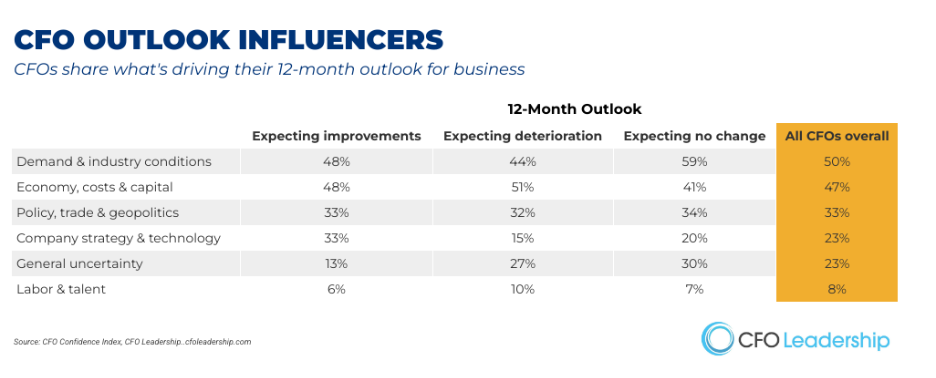
CFOs see current demand momentum, but uncertainties around inflation, policy, interest rates and customer behavior prevent a broader improvement.
For those with a more optimistic view of the next 12 months, company-specific actions such as acquisitions, expanded sales efforts, new products and operational improvements, combined with solid demand, will likely drive expectations for better conditions ahead.
The economy, inflation and rising costs were the top reasons for people expecting a recession, followed by domestic policy, regulation and uncertainty.
Small and medium-sized enterprises are more bullish, but sectoral disparities are emerging
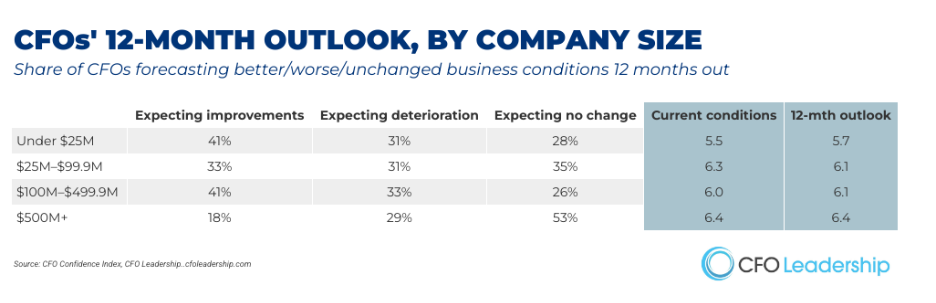
Confidence is strongest among small businesses, with 41% of CFOs at companies with less than $25 million in annual revenue expecting business conditions to improve. The same percentage of CFOs at companies with revenues between $100 million and $499.9 million are optimistic.
By contrast, a much smaller percentage of CFOs at large companies expect improvement. Only 18% of CFOs at companies with revenues of $500 million or more are optimistic that conditions will improve over the next year, while 53% expect conditions to remain the same.
Sector differences were also observed. Technology CFOs were the most optimistic, with 45% expecting the situation to improve.
Healthcare CFOs are more cautious, with only 25% expecting conditions to improve and 42% expecting conditions to worsen. Domestic policies and regulations were the most frequently cited concerns, along with customer demand.
Company forecast
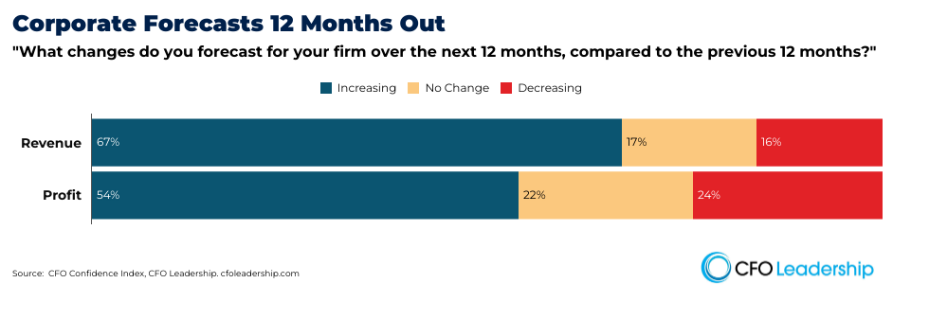
Despite mixed outlooks for next year, CFOs remain largely positive about their companies' performance.
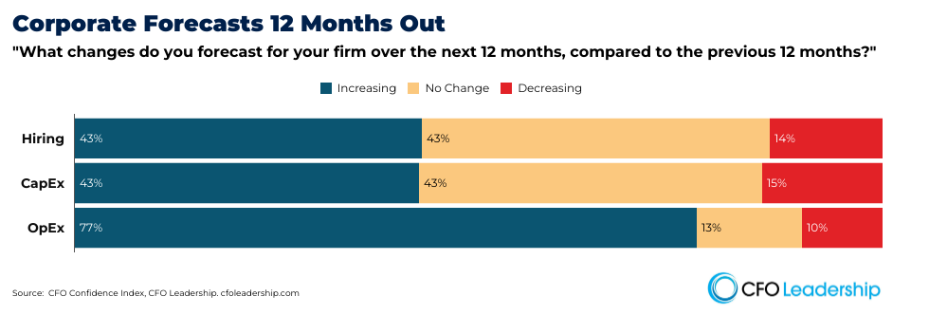
- 67% of CFOs expect revenue to increase in 2026 compared to 2025, up from 64% in the second quarter but still below the 73% reported at the beginning of the year.
- 54% expect profitability to improve, up from 52% last quarter and slightly below 56% in Q1.
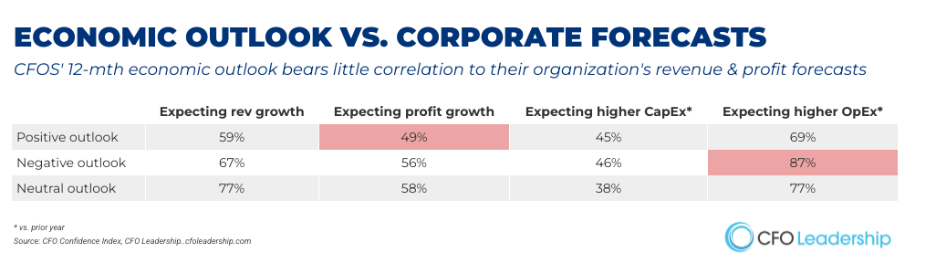
These expectations do not neatly align with CFOs' broader outlook on market conditions. Neutral CFOs are the most likely to predict revenue growth, at 77%. Two-thirds of pessimists also expect sales to rise, and 56% expect profits to rise.
Much of this discrepancy may be explained by cost. 77% of all CFOs surveyed said they expect operating expenses to increase this year, up from 74% in the second quarter. But among pessimists, that percentage rises to 87 percent. Among optimists, that percentage drops to 69%.
Still, CFOs continue to invest, with 43% saying they will spend more on capital in 2026 than in 2025, up from 40% in the second quarter and 38% at the beginning of the year. Only 15% expect capital spending to decline.
For many finance leaders, the opportunity is not simply to increase spending, but to invest selectively while controlling cost increases. “We expect organizations to continue investing in technology, automation and AI to improve productivity and address ongoing labor issues,” said Jackie Herman, chief financial officer of Crown Bank, a commercial bank headquartered in Edina, Minn. “I believe that companies that maintain strong liquidity, exercise disciplined expense management, and focus on long-term strategies are well-positioned to take advantage of growth opportunities as economic conditions continue to normalize.”