


Like the companies they help run, directors at U.S. public companies are fully committed to using generative AI, often without guidelines, policies, or oversight. This is a troubling trend with potentially significant legal and operational implications for businesses.
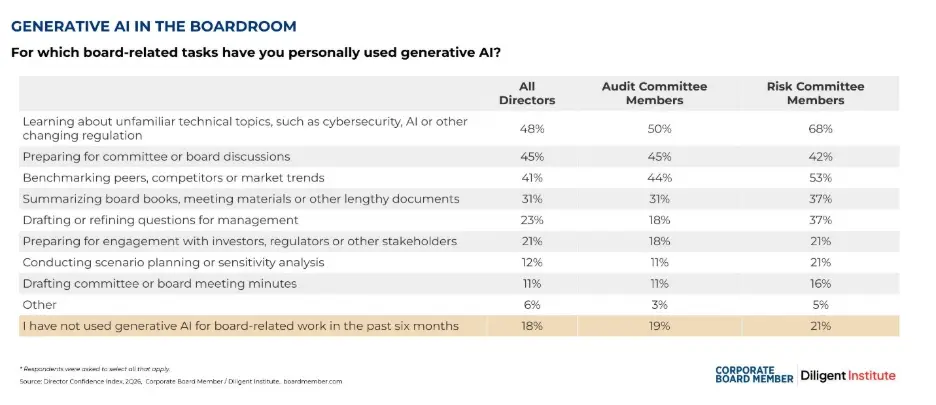
A new survey of 104 U.S. public company directors found that 82% had used generative AI in board work within the past six months, up from 66% in September 2025. However, 54% say their companies do not have guidance in place regarding board use of AI, and only 6% report formal board-specific policies.
Meanwhile, approximately 30% of those surveyed have used generative AI to summarize executive directories and meeting materials, which are among the most sensitive documents in public companies. Approximately 45% use it to prepare for board or committee discussions or to benchmark against peers, competitors, and market trends.
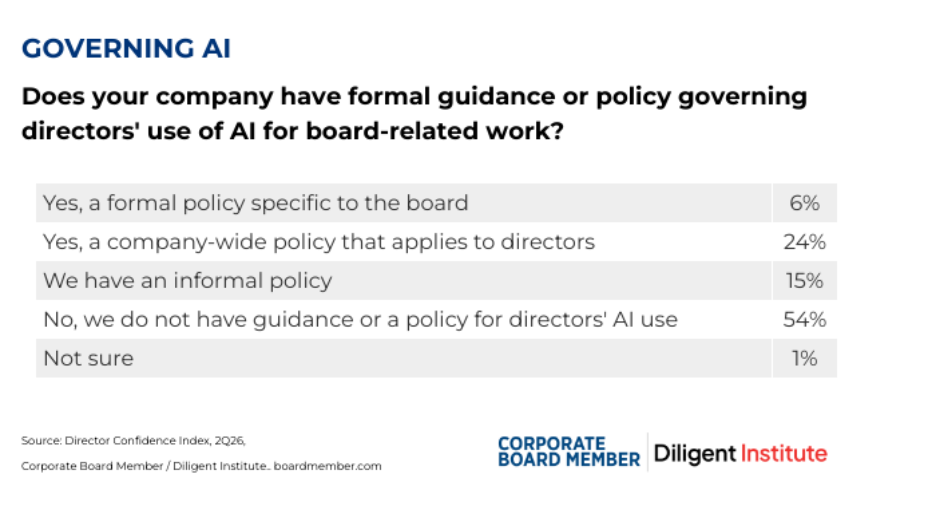
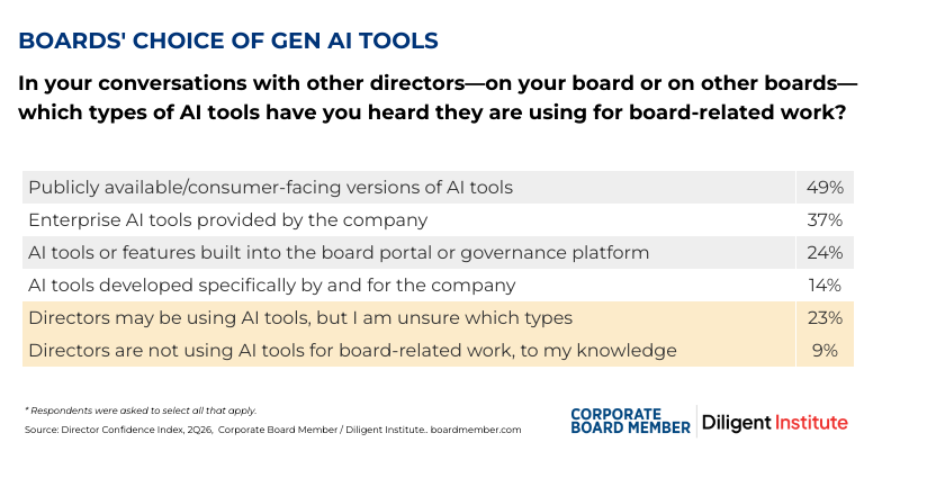
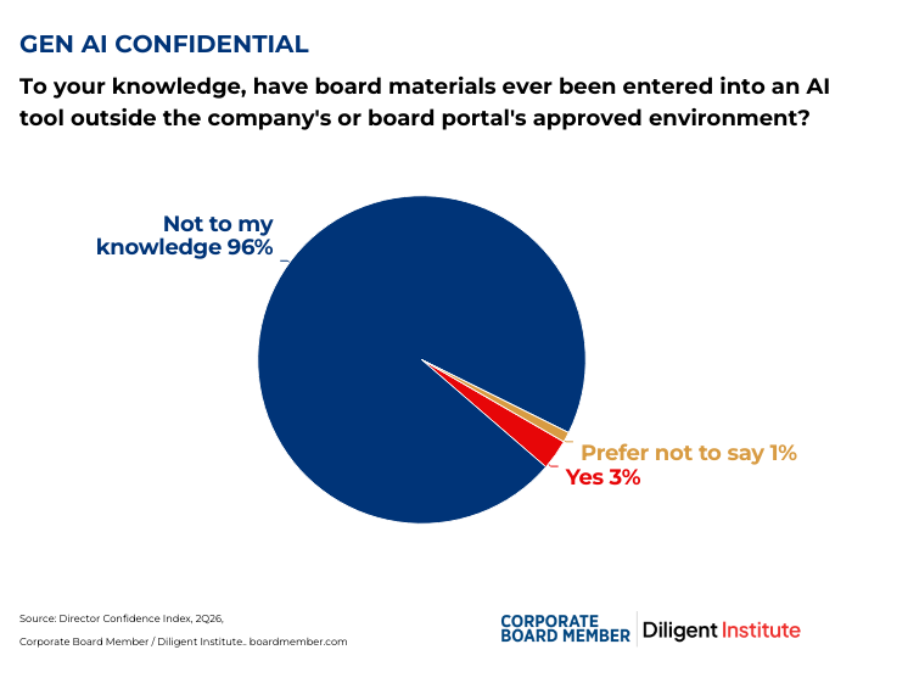
Almost half (49%) of directors surveyed said they had heard of board members using publicly available or consumer-facing AI tools for board work rather than company-approved platforms and systems, a clear red flag for most GCs and external governance experts. Adding to the confusion, 96% of those surveyed said they were unaware of an instance in which board materials were entered into “a tool outside the company or board portal's approved environment.”
“This shows that boards are not waiting for the perfect governance framework to experiment with AI,” said Kira Ciccarelli, senior research manager at the Diligent Institute. “That makes it even more urgent for boards to define where these tools are appropriate and where the line of confidentiality needs to be drawn.”
AI everywhere
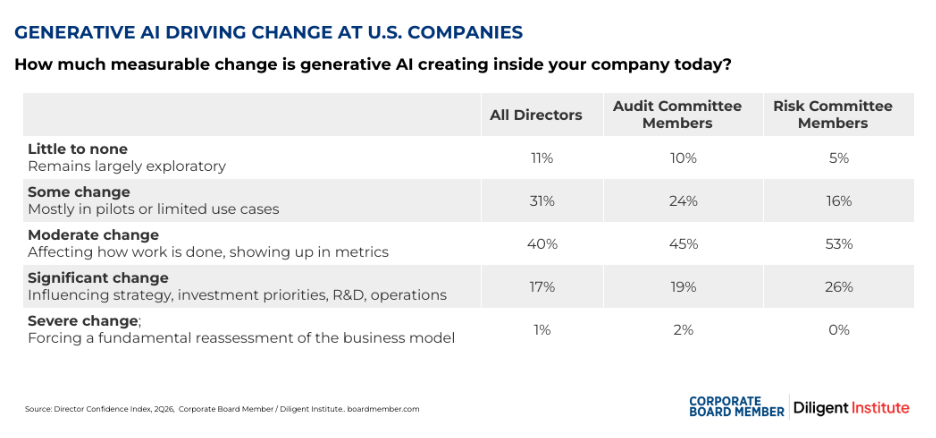
At the same time, the use of AI in enterprises is also exploding. Six in 10 board members currently say that generative AI is already creating at least moderate measurable change within their companies. This corporate-level movement is also emerging among directors who have not yet implemented the tools into their own board work. Of the nearly one in five directors who say they have not used any generative AI for board-related work in the past six months, 53 percent still say generative AI is already driving moderate or significant change within their company.
Dottie Schindlinger, executive director of the Diligent Institute and partner on the study, said she was struck by the gap between the adoption of AI in the boardroom and the impact directors are already seeing within their companies. “Use cases remain fragmented and governance is still immature. The real question for boards is whether oversight is evolving fast enough to keep up.”
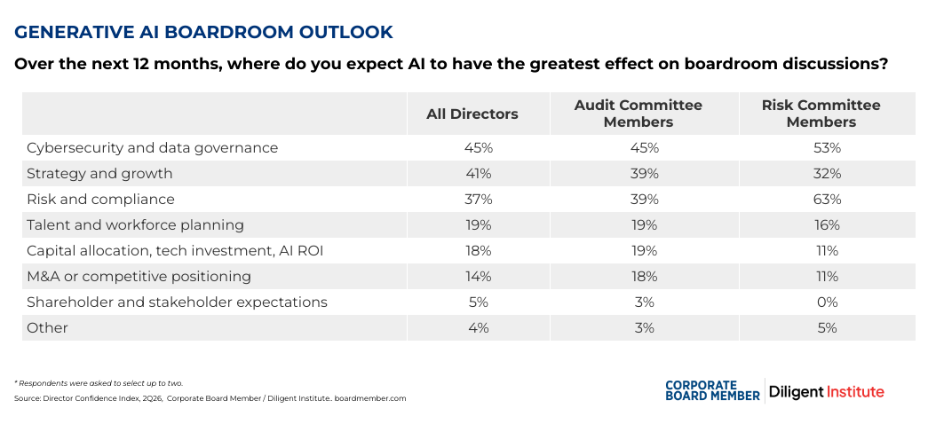
Our research shows that directors expect the impact of AI to reach boardroom agendas over the next 12 months, particularly around cyber, data and risk. Cybersecurity and data governance topped the list at 45%, followed by strategy and growth at 41% and risk and compliance at 37%.
Committee assignments can help shape how directors view the speed and nature of AI’s impact. For example, directors who serve on audit committees are more likely than other directors to say that this technology has already led to measurable changes within their companies, with 66% reporting moderate, significant, or significant changes, compared to 48% of directors who do not serve on audit committees.
This pattern is particularly pronounced among directors who serve on dedicated risk committees. Although 79% say Gen AI is driving moderate to severe measurable change within their company, they are also more likely to use gen AI for board work, compared to 54% of directors who don't serve on a risk committee, and 68% use AI to learn about unfamiliar technical topics, compared to 44% of directors without a risk committee. 53% use it for benchmarking and market trends, compared to 39%. 37% use it to draft and refine questions for managers, compared to 20%.
Risk committee members are very likely to expect AI to reshape risk and compliance discussions in the near future. 63% cite risk and compliance as one of the areas where AI will have the biggest impact on board discussions over the next 12 months, compared to 31% of directors who do not sit on a risk committee.
What the data tells the board
The findings raise broader governance questions. Do boards with dedicated risk committees have an advantage in recognizing the short-term impact of AI? Data cannot definitively answer that question. Committee composition may reflect the complexity of a company's size, industry, regulatory impact, or risk profile. However, directional patterns are difficult to ignore.
For boards, the message is not just that directors should use AI tools more often. AI is already impacting the companies they oversee, but board-level practices, policies, and comfort levels are still taking shape. This gap is not lost on board directors, with 27% saying their companies are moving too slowly in adopting AI.
The next stage of AI governance will require more disciplined conversations. That is, what tools are directors allowed to use? What information is off-limits? Where can AI improve board preparation without compromising confidentiality? How should management report on AI-related risks, benefits, and controls? And which committees, or the board as a whole, owns the oversight agenda?
Directors understand that AI is not a fad. “I believe that boards will be more effective if they have AI tools embedded in their governance platforms and reporting portals,” said one director.
The question is, is “responsible adoption” realistic in a space that is changing so rapidly? As another director hinted, “Maturifying AI and bringing real products to market may be the best path forward right now, rather than jumping into the pre-Facebook 'Myspace' era.”
